


Imprisoned with the dead: the only recorded copy of an American penny dreadful
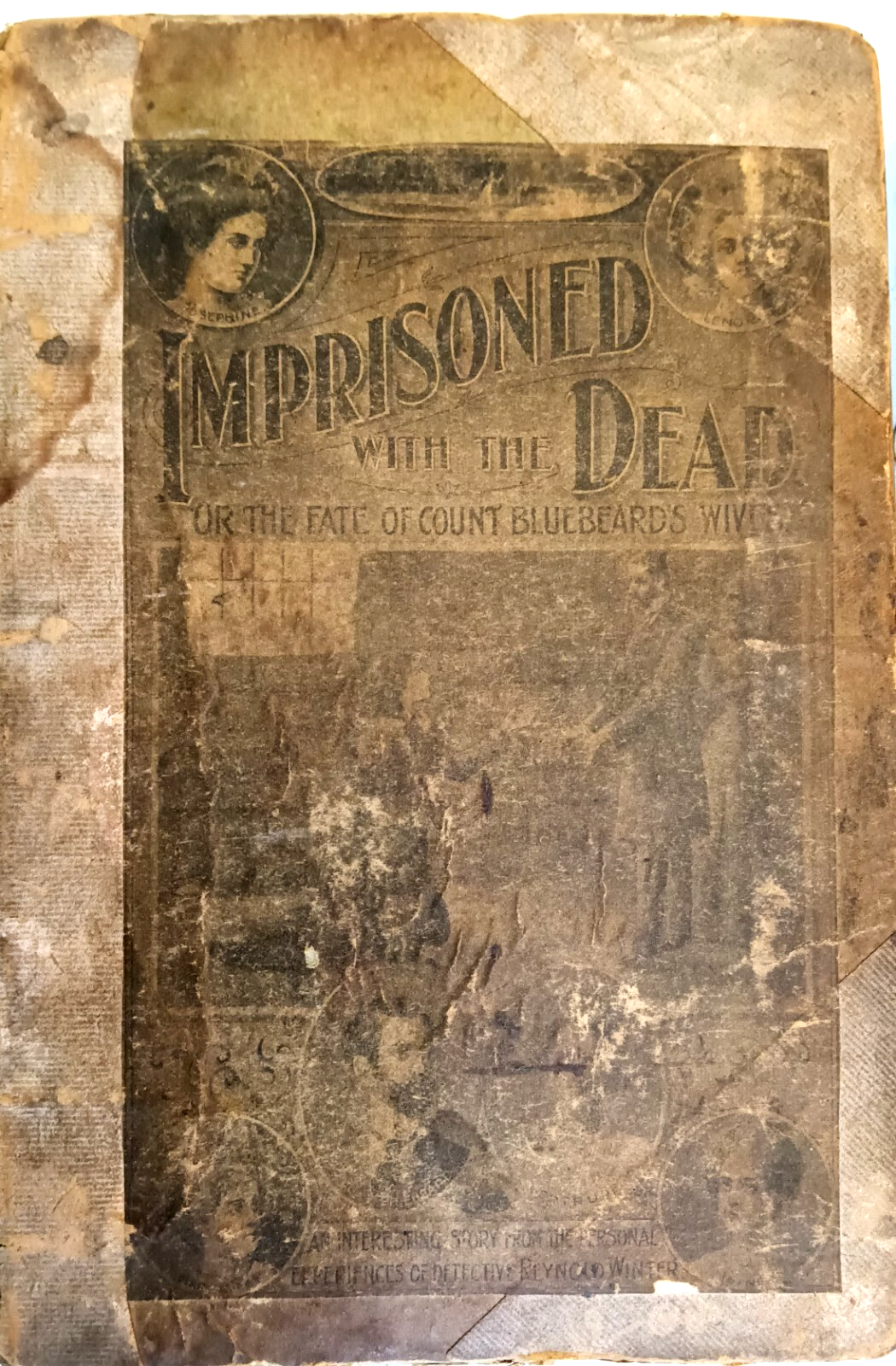
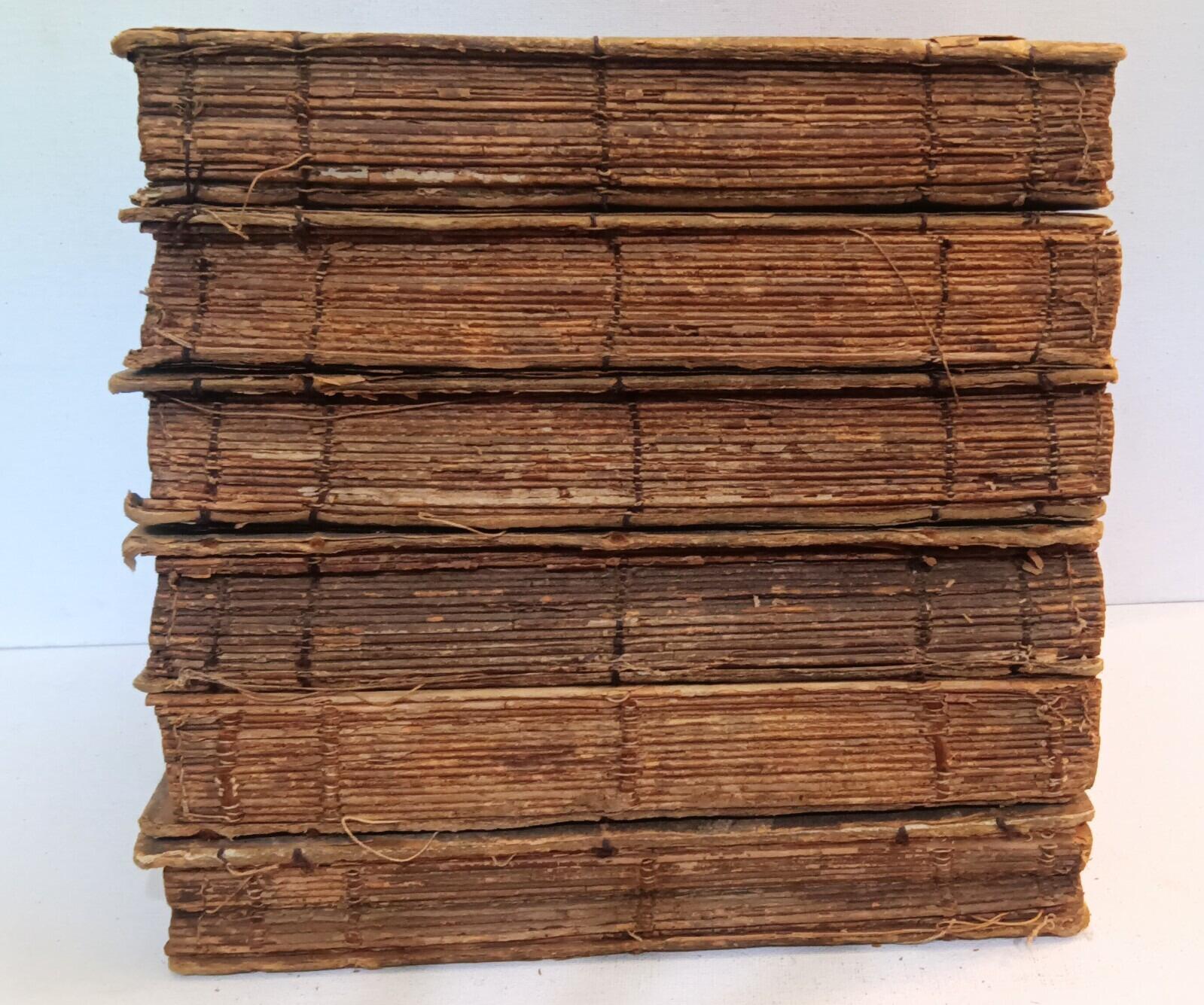
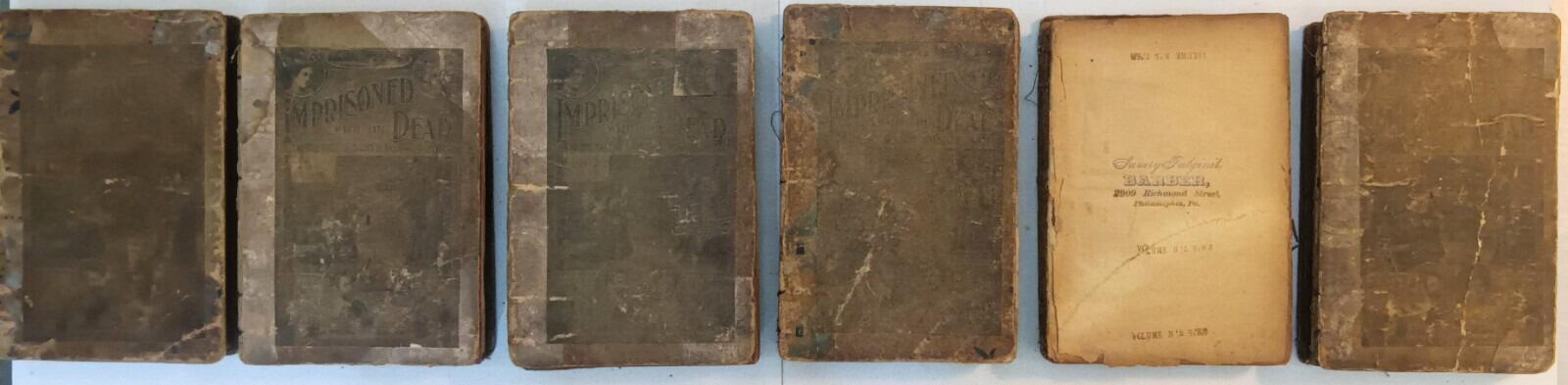
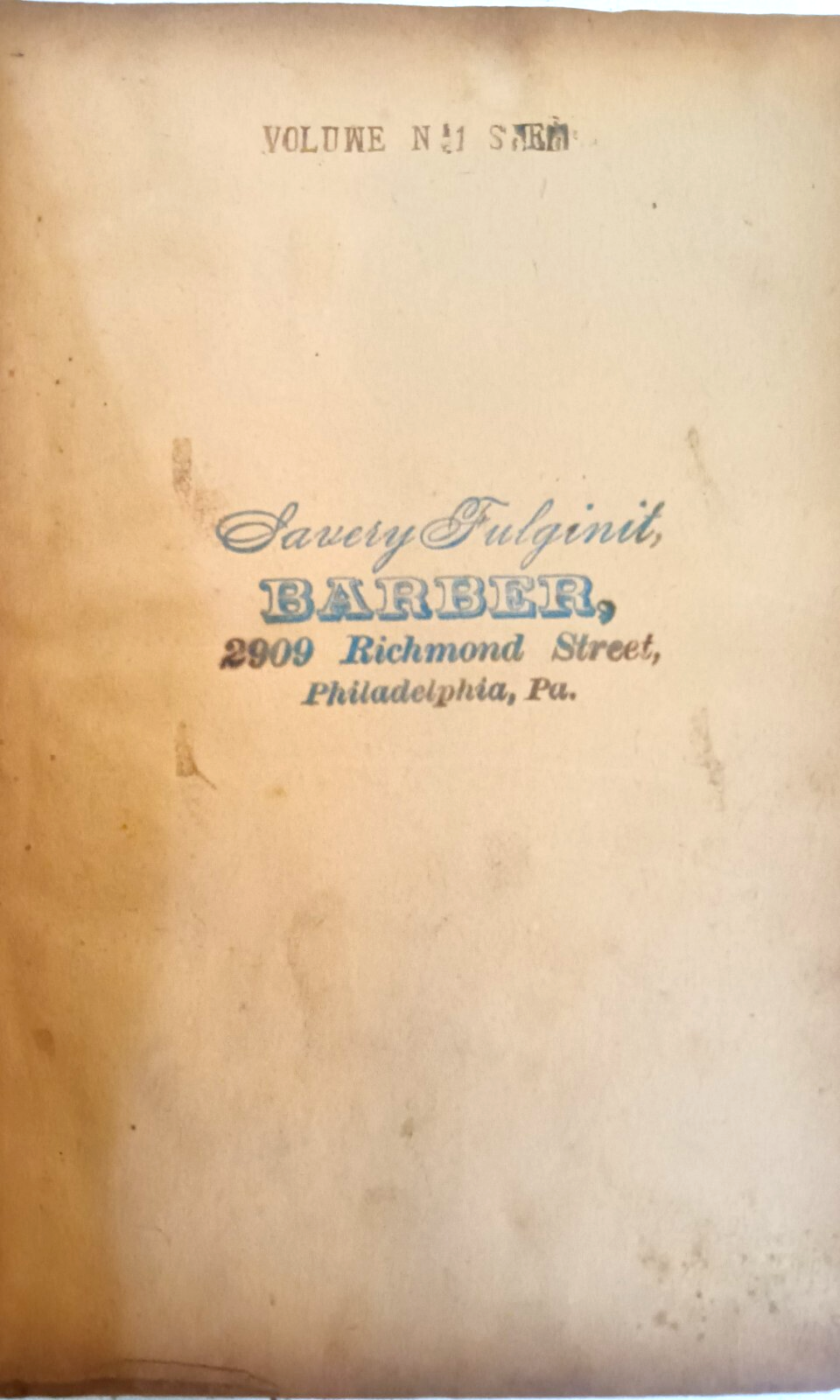
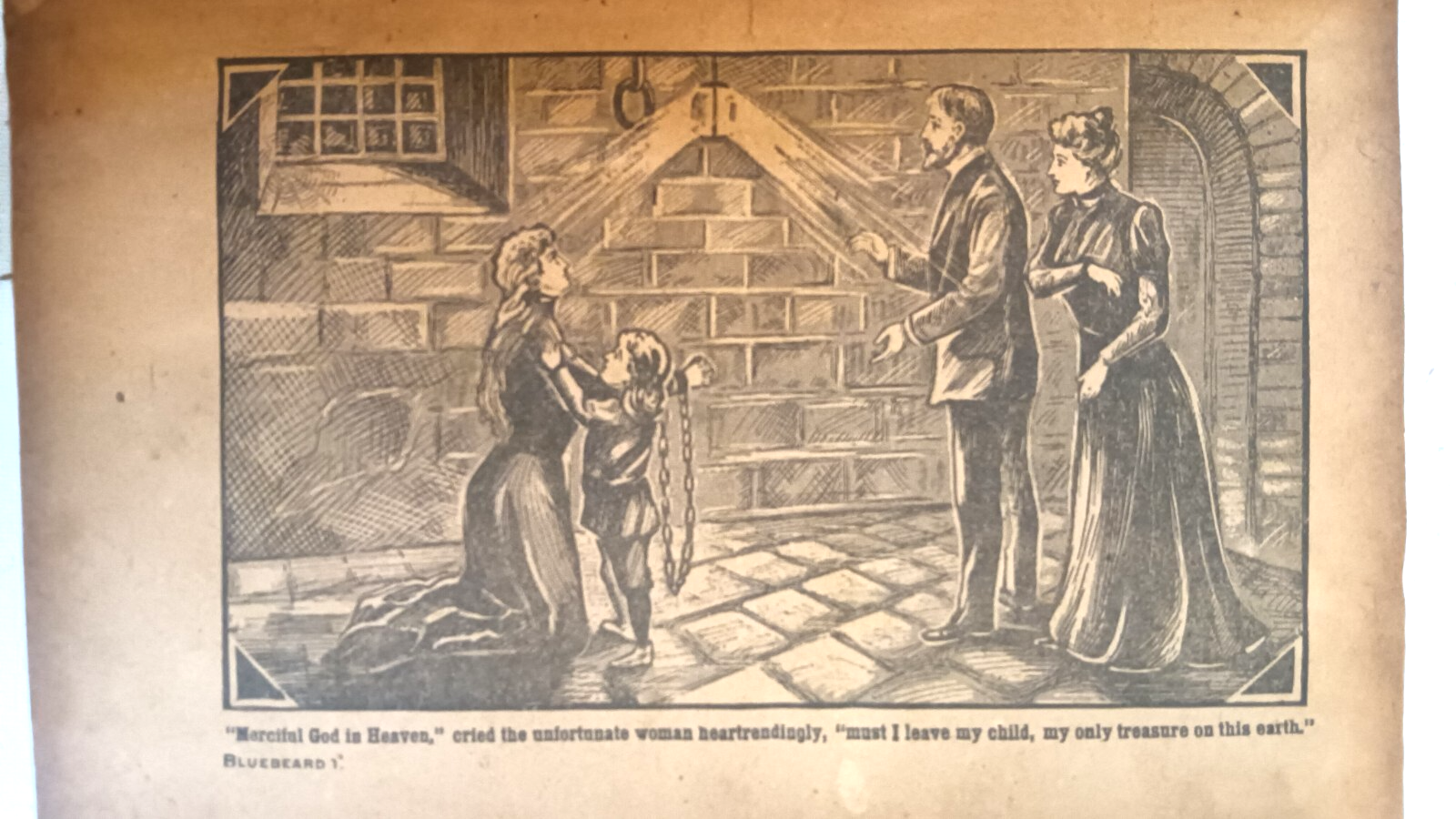
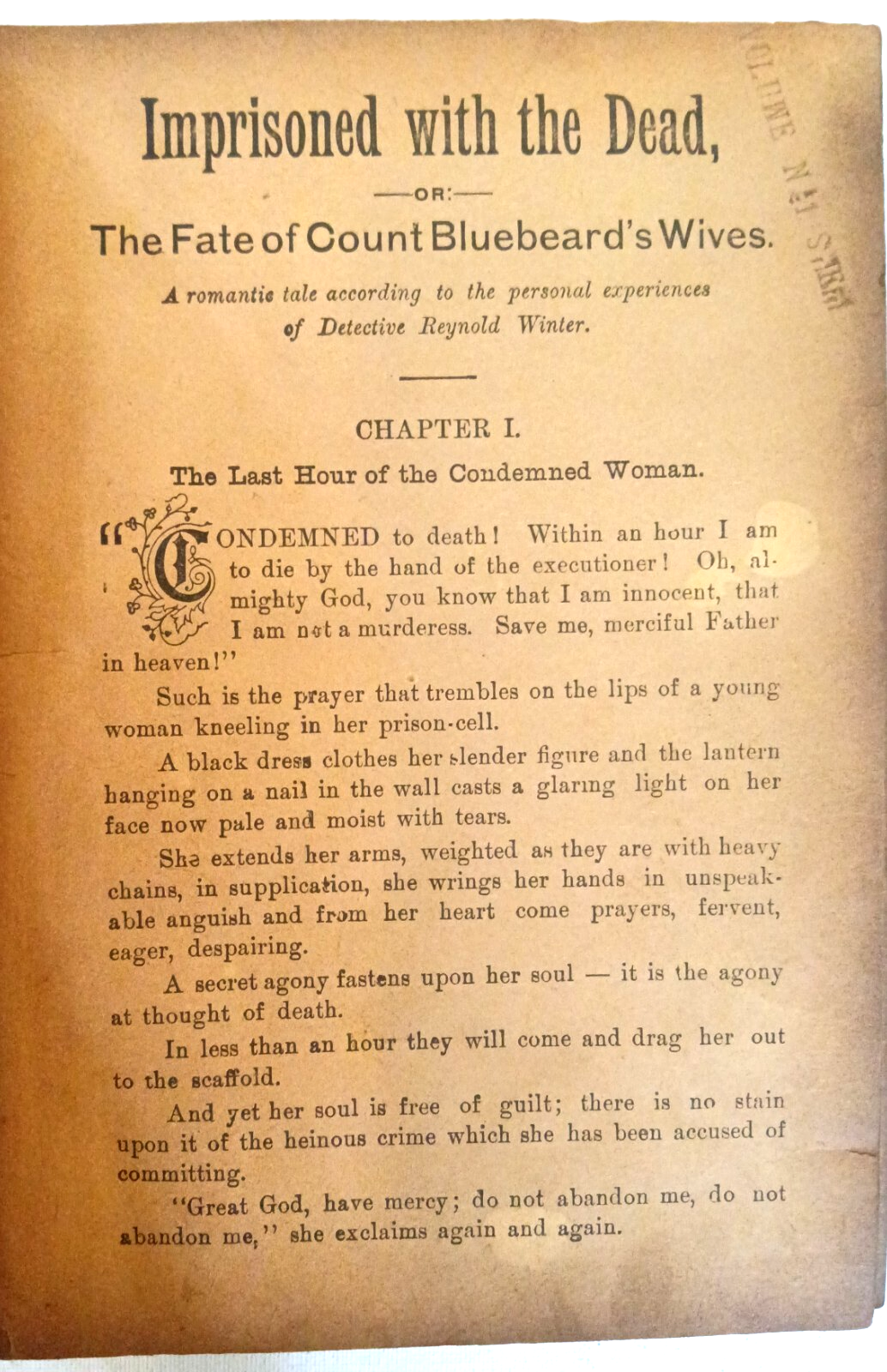
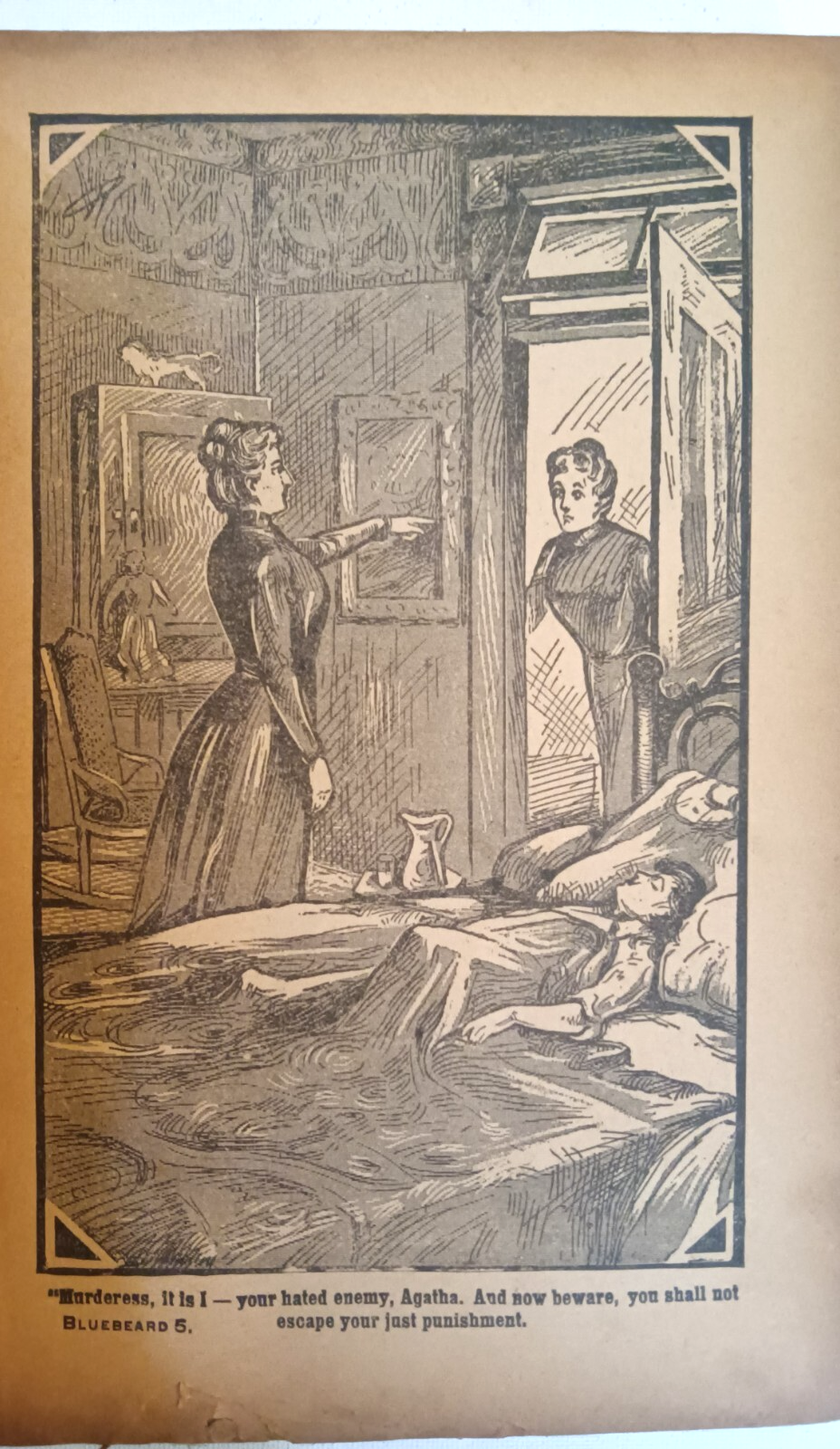
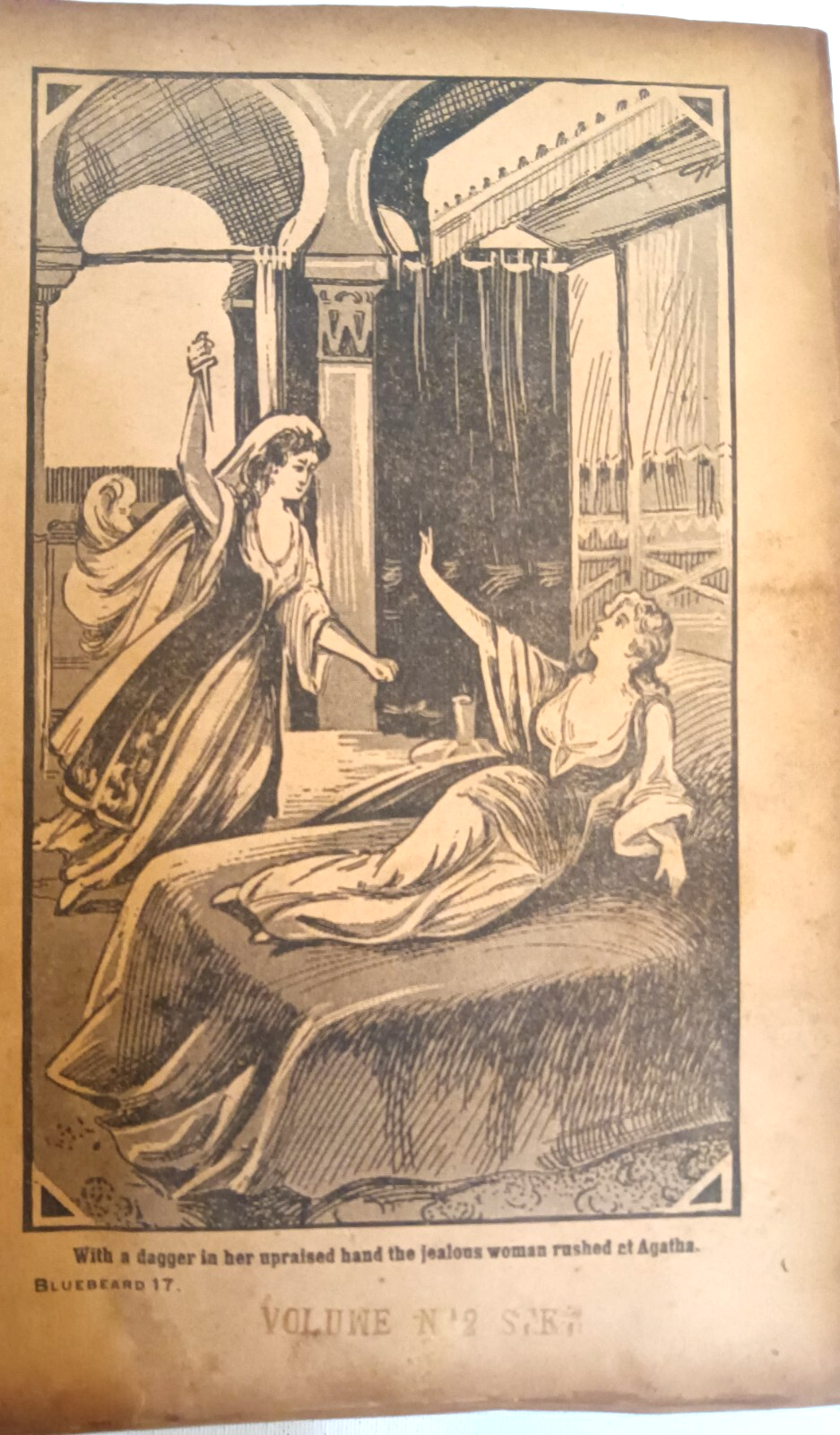
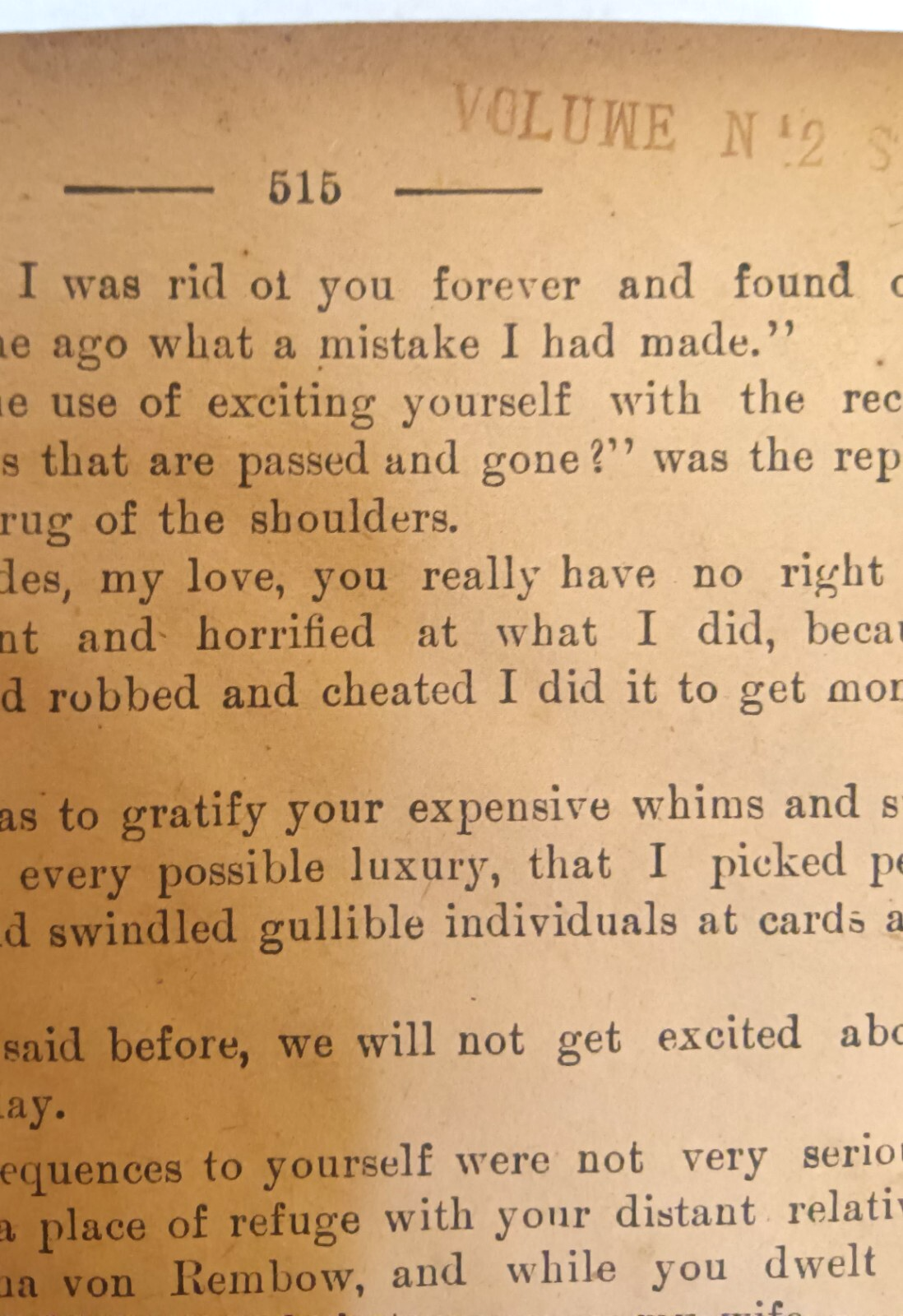
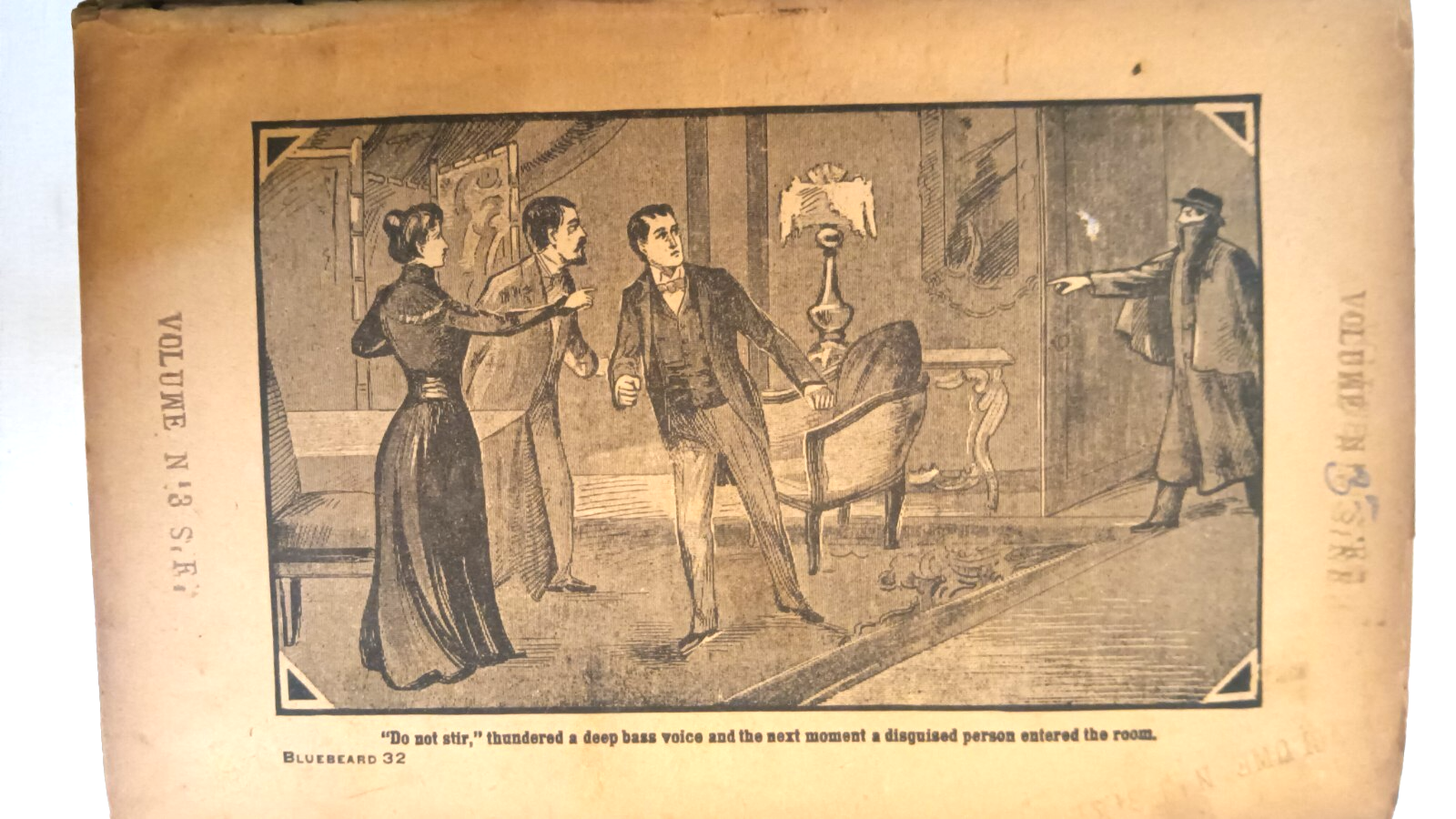
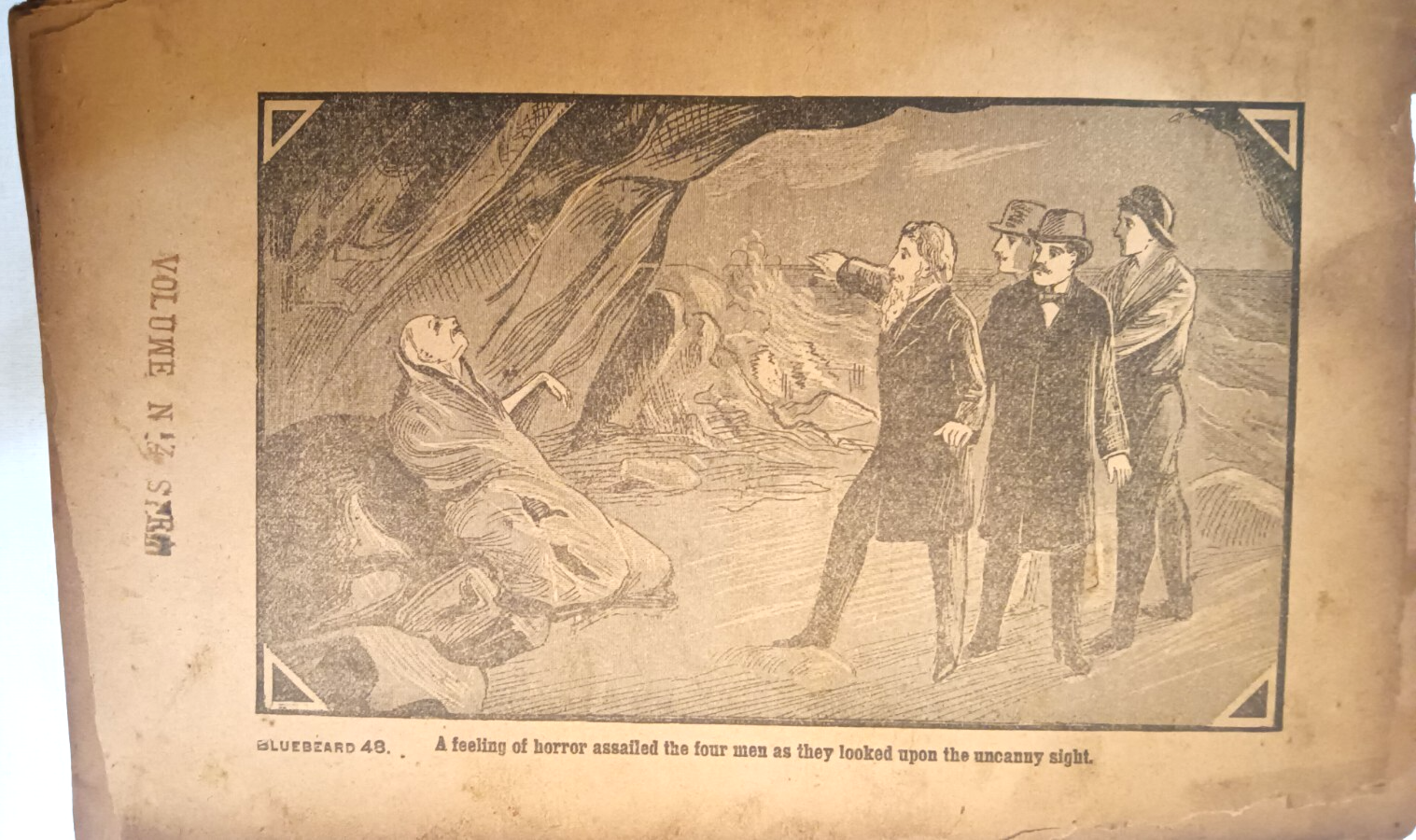
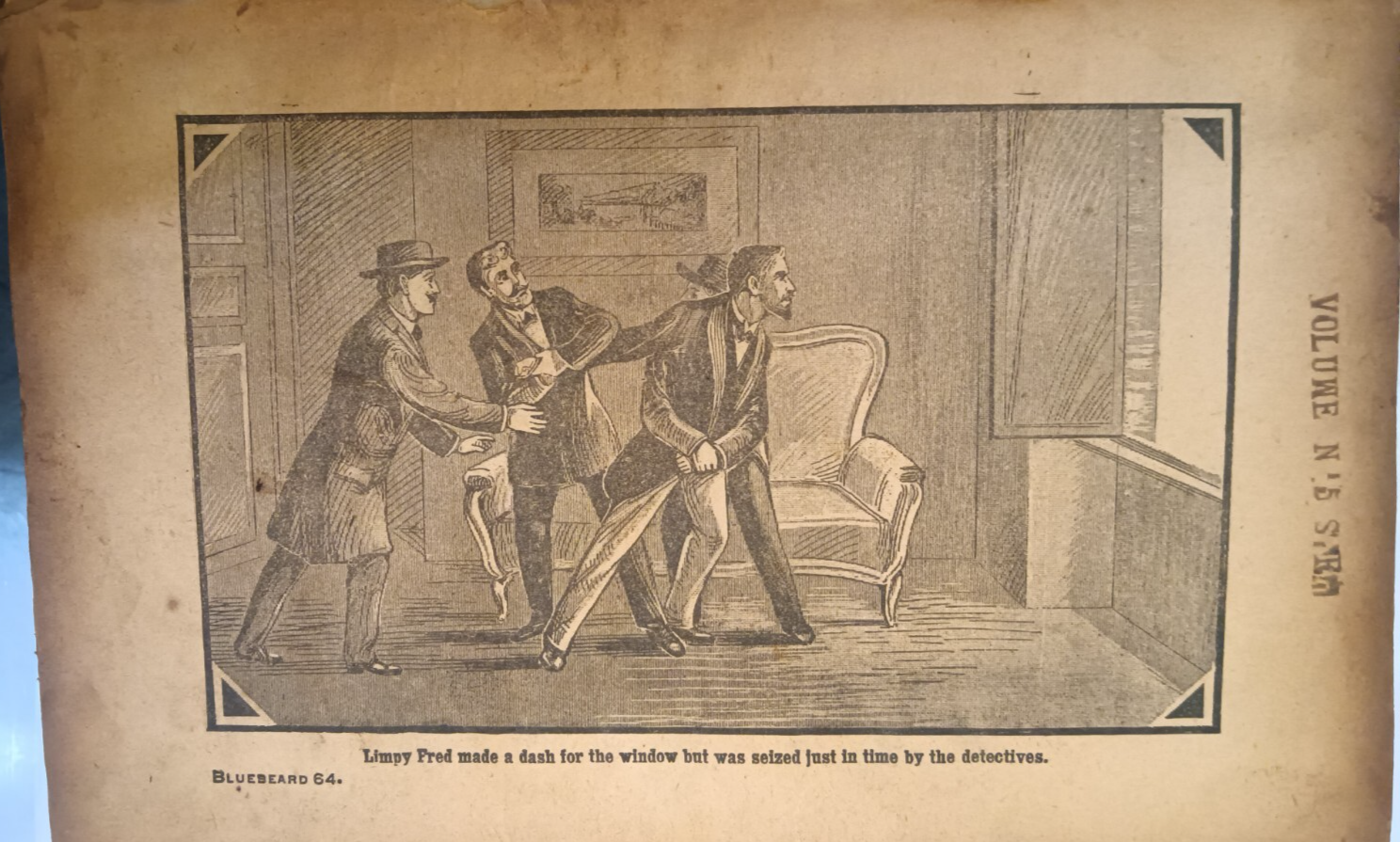
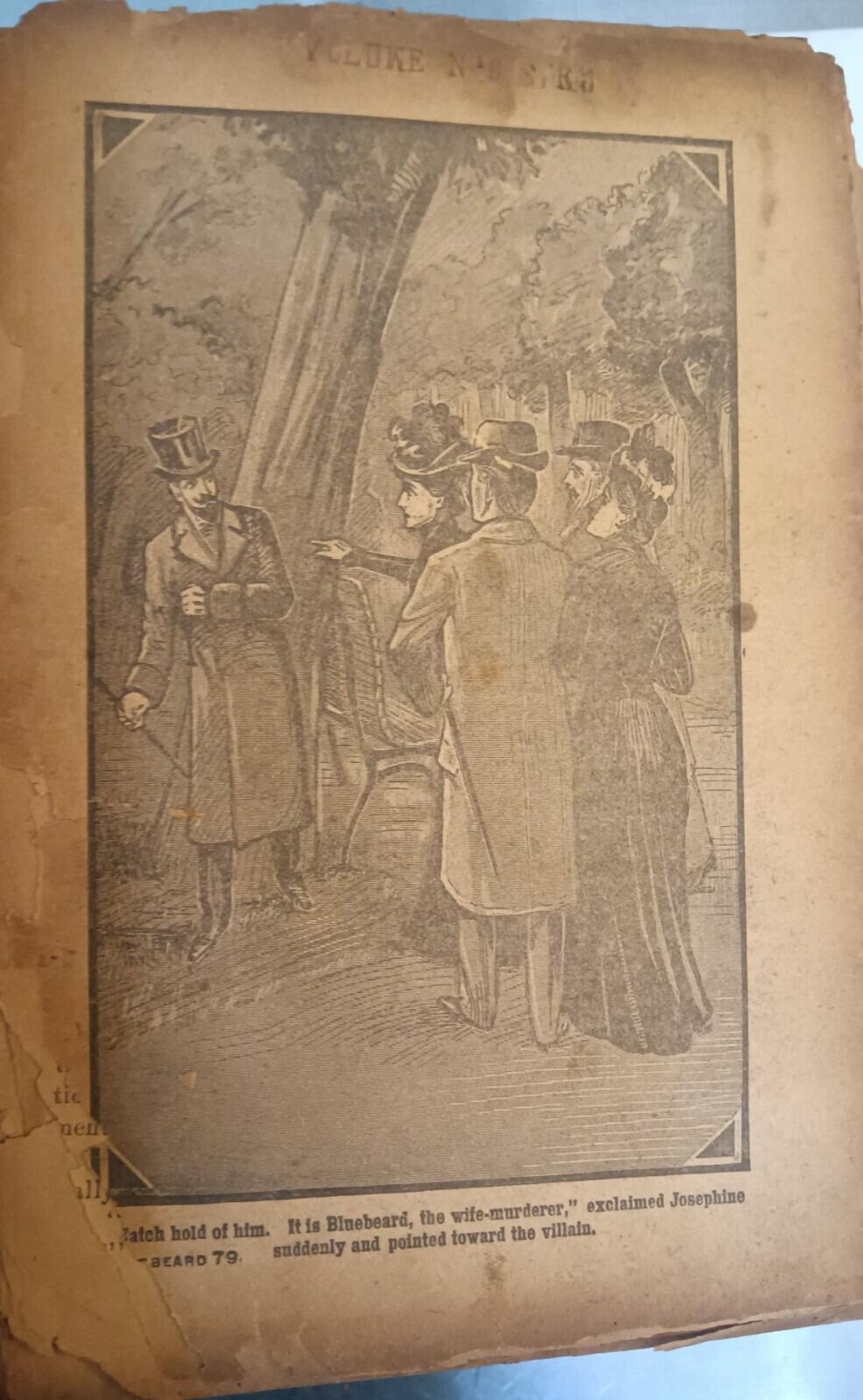
[Harrison, Monroe Burt (?)]. Imprisoned with the dead, or the fate of Count Bluebeard's wives, an interesting story from the personal experiences of detective Reynold Winter. [New York: Wolfer Printing Company, 1901] Serial novel in 96 issues, each 32 pages, numbered consecutively, 8 7/8 x 6 in. Each issue with a frontispiece illustration. Six volumes, pp. 1-512, 515-992, 995-1504, 1507-2016, 2019-2496, 2499-2976, in rude vernacular bindings. Five of the six volumes have wrappers from the original pasted on the front boards; regrettably neither the author nor the imprint has been preserved. The fifth volume lacks the front board and none of the volumes has a spine. Pages browned and brittle, some signatures are loose. There are printer's marks throughout. Each volume bears the ownership stamp of Savery Fulginit (e.g. Saverio Fulginiti), Barber, 2909 Richmond Street, Philadelphia, Pa.
A complete set of the only recorded copies of an epic serial novel with an intriguing provenance and devastating consequences.
The Wolfer Printing Company
Imprisoned with the dead was published by Maurice Wolfer (1861–1921), who emigrated to the United States from Austria in either 1880, 1883, or 1890 – his answers varied – and was naturalized as a citizen in 1896. He later claimed to have started his publishing firm in 1882 or 1888, but Wolfer’s earliest listings in city directories (New York in 1892 and 1894, Fall River in 1893), suggest that he actually started out as an artist specializing in crayon portraits. By 1896, however, he had set himself up as a publisher, with premises at 14 Clinton Place.
Wolfer was at times closely associated with the New York garment industry, in several capacities it seems. In 1896 a merchant named Morris Lewenthal sued Wolfer and an associate for damages relating to bolts of cloth the two men had taken in the context of a dispute (see the records of the case here). Wolfer printed magazines (The Women’s Review, The North American Review) and other materials. A 1912 notice in a trade journal advertised his work for clothiers:
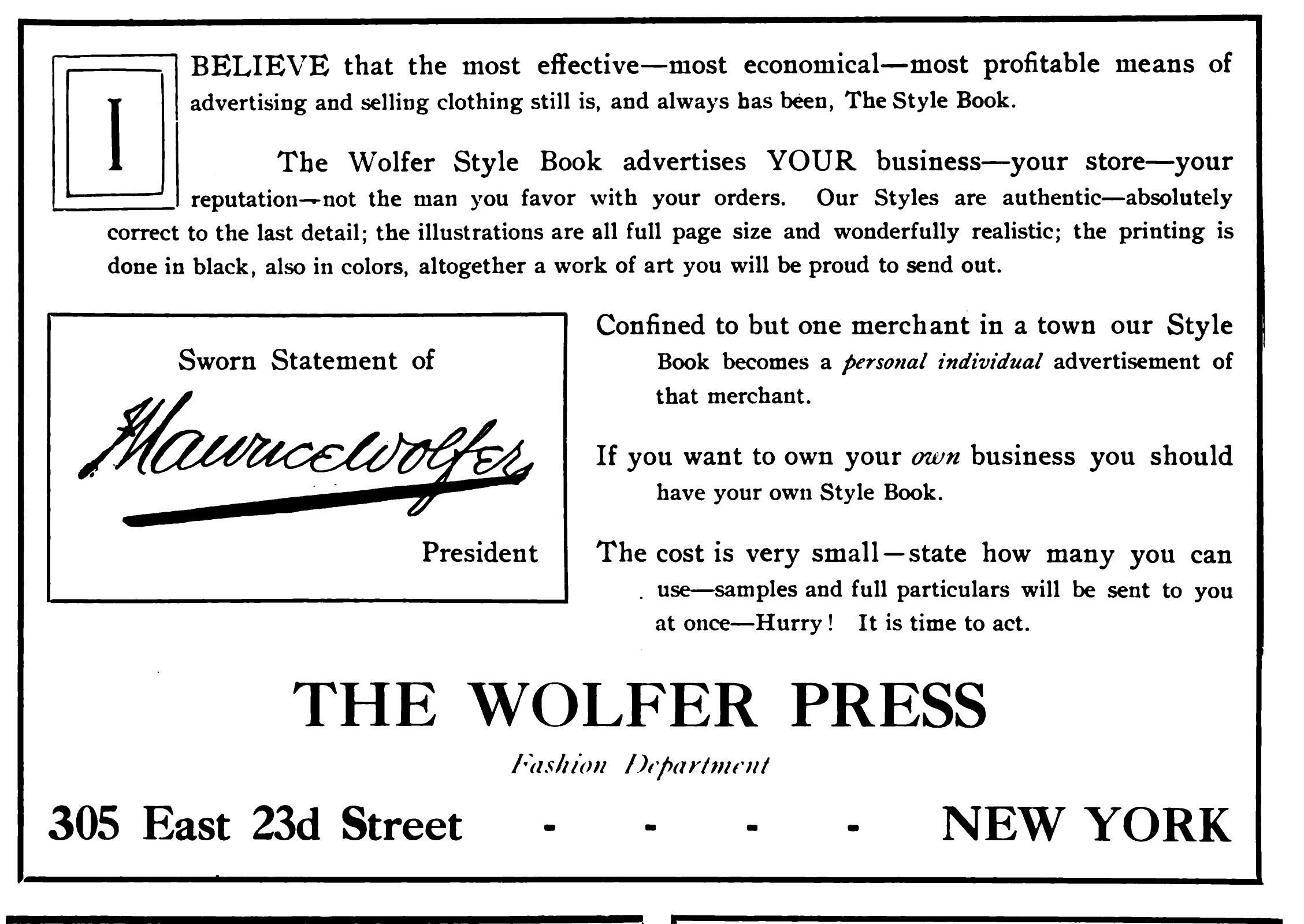
The Clothier and Furnisher, August 1912, p. 136
The pulp serials Wolfer appear to have been born out of a commercial advertising scheme. These novels appear to be original and were published under a range of local imprints, including the Coast Premium and Publishing Company (Los Angeles), the Neilsen Company (Cincinnati), Barclay and Company (Cincinnati) and Otto Ruediger Publishing & Premium House (Elmira). Each issue carried a notice for a local firm on the interior. Copies of one of serial novels issued by Wolfer, His secret wife; or a crown of thorns by Monroe Burt Harrison, are held in four institutions; we expect that comparing the interior advertisements may be instructive.

The office of the Wolfer Printing Company, American Printer 45 (February 1908) p. 646
An 1908 article on the Wolfer Printing Company suggests that he expanded operations dramatically in 1903. “The Wolfer Press has an equipment for its general business that is vitually new throughout,” the American Printer reported. “The jobbers and five new cylinder presses are of the latest patterns; all machines are operated by individual electric motors; the composing-rooms are supplied with new types; the binder is complete in its equipment of folders, wire stitchers and cutters; every modern device of practical value for simplifying work, including the metallic overlay, is made use of.” Regrettably, he appears to have overextended himself. By 1910 he was compelled to file for bankruptcy.
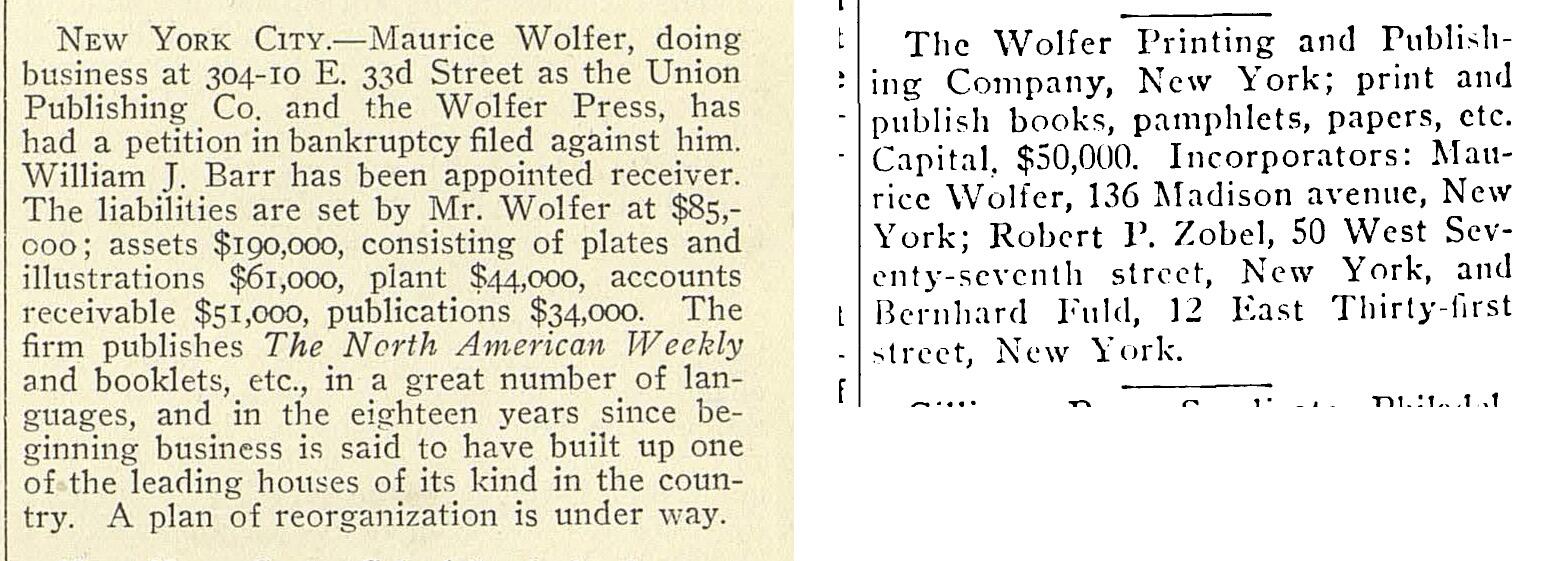
Left: Publisher’s Weekly, 19 February 1910, p. 982; Right: Editor and Publisher, 4 June 1910, p. 6.
Reorganizing the company a few months later with a capitalization of $50,000, Wolfer appears to have kept his offices and reacquired his equipment. He ran the company with a succession of subordinates until his death in 1921, at which point the company appears to have been dissolved. Another commercial jobber of the same name, the Wolfer Printing Company of Los Angeles, appears to be a wholly separate enterprise, though it is possible that the founder William Wolfer Sr. (1872–1957) was related in some way to Maurice.
Imprisoned with the Dead
Besides Imprisoned with the Dead, Wolfer appears to have published at least four other serial novels, Edith's Honor or The Clairvoyant's Secret; His secret wife, or, A crown of thorns (1911), Her Double Life : the story of a stolen fortune (1911), The unpardonable sin : a thrilling story of love and intrigue (1921). The first of these was credited to Marie Cornell; the latter three are credited to Monroe Burt Harrison. It is entirely possible that these are all house pseudonyms.
[See our copy of Edith's honor here.]
Wolfer He published a magazine, North American Weekly, comprised primarily of content pirated from other publications. So another possibility is that these serials represent retitled versions of novels published elsewhere with the names of the authors changed. It is intriguing to note that Maurice Wolfer counted some distinguished writers among his circle – Fannie Hurst (1889--1968), for example, whose husband gave piano lessons to Wolfer’s daughter.
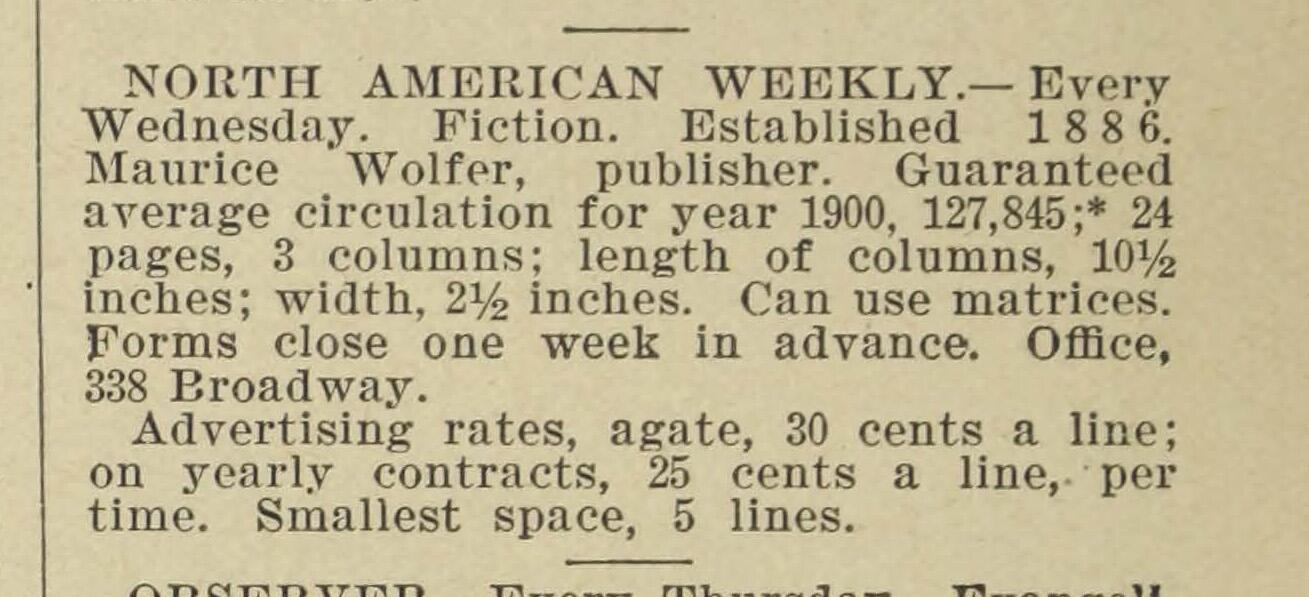
Advertiser's rate book...1901. St. Louis: Nelson Chesman & Co., 1901), p. 156.
[See our copies of North American Weekly here.]
Imprisoned with the Dead appears to be the earliest of Wolfer’s dime novel publications. It was also the most notorious. Much more violent and lurid than his other publications, it was associated with a brutal crime. In April 1901, a young man of Louisville, Kentucky murdered his wife and then committed suicide. On his desk was a copy of an installment of Imprisoned with the Dead that included a gristly description of uxoricide. Anticipating the arguments that Fredric Wertham would make with reference to comic books half a century later, opinion writers cited the malign influence of pulp fiction as the inspiration for his crime. This might help to account for the great rarity of the novel. The present set comprises the only copies on record.
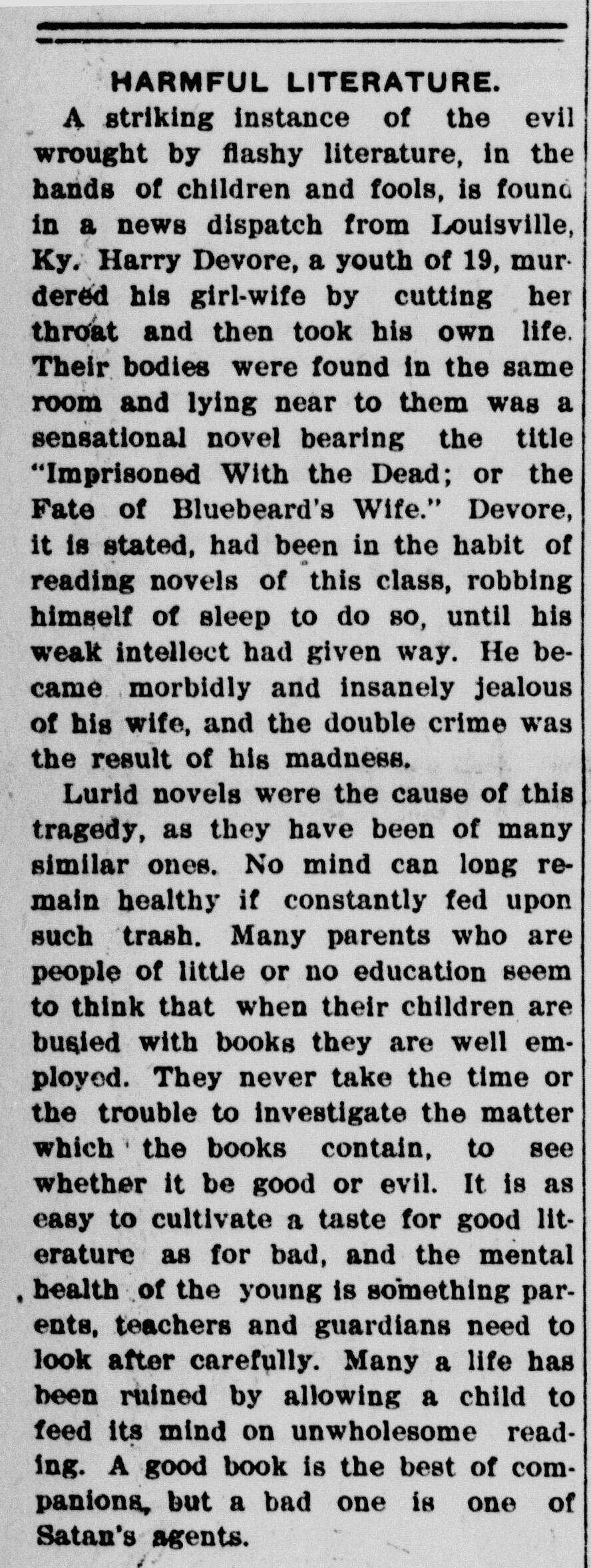
East Liverpool [Ohio] Evening News, 12 April 1901, p. 4.
Was it the hair-raising nature of the tale that made it a useful accoutrement to its previous owner, a Philadelphia barber? A native of Italy, Saverio Fulginiti (1866–1938) emigrated to the United States in 1896. According to census records and city directories, he was working as a barber by 1900 and retained his premises on Richmond Street at least through the 1920s. His stamp in each of these crudely bound volumes collecting the 96 parts of Imprisoned with the Dead offers a rare glimpse into how dime novels were circulated and read.
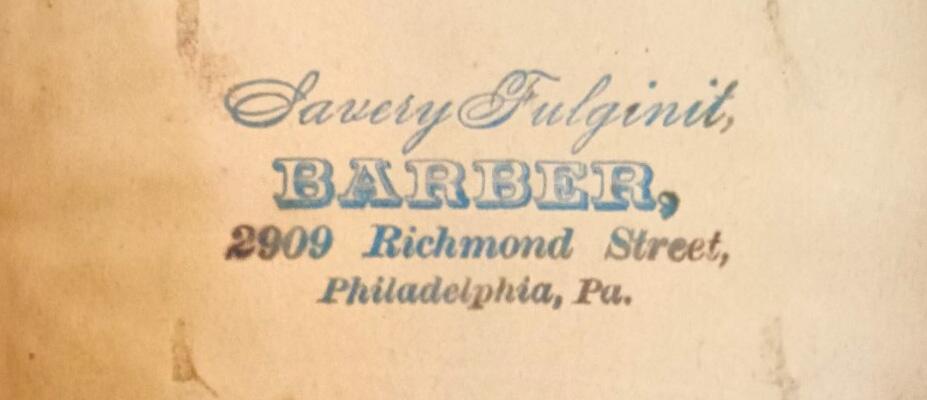
Selected References
“J.S. Danielson to summer in the Orient,” Musical Courier, 11 May 1916, p. 8.
“Wolfer Press,” American Printer 45 (February 1908) p. 646-7.
NOTICE: Given the historic risks of reading lurid literature, this serial novel is sold only on condition that the purchaser agrees to indemnify Carpe Librum and its heirs and assigns from any responsibility for murderous rampages that may be perpetrated by readers of the book.
Product tabs
SOLD
Recommend this product
Imprisoned with the dead: the only recorded copy of an American penny dreadful
Related products
Charles DICKENS, The Mystery of Edwin Drood (1870), First American edition
Dickens, Charles (1812-1870). The Mystery of Edwin Drood, and Some Uncollected Pieces. Boston: Fields, Osgood, & Co., 1870. First American editio...
view details
$600
View details

Russ Cochran comic art auction catalogues -- complete run, 1979 to 2008
Cochran, Russ (1937 -- 2020). A complete run of over 100 auction catalogues by this influential comic book publisher and dealer. West Plains, Mo.: Rus...
view details
$4,500
View details

Asimov, Pebble in the Sky, first edition
Asimov, Isaac (1920–1992). Pebble in the Sky. Garden City: Doubleday, 1950. First edition. Near fine in very good plus dustwrapper with minor faults. ...
view details
$1,500
View details

Robert A. Heinlein’s Cold War manifesto and the origins of Starship Troopers
Heinlein, Robert A. (1907–1988) and Virginia Heinlein (1916–2003). Who are the heirs of Patrick Henry? Stand up and be counted! [Colorado Springs, Col...
view details
$850
View details

Thomas Bewick. Poems by Goldsmith and Parnell (1795), with an unrecorded suite of plates.
[Bewick, John and Thomas]. Poems by Goldsmith and Parnell. London: W[illiam] Bulmer, 1795. First edition thus. 4to. xx+76 pp. Some light foxing, else ...
view details
$1,250
View details

Philip K. Dick, Solar Lottery, signed
Dick, Philip K. (1928 – 1982) Solar Lottery. New York: Ace Books, 1955. First edition. Bound dos-à-dos with Leigh Brackett, The Big Jump. Fine in wrap...
view details
$3,250
View details
William FAULKNER, Knight's Gambit (1949). Uncorrected Proof. One of three known copies.
FAULKNER, William (1897-1962). Knight’s Gambit. New York: Random House, 1949. Uncorrected proof of the first edition, “for advance readers.” [148] unn...
view details
$12,000
View details

Winslow Homer. Hardy Lee, His Yacht (1857). His rare comic album
[HOMER, Winslow] Charles Ellery STEDMAN, Mr. Hardy Lee, his yacht: being XXIV sketches on stone, by Chinks. Boston: A. Williams, 1857. [24] leaves : ...
view details
$5,000
View details

Ian Rankin. Knots and Crosses. First edition. Signed.
Rankin, Ian (b. 1960). Knots and Crosses. Garden City, N.Y, Doubleday & Company, 1987. First US edition. A very fine copy in dustwrapper.Signed by...
view details
$1,500
View details

Mel Lyman, Boston Avatar: A nearly complete run of underground publications
[Lyman, Mel] Avatar 1, 3-24 (June 9/22, 1967-April 26/May 9, 1968) [with] American Avatar 1-4 (October 1968-Summer 1969; all published) [with] Pluto #...
view details
$2,000
View details

H. P. LOVECRAFT. The Outsider (1939). First edition.
Lovecraft, H. P. (1890-1937). The Outsider and Others. Sauk City, Wisconsin: Arkham House, 1939. First edition. [i]-xiv pages, 3-553 [1] p.; 24 cm. Th...
view details
$6,500
View details

The original art for A Dark Adapted Eye by Barbara Vine / Ruth Rendell, winner of the Edgar Award
Sciacca, Thomas; Ruth Rendell (1930 – 2015). A Dark-Adapted Eye, 1986. Acrylic on Masonite. 13 ¾ x 11 ½ in. (central image: 11 ½ x 8 ½ in.). Some soil...
view details
$2,250
View details

Max ERNST. Sept Microbes (1953). Microscopic Surrealism
Ernst, Max. Sept Microbes: Vus à Travers Un Tempérament. Paris: Les Editions Cercle des Arts, 1953. First edition. One of 1,000 numbered copies. A ...
view details
$500
View details

Gettysburg Veterans from Dutchess County, New York
TIPTON, William H. (1850-1929). Dedication of the 150th New York Monument, Sept 17th 1889. Original photograph (11 x 16¼ in.) mounted on cardstock (1...
view details
$1,250
View details

Manuscript Archive for Atomsk, a Cold War novel by intelligence operative Paul Linebarger
Linebarger, Paul Myron Anthony (1913 - 1966). Atomsk: A Novel of Suspense by "Carmichael Smith." Original manuscript archive for the novel published p...
view details
$25,000
View details

An 1850 Portrait of a Maryland woman by the son of her enslavers
Gilliams, John Jacob (1831–1911), Portrait of Aunt Sukey, St. Mary County, Maryland, circa 1850. Watercolor on paper, 11½ x 7¼ inches. Paper foxed, wi...
view details
$11,500
View details

A synagogue scene by Sir Frank Brangwyn
Sir Frank Brangwyn, RA RWS RBA (British, 1867–1956). Sermon in the Synagogue, circa 1900–1910. Brush and brown ink over pencil, brown wash, white wash...
view details
$1,250
View details

Boston broadside blasting beer: an experimental printing in black and gold
Dod, John (ca. 1549-1645). Sermon on Malt. Boston: [Isaac R.] Butts, [ca. 1840]. Broadside, 24 x 19 cm. Printed in gold ink on paper with a glossy bla...
view details
$1,750
View details

Consumer culture, art, and subjectivity in Kazimierzowo, Chicago
Porembski, Olga V. (1924-2011). Rose Rosinski and Bruno Zidek, April 11, 1942. 96 leaves, 11½ x 14 in. (29 x 26 cm.) Homemade scrapbook comprised pri...
view details
$1,250
View details