


Robert A. Heinlein’s Cold War manifesto and the origins of Starship Troopers
Heinlein, Robert A. (1907–1988) and Virginia Heinlein (1916–2003). Who are the heirs of Patrick Henry? Stand up and be counted! [Colorado Springs, Colorado: Robert and Virginia Heinlein, 1958]. Broadside, 15" x 23" in. Printed on cheap newsprint, now toned and brittle but deacidified and archivally backed with tissue, making it safe to handle. Chipping and other minor faults, especially along top edge, the visual impact of which is lessened by watercolor tinting to the backing.
A very rare broadside reprinting a libertarian polemic Heinlein first published in the Colorado Springs Gazette-Telegraph on Saturday, 12 April 1958.
As Cold War tensions were at their peak, Heinlein was moved to action by an advertisement sponsored by the National Committee for a Sane Nuclear Policy (SANE) calling for an end to weapons testing. The Soviets had won the first salvo of the space race in October 1957 with the launch of Sputnik, triggering a frenzy of alarmist paranoia. In its first campaign, initiated in early 1958, SANE produced a pacifist statement headlined “We are facing a danger unlike any danger that has ever existed,” affirming a series of principles meant to de-escalate the rising tensions of the Cold War. The SANE advertisement included a letter to President Eisenhower that the reader was encouraged to clip, sign, and send calling for the reduction of nuclear arms and the greater involvement of the United Nations. SANE coordinated with local pacifist groups throughout the United States to publish the ad in their local papers.
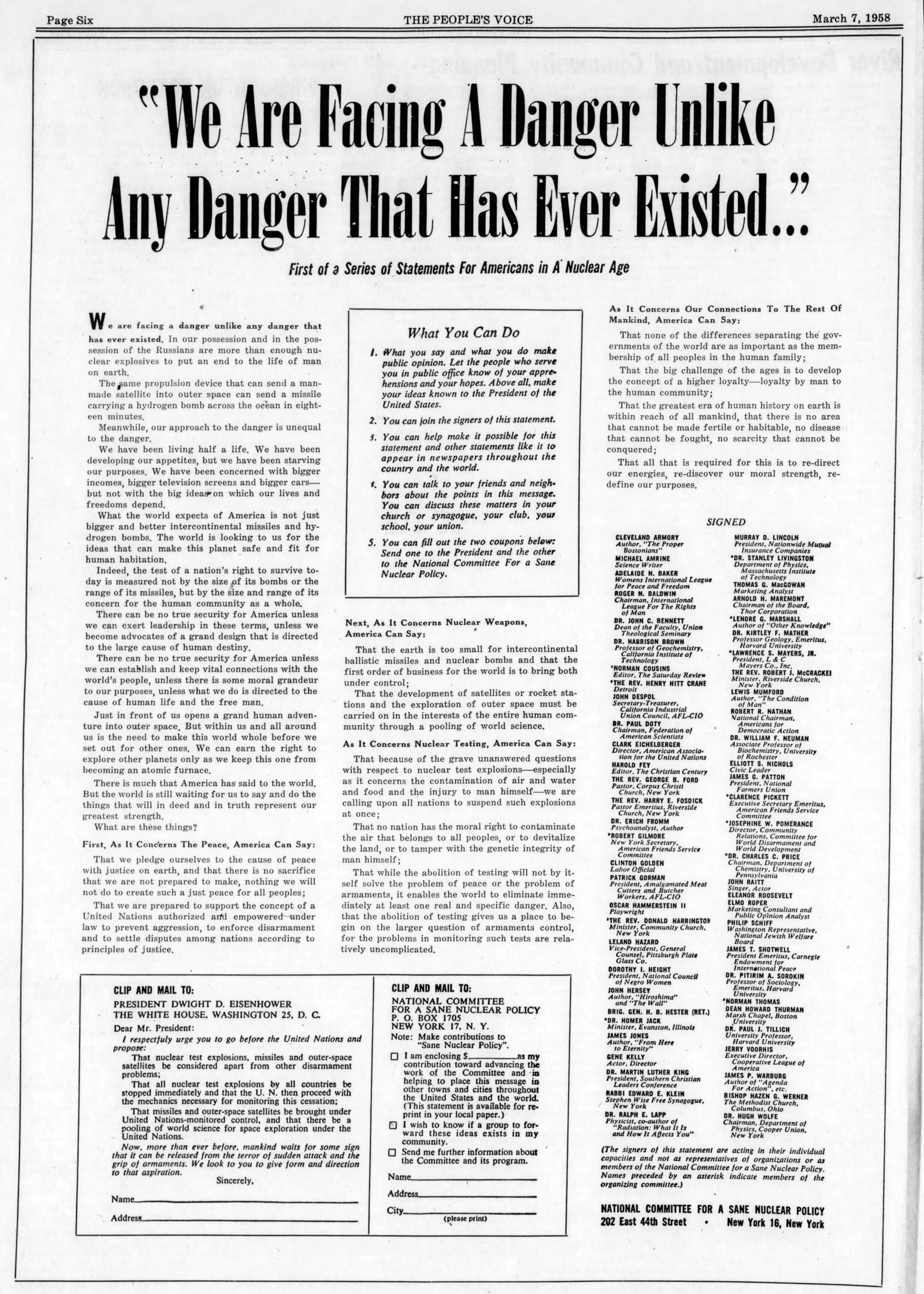
In early 1958, the National Committee for a Sane Nuclear Policy (SANE) placed this full-page advertisement in newspapers nationwide.
When the SANE ad was printed in the Colorado Springs paper, both Heinlein and his wife Virginia were appalled. “We read the insane manifesto of the so-called ‘Committee for a ‘Sane’ Nuclear Policy’ and we despised it,” Heinlein wrote. Over the next several weeks he drafted this advertisement in response. “[The SANE] manifesto is the rankest sort of Communist propaganda,” Heinlein wrote.
This follows the pattern of a much-used and highly-refined Communist tactic: plan ahead to soften up the free world on some major point, package the propaganda to appeal to Americans with warm hearts and soft heads, time the release carefully, then let the suckers carry the ball while the known Communists stay under cover. …
These proposals are not a road to world peace, they are abject surrender to tyranny. If we fall for them, then in weeks or months or a few years at most, Old Glory will be hauled down for the last time and the whole planet will be ruled by the Butchers of Budapest.
In calling for continued nuclear armament against the Soviet Union, Heinlein knew that he courted the “mutually assured destruction” that would soon dramatized in such films as Failsafe (1964) and Dr. Strangelove (1964), but this did not trouble him.
If it comes to atomic war, the best we can hope for is tens of millions of American dead – perhaps more than half our population wiped out in the first few minutes.
Colorado Springs is at least a secondary target; all of us here may be killed.
These are the risks. The alternative is surrender. We accept the risks.
Heinlein’s manifesto deliberately copied the form of the SANE advertisement, including a form letter to the President urging him to “stand steadfast.” There was also a note proposing the organization of a Patrick Henry League, suggesting that readers form their own chapters. “Let us all stand up and shout aloud again and again forever: ‘Give Me Liberty or Give Me Death.’”
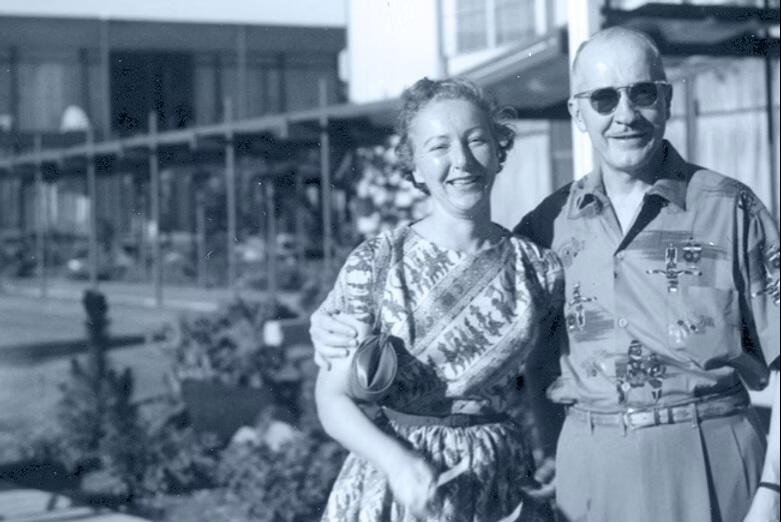
The Heinleins, looking as if they had just heard President Kennedy's announcement on 25 April 1962 that in response to Soviet actions, the United States would resume nuclear testing after a moratorium of over three years. Robert A. & Virginia Heinlein Archives, heinleinarchive.org
In his afterward to a reprint of the text in his collection Expanded Universe, Heinlein described his work on “this ‘Patrick Henry’ drive.”
We published our ad in three newspapers, encouraged its publication elsewhere, mailed thousands of reprints, spoke before countless meetings, collected and mailed to the White House thousands of copies of the letter above…
His biographer expressed skepticism; there is little record of Heinlein seeking to promote the piece as widely as he claimed. His wife was more modest. After placing the ad in the Colorado Spring papers, recalled Virginia Heinlein in 1989, “we ordered extra copies of the page and sent them out to our mailing list, which was not very large at that time.” In a letter to his agent, Heinlein named only a few recipients, including such science fiction stalwarts as Martin Greenberg (Gnome Press), Earl Kemp, Frederic Brown, Philip José Farmer, Alan E. Nourse and Jack Williamson. The present example is one of several copies, printed on newsprint, that Heinlein sent to Chicago-area fan George Price, an ardent libertarian and a partner in Advent:Publishers, with the expectation that he would help distribute them. (Price would later publish Alexei Panshin’s groundbreaking study of Heinlein's work.)
Although no one seems to have taken up the call to organize Patrick Henry Leagues, later that year Robert Welch and his colleagues formed the John Birch Society. The Heinleins did not formally join the new organization; Heinlein wrote that he found Welch’s approach to be “puerile.” But Heinlein approved of his goals, and noted that he was an excellent drinking companion, so they contributed to the cause.
Heinlein's Patrick Henry broadside had two important impacts. First, it served to divide the ever-fractious science fiction community into opposing political camps, hardening his emerging reputation as a voice on the right. “It brought down on me the strongest and most emotional adverse criticism I have ever experienced,” Heinlein recalled in 1980. Not only did many in the field decline to sign the Patrick Henry pledge, many wrote back to criticize him. Editors John Campbell (no pacifist himself), H. L. Gold, William White (aka Anthony Boucher), J. Francis McComas, and Alice Dalgliesh all objected to the jingoistic tone of the manifesto. Lew Tilley, a Colorado Springs artist who once was friends with the Heinleins, had been one of the local signatories to the SANE advertisement; Robert Bloch expressed also his pacifism. Heinlein’s movie representative Ned Brown and his publisher Charles Scribner simply ignored it.
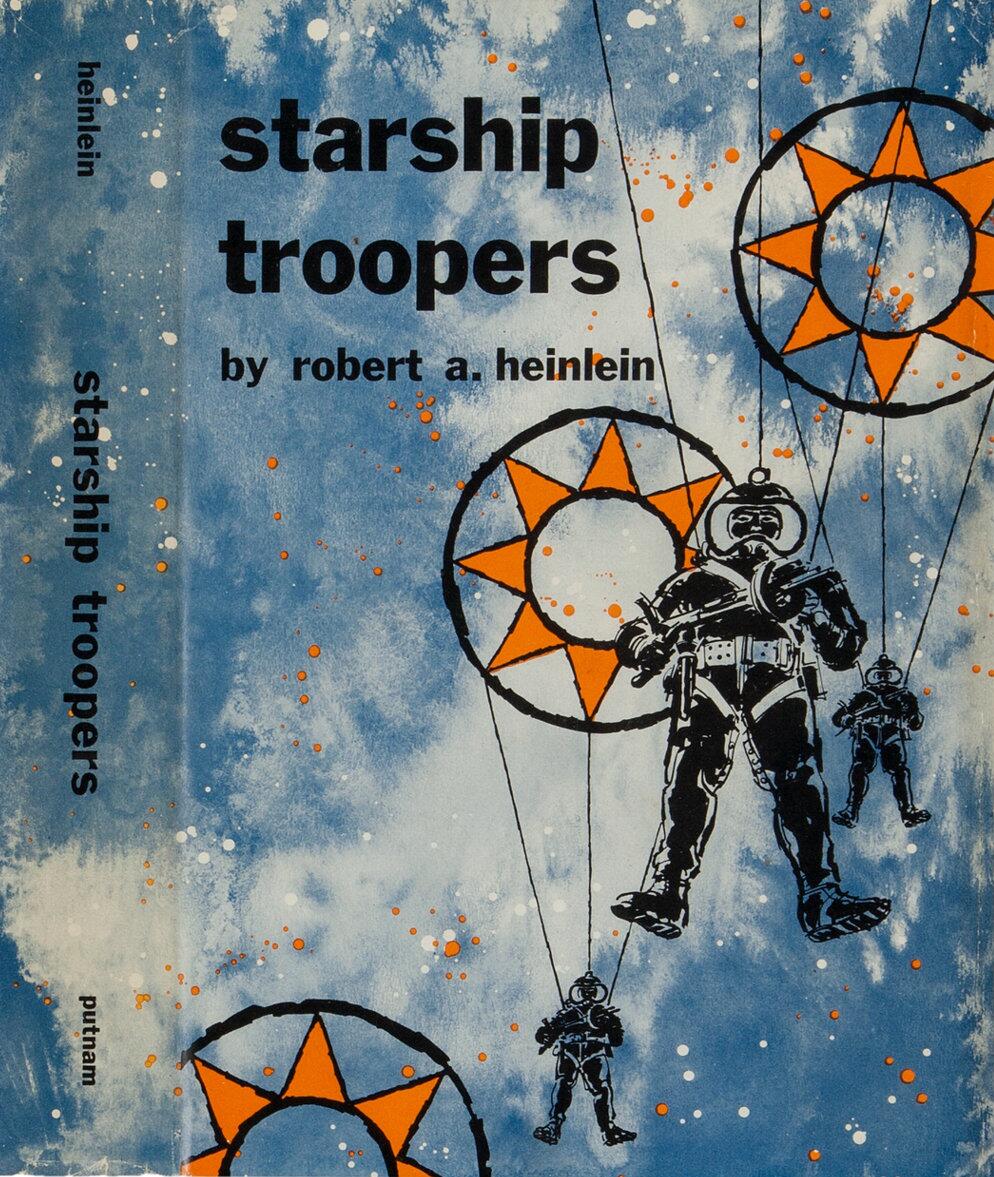
After he published the Patrick Henry broadside, Heinlein's fiction shifted significantly, beginning with Starship Troopers (1959)
The experience also redirected Heinlein’s work. He had been working on a novel provisionally titled The Martian Named Smith when he became distracted by the SANE advertisement. After trying to promote his broadside, he started work on a new novel that would, as Alexei Panshin notes, “attempt to make many of the same arguments in fictional form.” Recognizing the affinities with the Patrick Henry manifesto, Dalgliesh, his long-time editor at Scribners, rejected the book and Charles Scribner himself suggested dropping Heinlein entirely. He collected rejections also from his editors at Doubleday, and John W. Campbell declined to serialize it in Astounding. The novel, which Norman Spinrad called “a military wet-dream fantasy … in which righteous ingénues guiltlessly slaughter faceless gunfodder in alien or robot gook-suits,” would be published in 1959 as Starship Troopers. Much to everyone’s astonishment, the book won Heinlein his third Hugo Award. “The ‘Patrick Henry’ ad shocked ‘em; Starship Troopers outraged ‘em,” Heinlein wrote later. Only once the libertarian spirits of Patrick Henry and Juan "Johnny" Rico were allowed to express themselves was Heinlein able to return to the manuscript he had been working on earlier, which would see print in 1961 as Stranger in a Strange Land.
Even though the controversial success of Starship Troopers came as a vindication, Heinlein would continue to resent the poor response received by Who are the heirs of Patrick Henry? “I do not ask to be forgiven and I do not want it to be forgotten,” he wrote defiantly twenty-two years later. Looking at the arc of Heinlein’s career, it is clear that the broadside marked the key turning point for his work. Before 1958, Heinlein wrote ripping yarns; afterwards, he wrote social commentary, using fiction as a vehicle for the garrulous opinions of such soapbox philosophers as Jubal Harshaw and Lazarus Long. Through the Patrick Henry episode, Heinlein redefined himself: once an entertainer, he was now a public intellectual.
To our knowledge, the only copy of this vital publication that has been catalogued to date is a single example in the Heinlein archives at UC Santa Cruz. The copy in the Swarthmore College Peace Collection appears to be a tearsheet from a newspaper, the Colorado College Tiger. It is not listed in any Heinlein bibliography published to date.
Selected References
Franklin, H. Bruce. Robert A. Heinlein: America as Science Fiction. New York: Oxford University Press, 1980
Heinlein, Robert A. “Who are the heirs of Patrick Henry?” in Expanded universe (New York: Grosset & Dunlap, 1980), 386-402
-----. Grumbles from the grave, ed. Virginia Heinlein (New York: Ballantine Books, 1989), 208-10
Katz, Milton S. Ban the bomb: a history of SANE, the Committee for a Sane Nuclear Policy, 1957-1985 (New York: Greenwood Press, 1986)
Olander, Joseph D. and Martin Harry Greenberg, eds. Robert A. Heinlein. Edinburgh: Paul Harris, 1978
Panshin, Alexei. Heinlein in dimension: a critical analysis (Chicago: Advent Publishing, 1968)
Patterson, William H. Robert A. Heinlein in dialogue with his century, vol 2: 1948-88: The man who learned better (New York: TOR, 2014), 2: 151-57, 543-46
Seed, David. American science fiction and the Cold War: literature and film. Edinburgh University Press, 1999
Spinrad, Norman. Science fiction in the real world (Carbondale: Southern Illinois University Press, 1990)
Westfahl, Gary. “The joke is on us: the two careers of Robert A. Heinlein,” Locus Magazine, 25 November 2012. https://locusmag.com/2012/11/the-joke-is-on-us-the-two-careers-of-robert-a-heinlein/
Product tabs
$0
$850
Recommend this product
Robert A. Heinlein’s Cold War manifesto and the origins of Starship Troopers
Related products
Colonial Recruitment Poster: Doctors in Fiji
NUNNEY, John (1897-1966). Learning to be Doctors in Fiji. British Information Service, [1945]. Printed by Alf Cooke Ltd, Leeds and London. 506 mm x 76...
view details
$2,350
View details

Richard Matheson. The Shrinking Man (1973). First hardcover edition.
Matheson, Richard (1926-2013). The Shrinking Man. London: David Bruce & Watson, 1973. First hardcover edition. A fine, unread copy in a crisp dust...
view details
$750
View details

A most exquisite corpse
$8,500
A most exquisite corpse
Lise Deharme (1898–1980), Paul Éluard (1895–1952), Georges Hugnet (1906–1974) and Raymond Queneau (1903–1976). Cadavre exquis, [Paris], circa 1925-193...
view details
$8,500
View details

Zarafamania!
$65
Zarafamania!
Chalon, Alfred Edward (1780-1860). La Giraffe, dèdiée sans permission à Mademoiselle Chalon 1828. [London: The Graphic, 1889] 8pp., printed on rectos ...
view details
$65
View details

A 30-year Play-by-Mail collection
Price on Request
A 30-year Play-by-Mail collection
Persons,
Kelly S. (b. 1955), collector. Play-by-Mail Games archive, circa 1972–2005. An
extensive collection representing the activities of one dedica...
view details
Price on Request
View details

Russ Cochran comic art auction catalogues -- complete run, 1979 to 2008
Cochran, Russ (1937 -- 2020). A complete run of over 100 auction catalogues by this influential comic book publisher and dealer. West Plains, Mo.: Rus...
view details
$4,500
View details

Jazz monologues signed by Civil Rights artist Tracy Sugarman
Sugarman, Tracy (1921 – 2013) and George T. Simon (1912 – 2001), The Feeling of Jazz. New York: Simon & Schuster, 1961. First edition. 4to. Very g...
view details
$95
View details

Asimov, Pebble in the Sky, first edition
Asimov, Isaac (1920–1992). Pebble in the Sky. Garden City: Doubleday, 1950. First edition. Near fine in very good plus dustwrapper with minor faults. ...
view details
$1,500
View details
On
hold
hold
The Mexican Inquistion meets the French Enlightenment
Flores, Manuel de (1732 -- ?) and Francisco Javier Mier y Campillo (1748 -- 1818). Nos el Dr. D. Manuel de Flores, Inquisidor Apostólico, contra la h...
view details
$0
View details

Donald A. Wollheim. The Secret of the Ninth Planet (1959). A scarce Winston juvenile.
Wollheim, Donald A. The Secret of the Ninth Planet. Philadelphia: John C. Winston, 1959. First edition. Fine in a price-clipped first state dustwrappe...
view details
$250
View details

Imprisoned with the dead: the only recorded copy of an American penny dreadful
[Harrison, Monroe Burt (?)]. Imprisoned with the dead, or the fate of Count Bluebeard's wives, an interesting story from the personal experiences of d...
view details
$0
View details

George R. R. Martin. Quartet (2001), signed. The first foray into Westeros
Martin, George R. R. Quartet: Four Tales from the Crossroads. Illustrated by Charles Vess. Framingham, MA: NESFA Press, 2001. One of 1200 copies. A fi...
view details
$125
View details

Thomas Bewick. Poems by Goldsmith and Parnell (1795), with an unrecorded suite of plates.
[Bewick, John and Thomas]. Poems by Goldsmith and Parnell. London: W[illiam] Bulmer, 1795. First edition thus. 4to. xx+76 pp. Some light foxing, else ...
view details
$1,250
View details

Max ERNST. Sept Microbes (1953). Microscopic Surrealism
Ernst, Max. Sept Microbes: Vus à Travers Un Tempérament. Paris: Les Editions Cercle des Arts, 1953. First edition. One of 1,000 numbered copies. A ...
view details
$500
View details
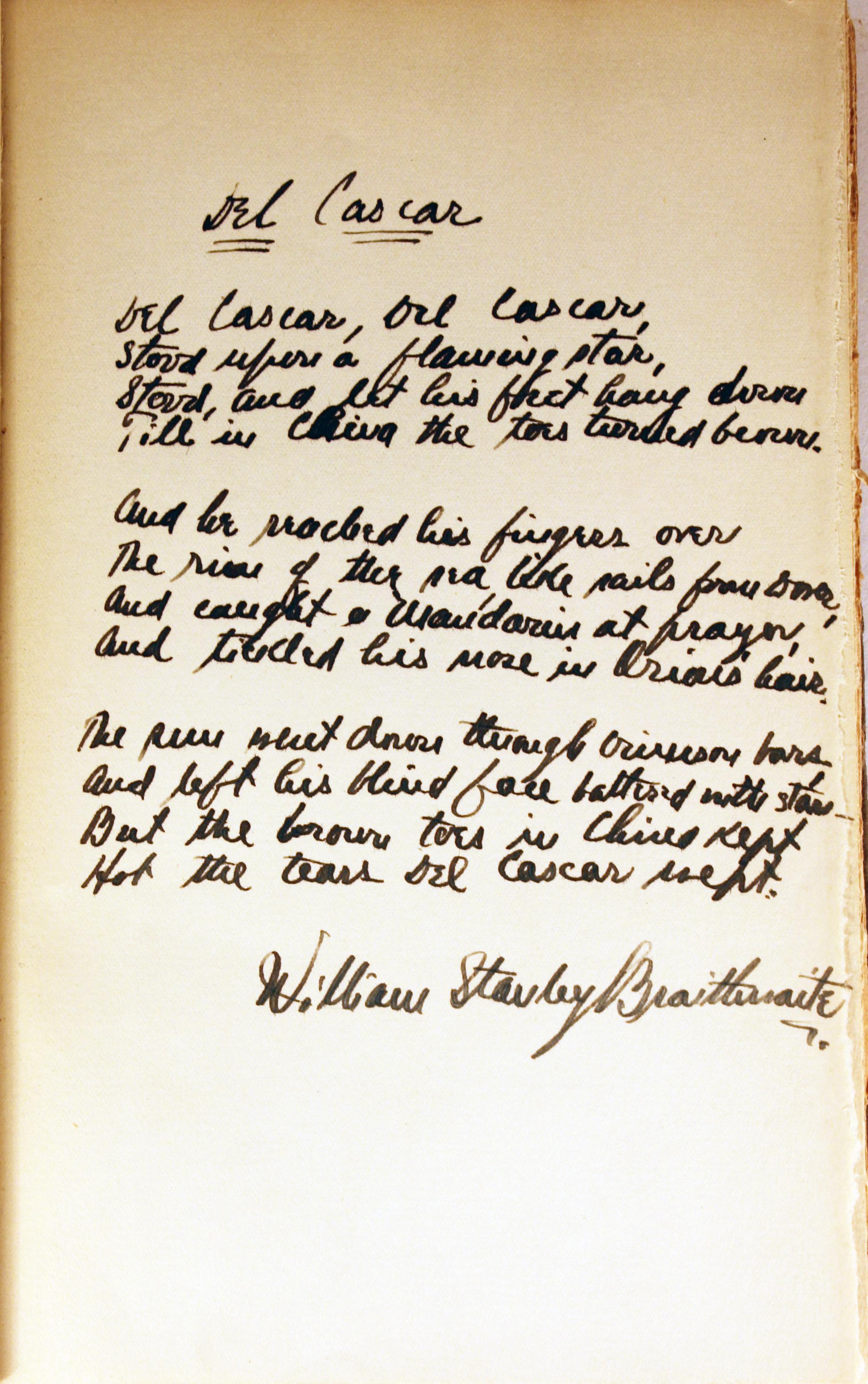
William Stanley Braithwaite / Winifred Virginia JACKSON / H. P. LOVECRAFT: the racial politics and family romance of Boston poetics
Braithwaite, William Stanley (1878-1962). "Del Cascar," manuscript poem in Anthology of Magazine Verse for 1921. Boston: Small, Maynard & Company,...
view details
$2,750
View details

Plate glass negatives from the Cook Studio, Richmond, Virginia
Price on Request
Plate glass negatives from the Cook Studio, Richmond, Virginia
Cook, George Smith (1819–1902), George LaGrange Cook (1849–1919), and Huestis Pratt Cook (1868–1951). Archive of photographic negatives from the Cook ...
view details
Price on Request
View details

Microart by Bruno Munari
Munari, Bruno (1907–1998). Four original constructions sent as holiday cards, a TLS, and two broadsides from the files of his translator, Maria Cimino...
view details
$0
View details

A large photograph from Finocchio's signed by Elton Paris, Lavern Cummings, Lucian Phelps and other drag legends
Murdach, Naomi [née Clinton E[dward] Tutt] (1932–2019). Large original photograph of eight drag queens at Finocchio's Club, early 1960s, 11 x 14 in. V...
view details
$1,450
View details

Gettysburg Veterans from Dutchess County, New York
TIPTON, William H. (1850-1929). Dedication of the 150th New York Monument, Sept 17th 1889. Original photograph (11 x 16¼ in.) mounted on cardstock (1...
view details
$1,250
View details