

Correspondence from the 18th century Irish poet Mary O’Brien
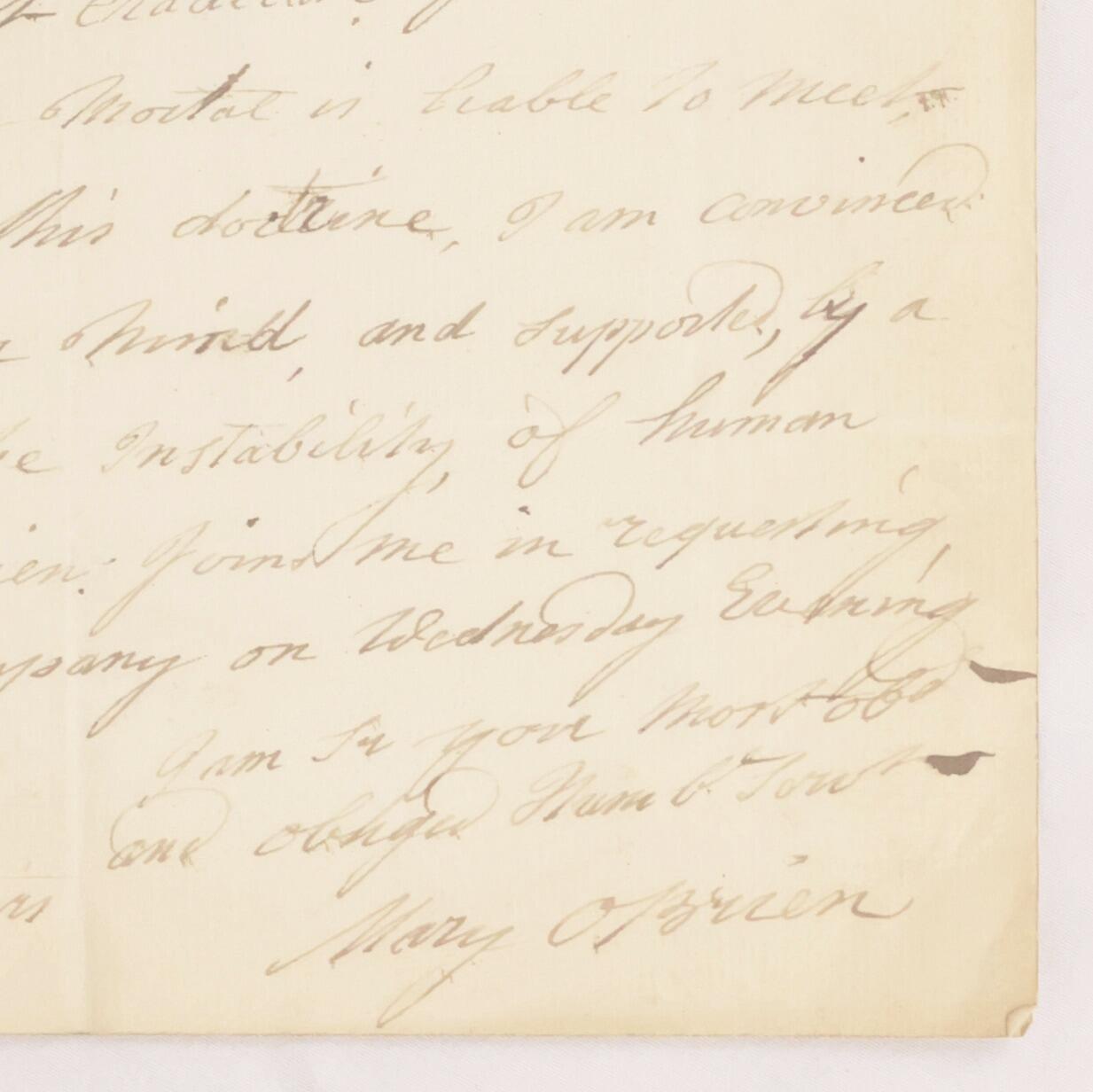
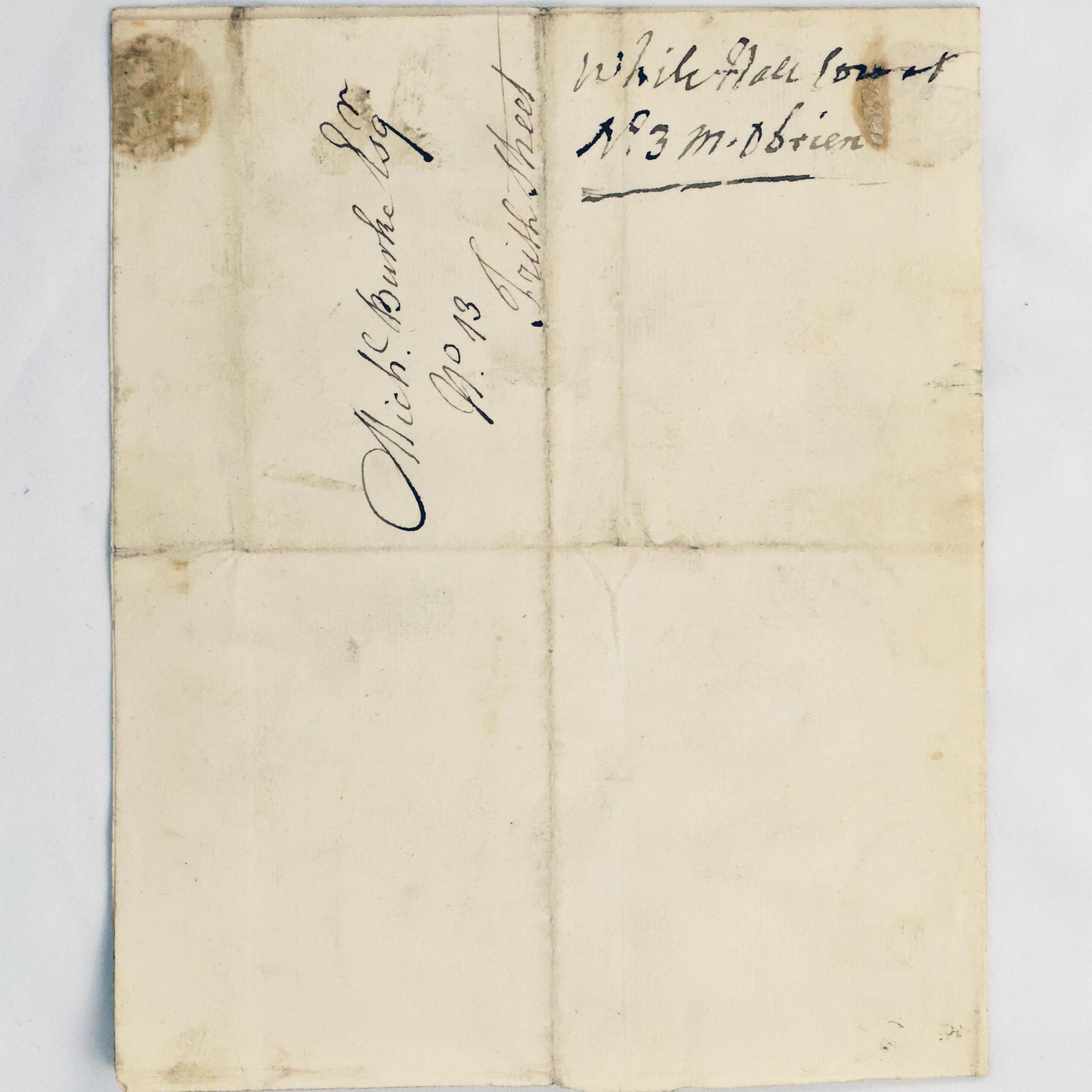
O'Brien, Mary (fl. 1785–1790). Three autograph letters from the author and her husband Patrick O’Brien to Michael Bourke, 1785 and n.d. 3 pp. bifolia. Some wear to paper and fading to ink but overall the letters are in very good condition and easily legible.
“Very little is known for certain about this author,” writes Dr. Sharon Ragaz in her headnote on Mary O’Brien for the Jackson bibliography of Romantic poetry. Her writing offers some clues. From her three volumes of poetry, one novel, and two plays we see that she was sharp and satirical, that she had links to Irish literary networks, that she detested William Pitt and Lord Gordon, that she supported Charles James Fox and Richard Brinsley Sheridan, that she supported Irish independence, and that she was proudly Catholic.
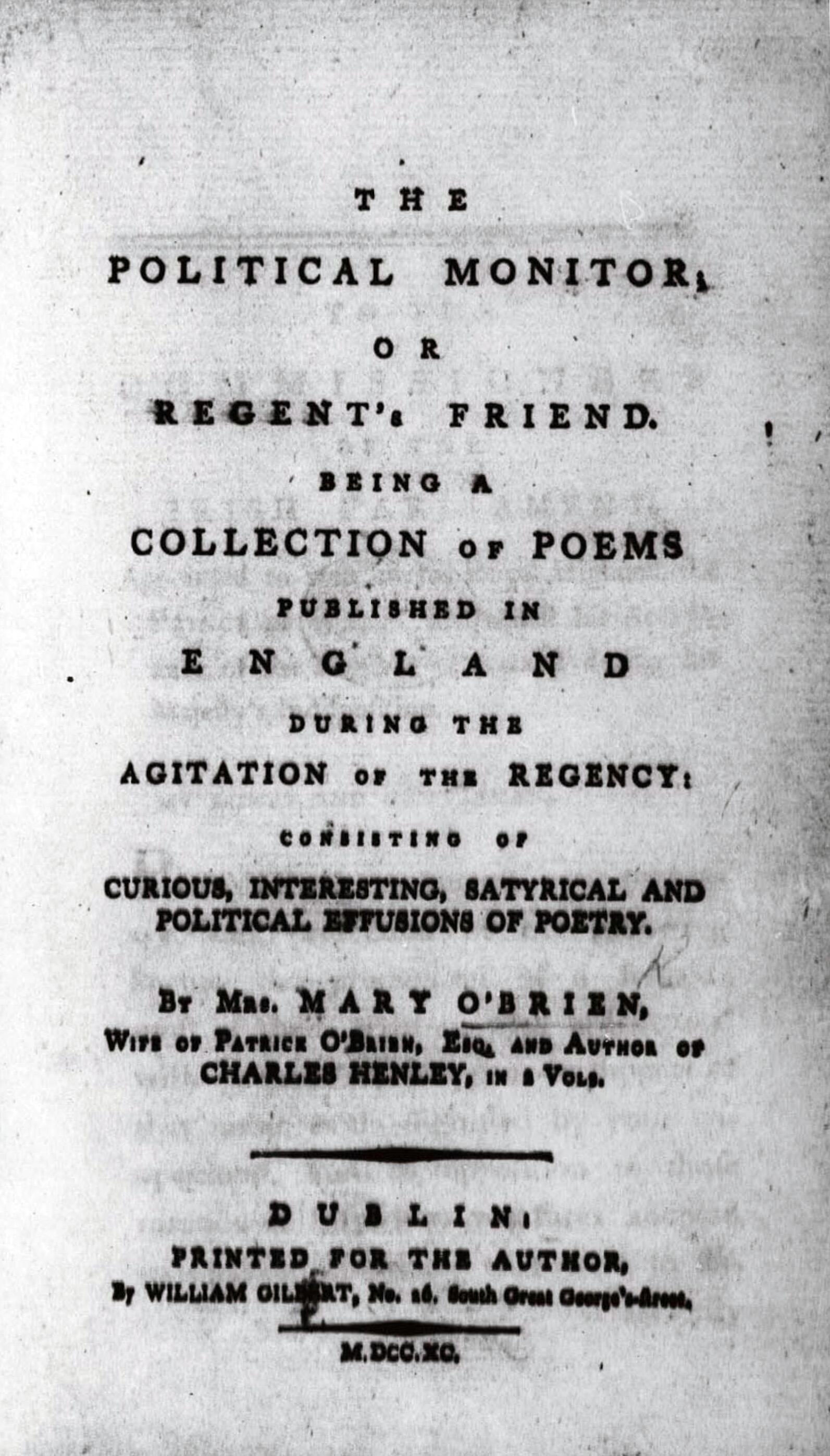
O'Brien's The pious incendiaries; or, Fanaticism display'd (1785) addressed the anti-Catholic Gordon riots. Her collection The political monitor: or regent's friend (1790) expresses outrage over British hegemony, "those mean and suspicious measures adopted in another kingdom, that were so deservedly reprobated by the generous sons of Ireland." Her poems remark on the disdain of the English for those whom they would colonize:
As Bacchus on a barrel rides
So [John Bull] on liberty bestrides,
Trotting with hobby horse's motion
To mount the cliffs of mother ocean.
Firm on a rock, a Briton born,
A foreign coast he views with scorn.
Critic Gregory A. Schirmer calls O'Brien "the most Swiftian of the political poets of the period. . . . an accomplished satirist with a sophisticated sense of irony and a Swiftian gift for manipulating a variety of dramatic personae." He continues:
What is most striking about several of O'Brien's poems attacking Pitt's actions during [the regency] crisis . . . is the way they turn condescending stereotypes of the Irish back against the English. "Paddy's Opinion. An Irish Ballad," for example, is written from the point of view of an Irishman who addresses ["Billy"] Pitt with all the obsequiousness attributed to the stereotyped Irish peasant, and it ends with an insult that depends on applying to the English the same kind of reductive condescension that stands behind Paddy's name.
Arrah, then, my dear Billy,
It might prove in the pull,
Paddy's not quite so silly
As your Jacky Bull.
These three letters from the O'Briens, one signed by her, the others by her husband, though brief, add significantly to our limited store of knowledge. Mary O’Brien’s publications reveal that she and her husband formed a working partnership – some of her books are credited to “Mrs. Patrick O’Brien” – and this is confirmed by the correspondence. One of the letters is in Mary’s hand and the two that are in Patrick’s both refer to her writing and her career.
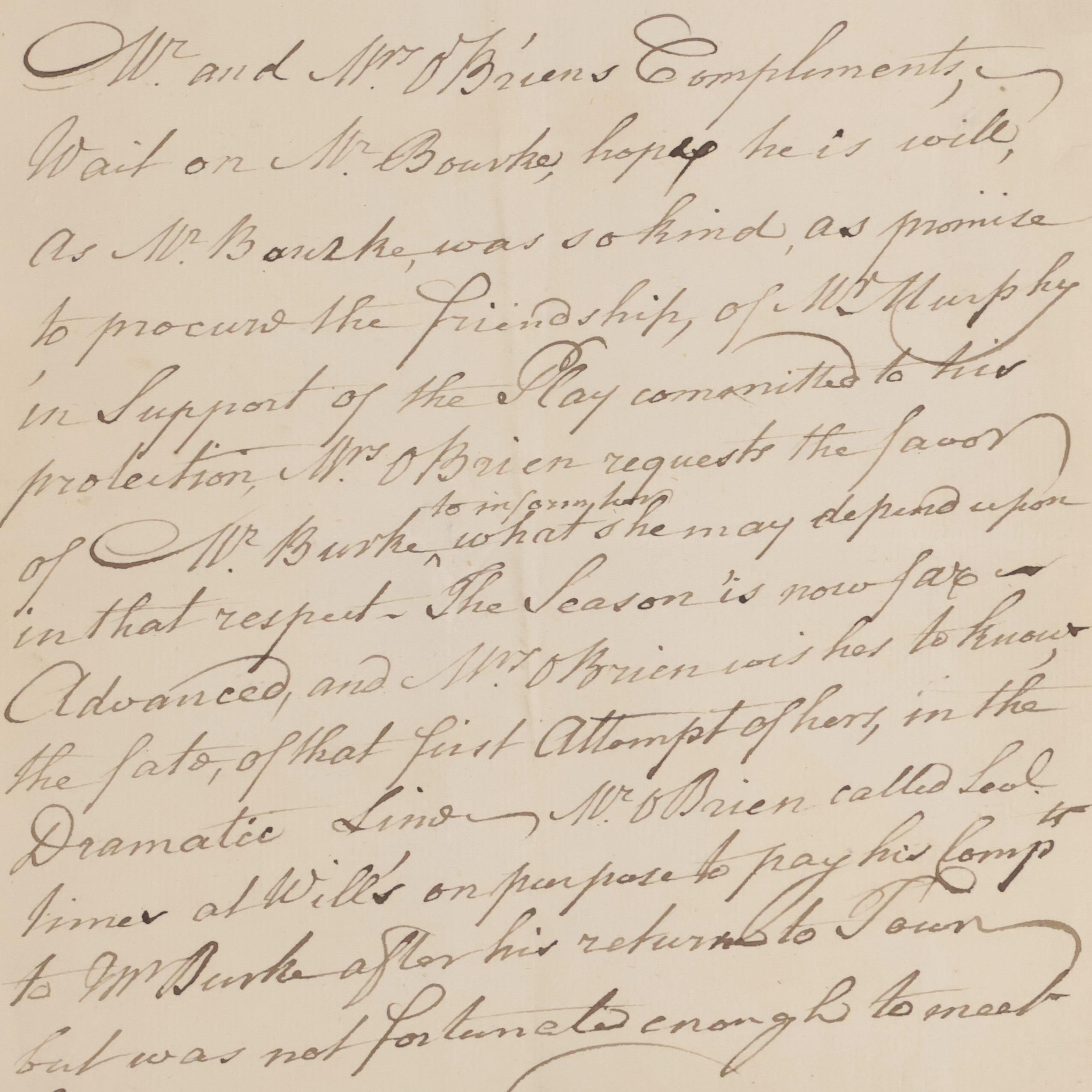
The letters are addressed to Michael Bourke, Esq. (c. 1710–1789), who was connected to the Irish literary and dramatic world, perhaps as a manager or a patron. He was close to the playwright Arthur Murphy (1727–1805), who served as executor and primary beneficiary of Bourke’s estate. Their names were linked in several literary projects. Both, for example, were listed among the subscribers to James Elphinston’s translation of the epigrams of Martial (1782). Bourke maintained a residence at Gerard (now Gerrard) Street, Soho, a posh address then and still, according to Time Out’s unbiased opinion, “one of the coolest streets in the world.” Bourke seems also to have lived or toured elsewhere; one letter refers to his “return to town.” In London, he frequented Will’s Coffee House, still celebrated in the 1780s as a haunt of writers, actors, and wits. “Mr. O'Brien called Sev[era]l times at Will's on purpose to pay his Compl[emen]ts to Mr. Burke,” the couple write, “but was not fortunate enough to meet him.”
The O’Briens appear to have known Bourke both personally and professionally. One undated letter, in Mary’s hand, expresses sympathy for a recent loss – probably the death of his wife Elizabeth in September 1784. (Bourke’s memorial to her is published in Thomas Caldwall’s 1796 collection of epitaphs). The O’Briens also invited him to “tea & coffee.” Another letter, this one in Patrick’s hand, refers to Bourke as a promoter of his wife’s work. Dated 27 May 1785, the O’Briens thank him for his interest in distributing Mary’s poem, presumably The pious incendiaries, and note that they have arranged to have 50 copies sent to him. The proceeds, they remark, should be sent to “Mrs. O’Brien’s Book Sell[er]” Mr. Hooper – very likely Samuel Hooper (d. 1793), an occasional publisher.
The third letter, dated 3 November 1785, refers to one of Mary O’Brien’s plays – perhaps The temple of virtue, which she sent to Sheridan (the manuscript is now in the BL) or The fallen patriot, which would be published in 1790. The couple thanks Bourke for showing her play to Arthur Murphy, who had achieved great success as a playwright in the 1750s, 1760s and 1770s, and remained connected to the theater even after he abandoned the footlights. “The Season is now far Advanced,” the couple write, “and Mrs. O'Brien wishes to know the fate of that first Attempt of hers in the Dramatic Line.”
With the exception of The temple of virtue, no other manuscript material by O’Brien has survived – at least not to the best of our knowledge. These letters will provide a crucial entry point for further work on this intriguing writer who plied her craft during what she called “the agitation of the Regency.”
Selected References
Behrendt, Stephen. Irish women poets of the romantic period: A different sort of other. Women's Writing 12 (2005): 153-176. 10.1080/09699080500200257.
Bourke, Michael. Epitaph for his wife, Elizabeth, in Thomas Caldwall, ed. A select collection of ancient and modern epitaphs and inscriptions: to which are added some on the decease of eminent personages. London: Printed for and sold by the compiler, also by Robinsons, Jeffery, Sael, Bell, and all other booksellers, 1796, p. 236.
----. Will, probated 22 April 1789. Prerogative Court of Canterbury Wills, 1384-1858. PROB 11/1178/321
Cunningham, Ed. This London street is officially one of the coolest in the world. Time Out, 13 March 2024. https://www.timeout.com/london/news/this-london-street-is-officially-one-of-the-coolest-in-the-world-031324
Elphinston, James, tr. The Epigrams of M. Val. Martial: In Twelve Books. London: Printed by Baker and Galabin, 1782.
O’Brien, Mary. The Glorious Revolutions of 1782: a Heroic Poem in Two Parts. Dublin: Printed and Sold by the Booksellers, 1782
-----. The pious incendiaries; or, fanaticism display'd. A poem. London: Printed for the author by S. Hooper, Stockdale, Egertons, and Richardson, 1785
-----. The political monitor; or Regent's friend. Being a collection of poems published in England during the agitation of the Regency: consisting of curious, interesting, satyrical and political effusions of poetry. By Mrs. Mary O'Brien, Wife of Patrick O'Brien, Esq. Dublin: Printed for the author by William Gilbert, 1789. Reprinted London, 1790.
-----. The Fallen Patriot, a Comedy, Dublin: Printed for the author by William Gilbert, 1790.
-----. Charles Henley, or The fugitive restored. 2 vols. London: Lane, 1790
-----. The temple of virtue. An opera in three acts, manuscript, n.d. BL Add MS 25927.
Schirmer, Gregory A. Out of what began: a history of Irish poetry in English. Ithaca: Cornell University Press, 1998
Many thanks to Dr. Sharon Ragaz for her generous advice; all errors in the description above are ours alone.
Product tabs
$0
$3,500
Recommend this product
Correspondence from the 18th century Irish poet Mary O’Brien
Related products
Free Love and New Masses: Ruth Chrisman Gannett in Bohemia
[Gannett], Ruth Chrisman (1896–1979). Pocket diary for 1926. 12mo.; 4.5 x 25 in.; approximately 180 pp. in easily legible black ink, with a few additi...
view details
$2,750
View details

French chansons of the 1780s
Receuil de Chansons Romances et Vaudeville. Manuscript, circa 1780-1789. Title + 21 pp. of text, 20.5 cm. Written on six sheets of paper with the “Vr...
view details
$375
View details
The origins of "Sinn Féin": Thomas S. Cleary's allegory of Irish independence
[Cleary, Thomas Stanislaus (1851–1898)]. Shin Fain; or ourselves alone: a drama of the exhibition, by Tom Telephone, pseud. Dublin: James Duffy and So...
view details
$2,750
View details

George Bernard Shaw ghostwrites a preface for Lawrence of Arabia
Lawrence, T[homas] E[dward] (1888–1935) and Shaw, George Bernard (1856–1950). Draft foreword to Revolt in the Desert. Holograph manuscript, [Ayot St. ...
view details
$11,000
View details

Between Women: Margaret Conklin, Sara Teasdale, and Naomi Jacob
Teasdale, Sara (1884–1933). The selected poems of Sara Teasdale. Holograph manuscript in the hand of Margaret Conklin (1903–1984), [New York?], 1937. ...
view details
$3,750
View details

Charles COTTON. Signed document (1663). A bond to the creditor who acquired Beresford Hall
Cotton, Charles (1630-1687), Bond for the performance of covenants between Charles Cotton and Joseph Woodhouse, dated August 1, 1663. Parchment, about...
view details
$5,000
View details

Stan BRAKHAGE. Space as Menace in Canadian Aesthetics (1989), signed typescript.
BRAKHAGE, Stan (1933-2003). Space as Menace in Canadian Aesthetics: Film and Painting. Photocopy of the 25-page manuscript (typewritten, with holograp...
view details
$750
View details
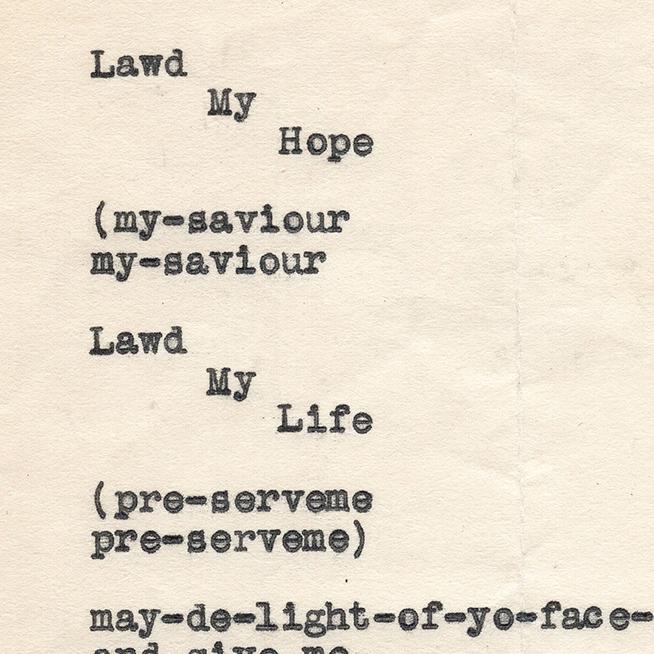
E. E. CUMMINGS, Lawd My Hope (1936). Manuscript for a lost poem.
CUMMINGS, Edward Estlin "E. E." (1894-1962). Lawd My Hope, original manuscript, [1936]. 8 ½ x 11 inches. Folding creases, a few cryptic notations in ...
view details
$5,000
View details

Manuscript Archive for Atomsk, a Cold War novel by intelligence operative Paul Linebarger
Linebarger, Paul Myron Anthony (1913 - 1966). Atomsk: A Novel of Suspense by "Carmichael Smith." Original manuscript archive for the novel published p...
view details
$25,000
View details

H. P. Lovecraft, A rare postcard to Alfred Galpin, “my intellectual superior” (1922)
Lovecraft, Howard Phillips (1890 – 1937). Postcard to Alfred Galpin, 21 November 1922. With a postscript by A. M. Adams. In fine condition.A charming ...
view details
$2,250
View details
On
hold
hold
The Burmese novels of Maurice Collis: a manuscript archive
Collis, Maurice (1889 – 1973). Archive for his six works of fiction. London, 1937 to 1970, including holograph manuscripts, corrected typescripts, cor...
view details
$18,500
View details

Samuel Palmer: The sketchbook of 1865-71
Palmer, Samuel (1805–1881). Pocket notebook, 1865-71. 50 leaves, about 7 x 12 cm. The notebook has been partially paginated in pencil by Palmer: [pp] ...
view details
$37,500
View details

A manuscript copy of an influential essay on Moravian folk songs by František Bartoš and Leoš Janáček
Bartoš, František (1837 - 1906) and Leoš Janáček (1854 - 1928). Několik slov o lidových písních moravských [A few words about Moravian folk songs...
view details
$850
View details

Tom McGrath and the Scottish Sixties: the lost poems
McGrath, Tom (1940 – 2009). A small archive of poetry typescripts and proofs. London, circa 1967. About 114 pages total. The archive comprises two se...
view details
$0
View details

A 30-year Play-by-Mail collection
Price on Request
A 30-year Play-by-Mail collection
Persons,
Kelly S. (b. 1955), collector. Play-by-Mail Games archive, circa 1972–2005. An
extensive collection representing the activities of one dedica...
view details
Price on Request
View details

A Coded film script by Lynn Riggs
Riggs, Lynn (1899-1954) and W. P. Lipscomb (1887-1958). The Garden of Allah: Dialogue Continuity. American Version. [Culver City:] Selznick Internatio...
view details
$750
View details

The script for a French opéra comique, adapted for the provincial stage
Étienne, Charles-Guillaume (1778 – 1845). Une heure de marriage: comédie en un acte, mêlée de chants. Paris: Chez Madame Masson, Libraire, An XII (18...
view details
$850
View details