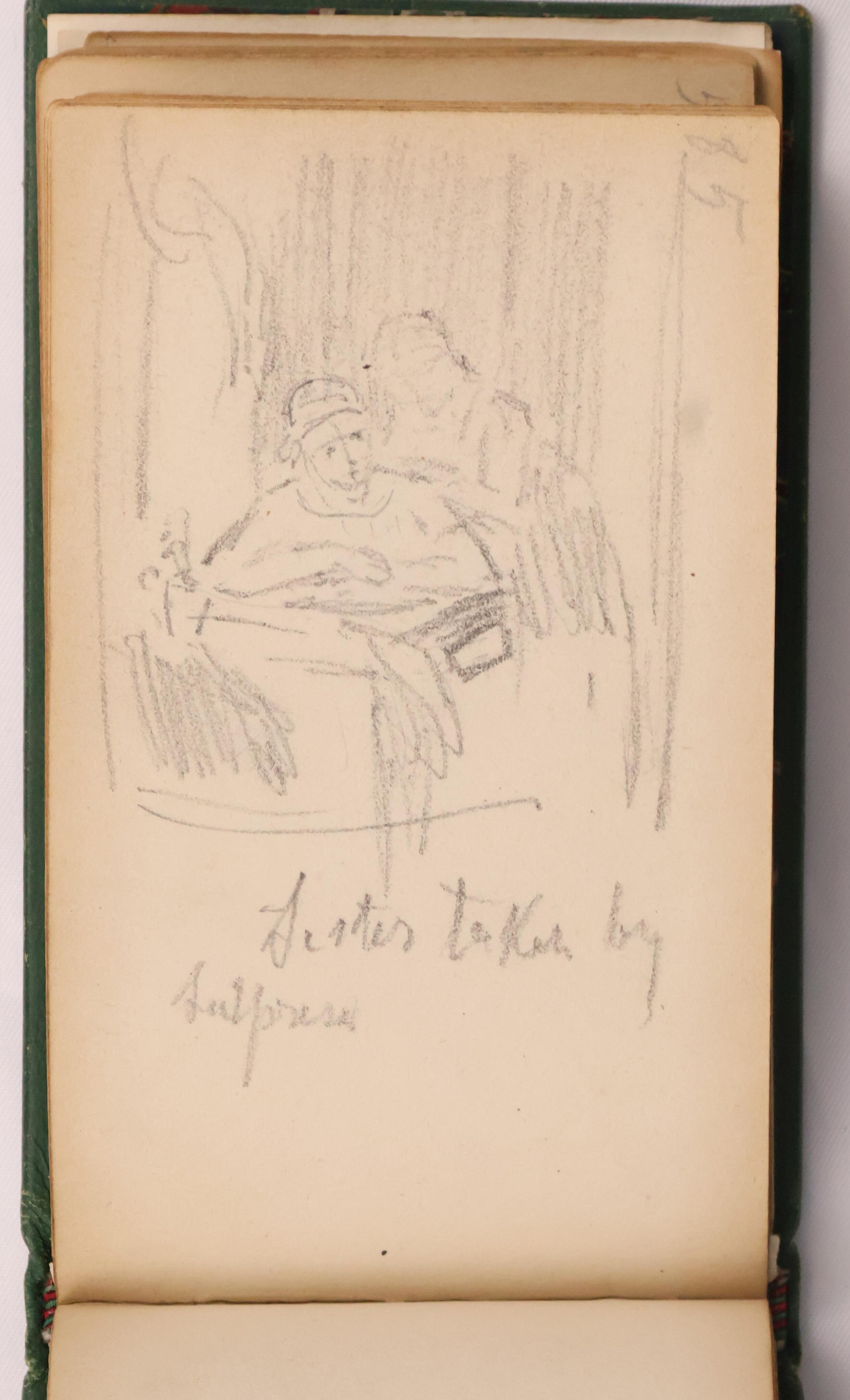
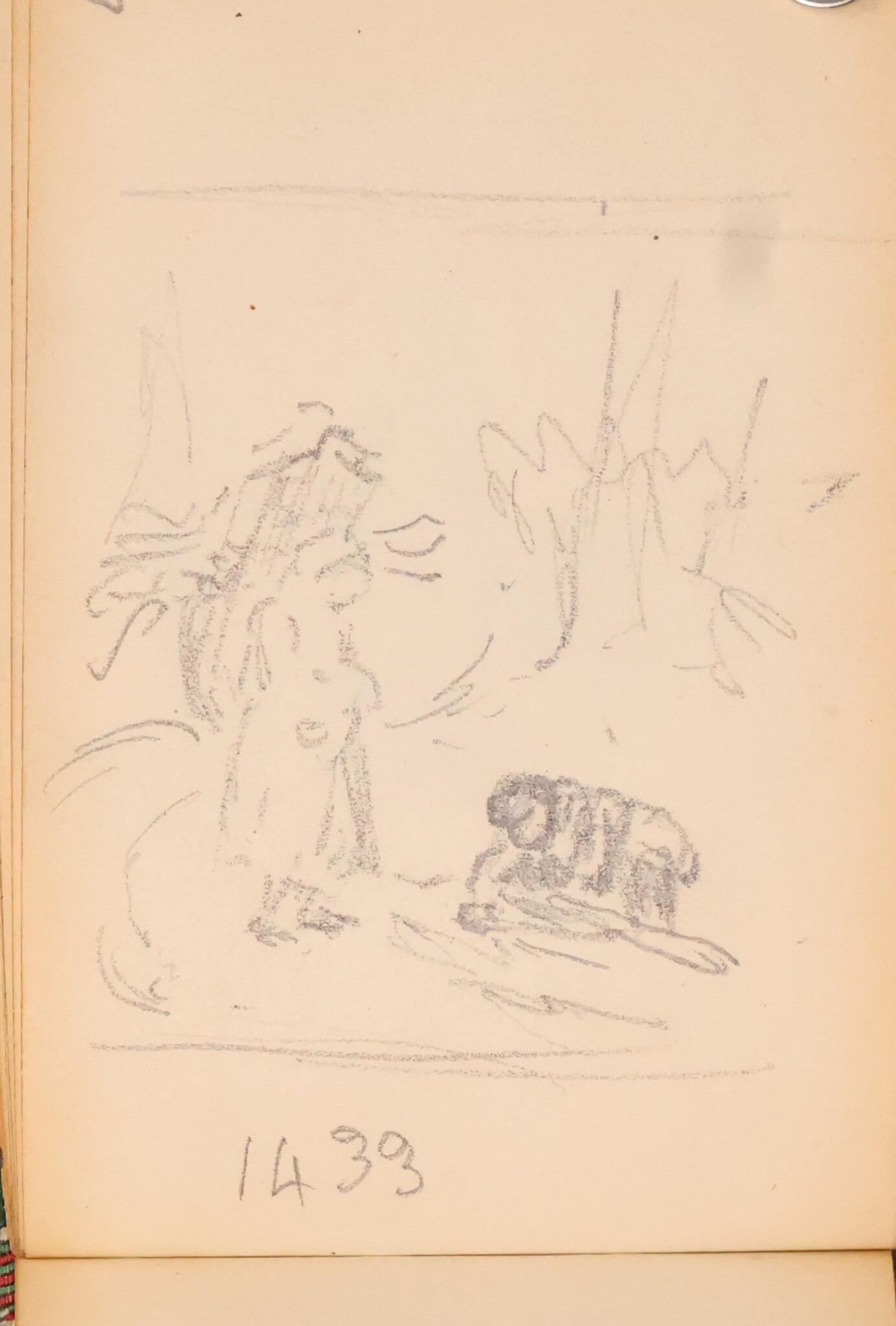
Palmer, Samuel (1805–1881). Pocket notebook, 1865-71. 50 leaves, about 7 x 12 cm. The notebook has been partially paginated in pencil by Palmer: [pp] 30-32; pp. 33-79 [excised leaf], pp 82-123; [pp] 124-147. In total, the volume contains over 73 pages of Palmer’s notes and sketches together with blanks irregularly scattered through the manuscript. There are 17 full page pencil sketches by Palmer, along with a number of small vignettes. Bound (by Carlos Peacock) in green sheepskin; marbled endpapers, spine titling in gilt.
One of three surviving notebooks of the eminent British artist Samuel Palmer, rich with quick sketches, notes on art, and personal memoranda. Dating from a key moment in the artist’s life, the volume hails from the collection of the eminent art historian Carlos Peacock, who describes it at length in the appendix to his monograph on the artist.
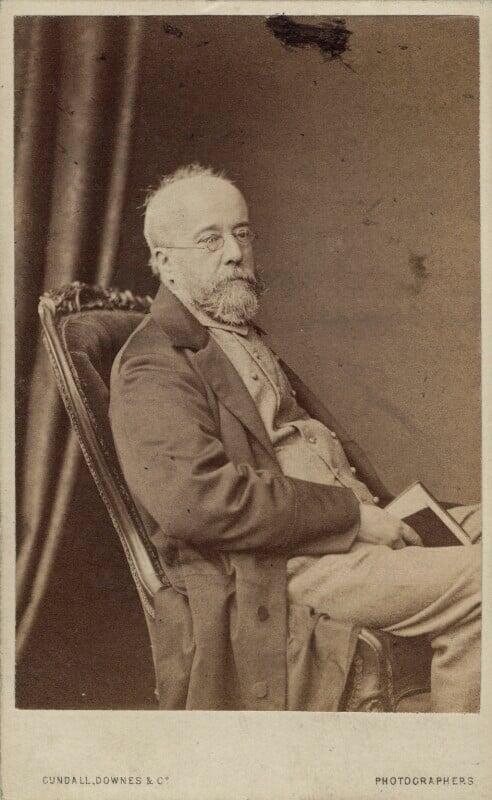
Samuel Palmer in a state of absorption, 1864. Photograph by Cundall, Downes & Co. National Portrait Gallery, London.
Palmer in the 1860s
The mid-1860s represented a significant period of change for Samuel Palmer. After early success with a series of ecstatic, visionary paintings in the 1820s and 1830s (his Shoreham period), he turned to more commercially appealing work in order to support his family and surmount a number of financial setbacks precipitated by his disreputable father and dissolute brother. He painted works intended to satisfy public tastes and took on private students that distracted him from his calling. He hit bottom in 1861 when his elder son died at age 19. "My whole life,” he cried, “has been little more than one continued punishment – flogging upon flogging.” Unable to work, he led an itinerant life for several years until finally settling in Furze Hill House at Redhill in Surrey, south of London. He began to visit the galleries of London again and take on students once more. He was just achieving a sort of stasis when suddenly an angel (investor) descended in the form of Leonard Rowe Valpy (1825–1884).
Valpy initiated a correspondence with Palmer in 1863 after buying a watercolor that he wanted altered. In June 1864, the alterations having been completed, Valpy asked whether the artist had a passion project. Palmer replied in the affirmative, telling him about his “meditation of a subject which, for twenty years, has affected my sympathies with sevenfold inwardness,” namely a series of works based on two poems of Milton, L’Allegro and Il Penseroso. The two negotiated terms, and by April 1865, they had an agreement in place. The commission renewed Palmer’s sense of purpose – and gave him the financial stability to pursue it. The painter wrote his patron that he was spending “time without limit or measure” on his art, riding a wave of inspiration that would carry him through his final years. The result was a series of large, luminous watercolors that are regarded as his late masterworks.
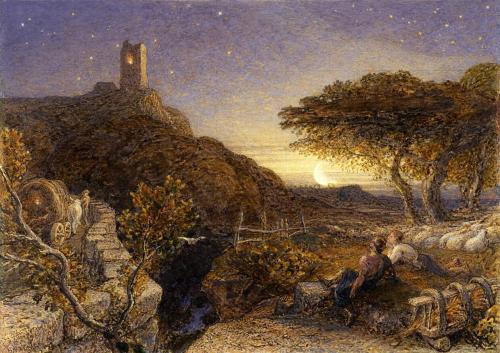
Samuel Palmer, Lonely Tower. The Huntington Library, Art Museum, and Botanical Gardens. Gilbert Davis Collection.
Palmer’s Pocket Praxis
The present sketchbook dates from just the moment when Palmer was beginning to work on his Milton series. Palmer’s son A. H. (Alfred Herbert) Palmer (1853–1932) recalled that the artist had a lifelong habit of keeping notebooks.
He made himself little vellum-covered memorandum-books just the size of his waistcoat pocket, and filled them with elaborately written notes, ranging from the solution of an algebraical problem, to a quotation from some favourite poet or divine. If the daily walk with his son proved wearisome or unattractive, out came the little book to shorten the homeward journey.
A. H. Palmer’s memoir is replete with references to his father’s pocket notebooks and quotations from them. Palmer’s notebooks could take the form of a personal journal – a series from his Shoreham years, now lost, “forms a kind of skeleton autobiography.” They were also vital to his artistic process. “A scratch with a pencil is the first thing – writing what there is no time to draw.” he noted in a letter of 1843. In 1862, Palmer urged one of his students to adopt his regular practice:
The best artist, in some two points of his work, will give the extremes of the definite and the indefinite if he can, and the lesser intensities of both elsewhere. When, where, and how is a life’s study, to be helped by carrying in the pocket something like [Joshua] Reynolds’s blot book. “The indefinite half is the more difficult of the two,” as Millais said to me when we were looking at the Turner Gallery. I never looked at the slight sediment at the bottom of a coffee cup without getting a lesson. When I think of a pocket sketch-book of soft printer’s paper (plate-paper), a piece of charcoal, or very soft chalk, and a finger to blend it about, I think of improvement – mastery. …
You doubt yourself whether hasty sketches are of any use for improving yourself. Quite agreeing with you as to what are usually called hasty sketches, allow me to suggest that the art of completed work is twofold. First the art of imitating what is before us with all its detail (I am speaking of pictures done out of doors), which imitation represents nature asleep; and secondly the knowledge of the phenomena. These bring it to life. The latter can be treasured up only by continual observation, and a little memorandum-book and pencil carried always in the pocket. Often the sketches must be rapid, as the effect is momentary. … A little figure study always going on is of golden use to the painter of landscape or architecture, and gives an increased value, artistic and pecuniary.
Incredibly, especially given the great care he gave to curating his father’s memory, A. H. Palmer destroyed most of Palmer’s sketchbooks and much else besides before emigrating to Canada in 1910. “Sooner than that multitude of slight sketches, blots, designs, etc., which my father valued so much … should be scattered to the winds, I burnt them,” he explained.
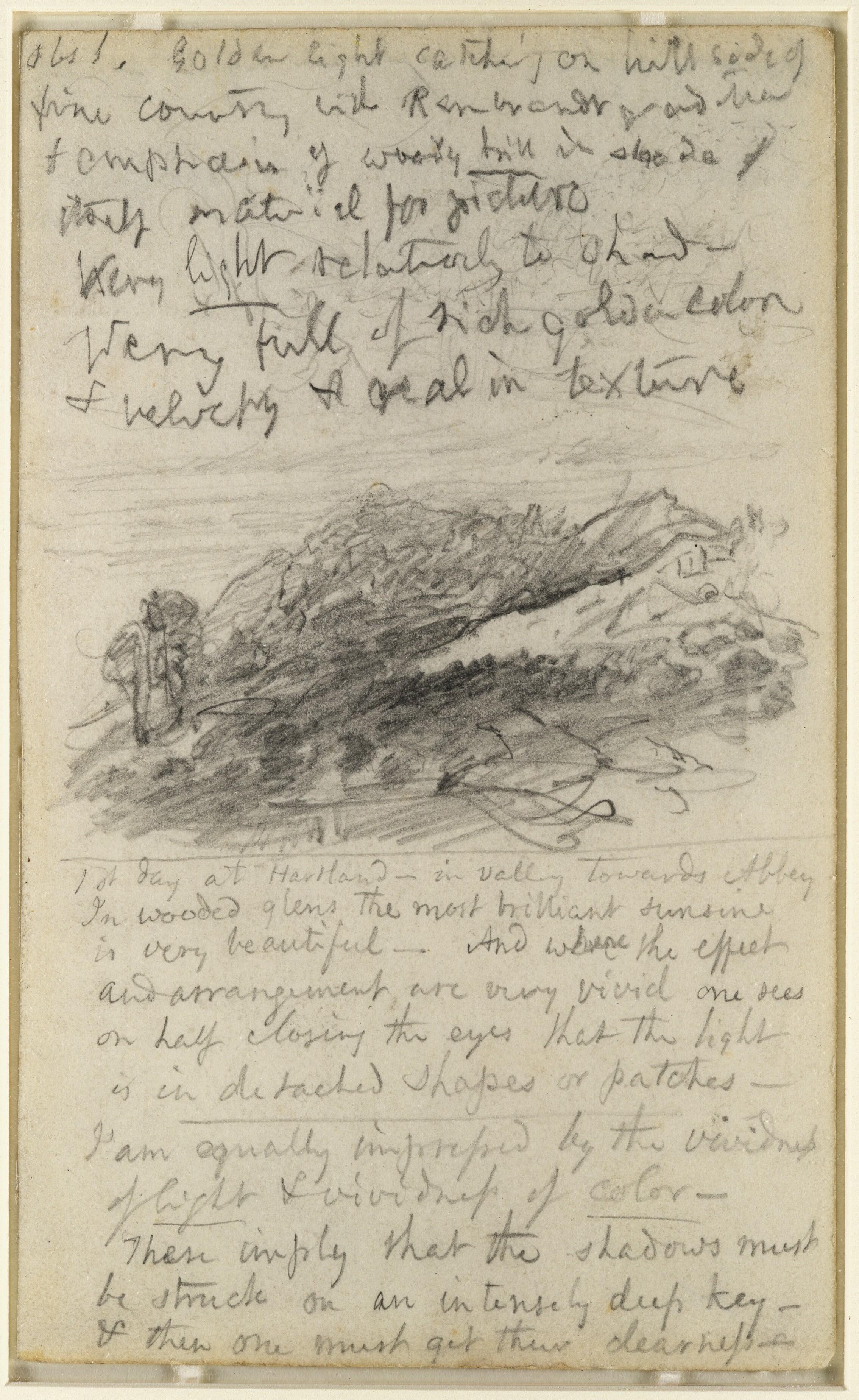
Samuel Palmer, Page from a sketchbook, ca. 1848. Metropolitan Museum of Art.
Fortunately, a few of Palmer’s sketches escaped the conflagration. Lister’s Catalogue raisonné lists stray leaves excised from various sketchbooks (Lister 44, 59, 446, 460, 525, 532, 534, 558-60, 664, 680, etc.), and there are two complete examples, one dating from 1819 the other from 1824, both now in the British Museum. The present offering is only the third complete notebook of Palmer's that is known to survive. It is not recorded in Lister, though certainly he knew about it; perhaps he considered it as a documentary source rather than an artwork.
Palmer’s 1865-71 Notebook
Carlos Peacock offers a detailed description of the present notebook as a six-page appendix to his 1968 monograph on the artist. Peacock dated the notebook to 1865-66 based on specific entries. But some notes refer to paintings that were not publicly exhibited until 1871, suggesting that Palmer used this volume intermittently over the course of several years. In its balance of text and image, the notebook greatly resembles a leaf from another sketchbook now at the Metropolitan Museum of Art (Lister 680). There are notes regarding finances, reflections on art, notes on paint, preparatory sketches, and even the odd ballad. The writing is in both pen and graphite, the latter rather smudged at times. Peacock described the book as being unbound so he must have had it bound himself after 1968.
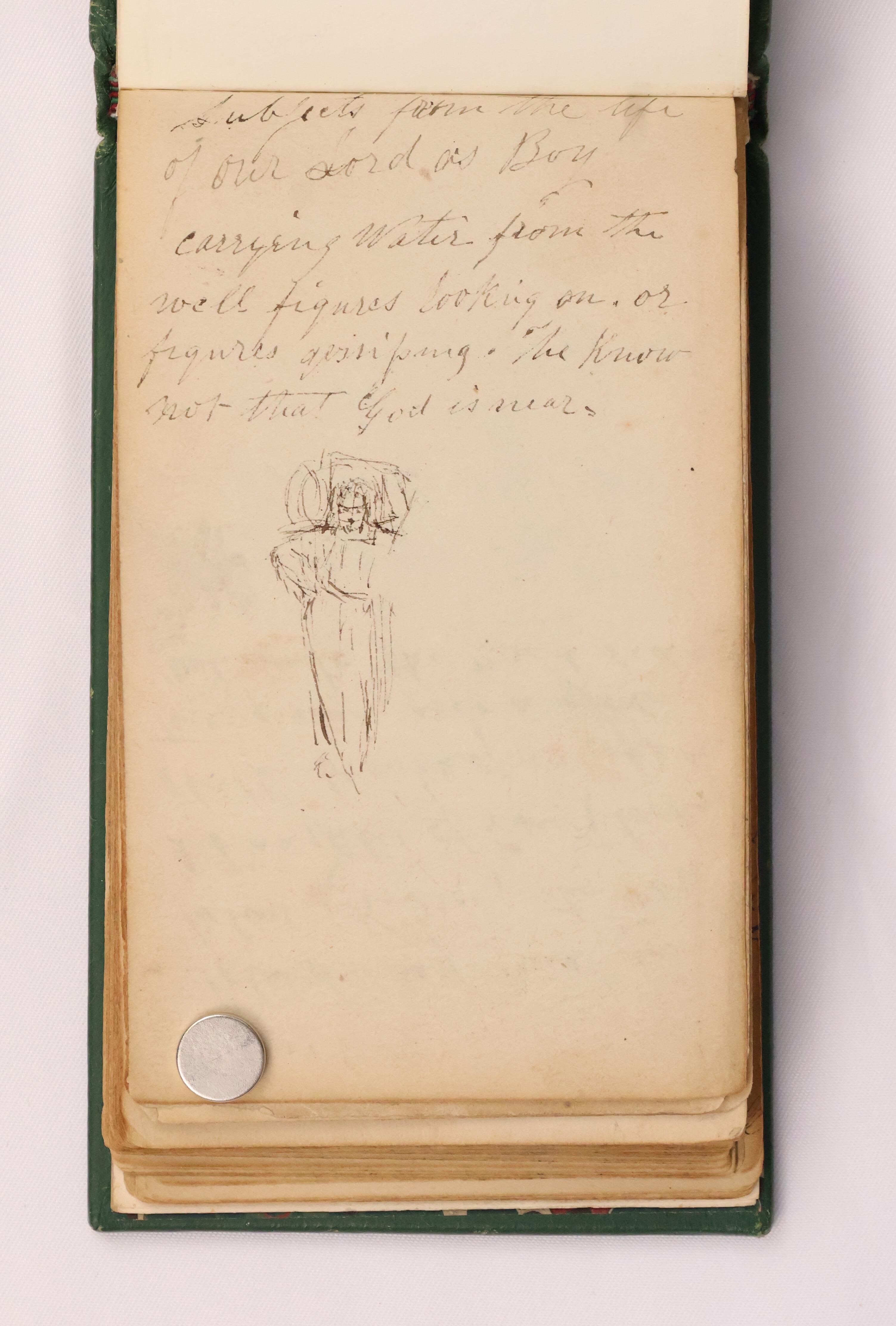
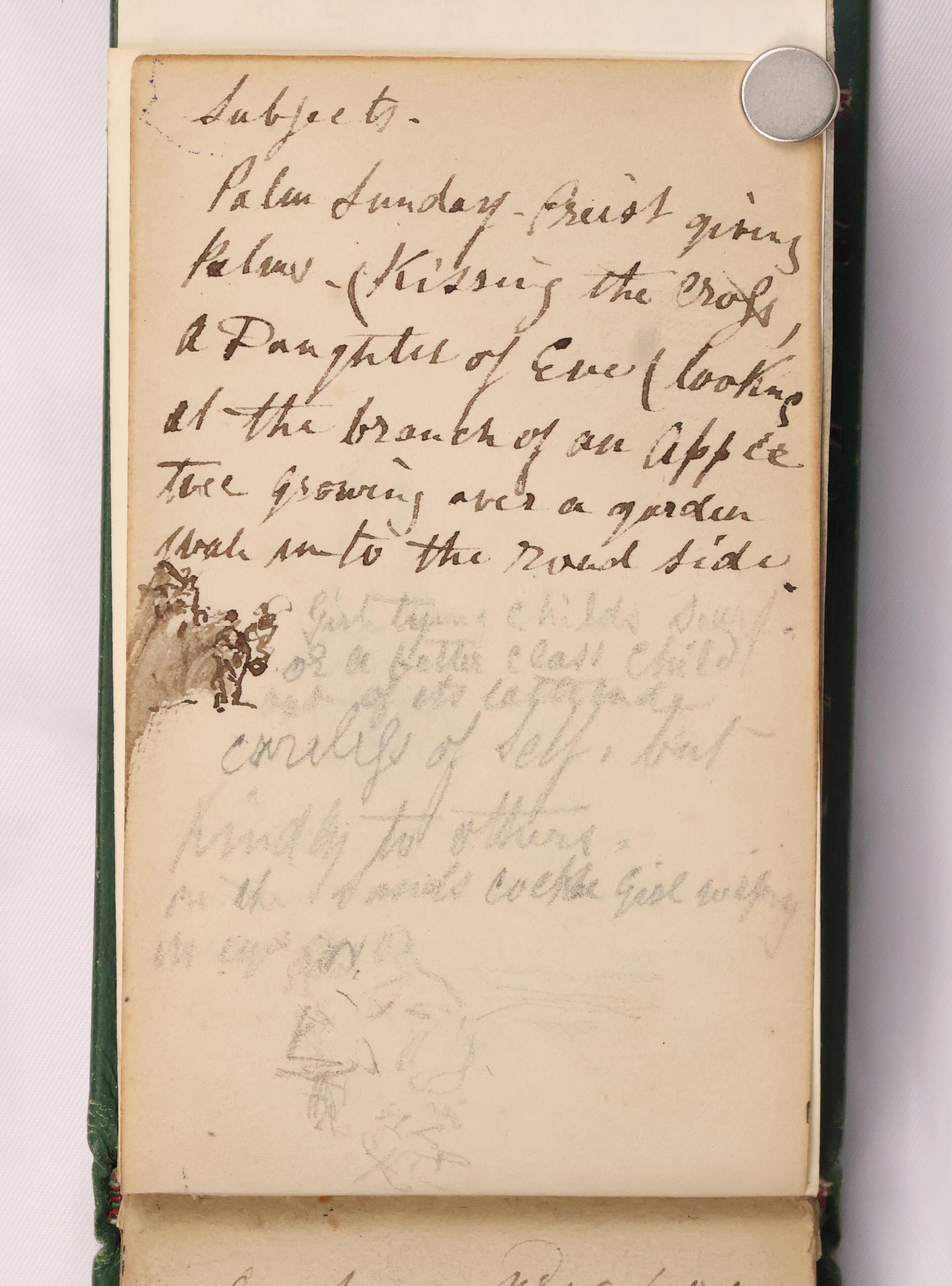
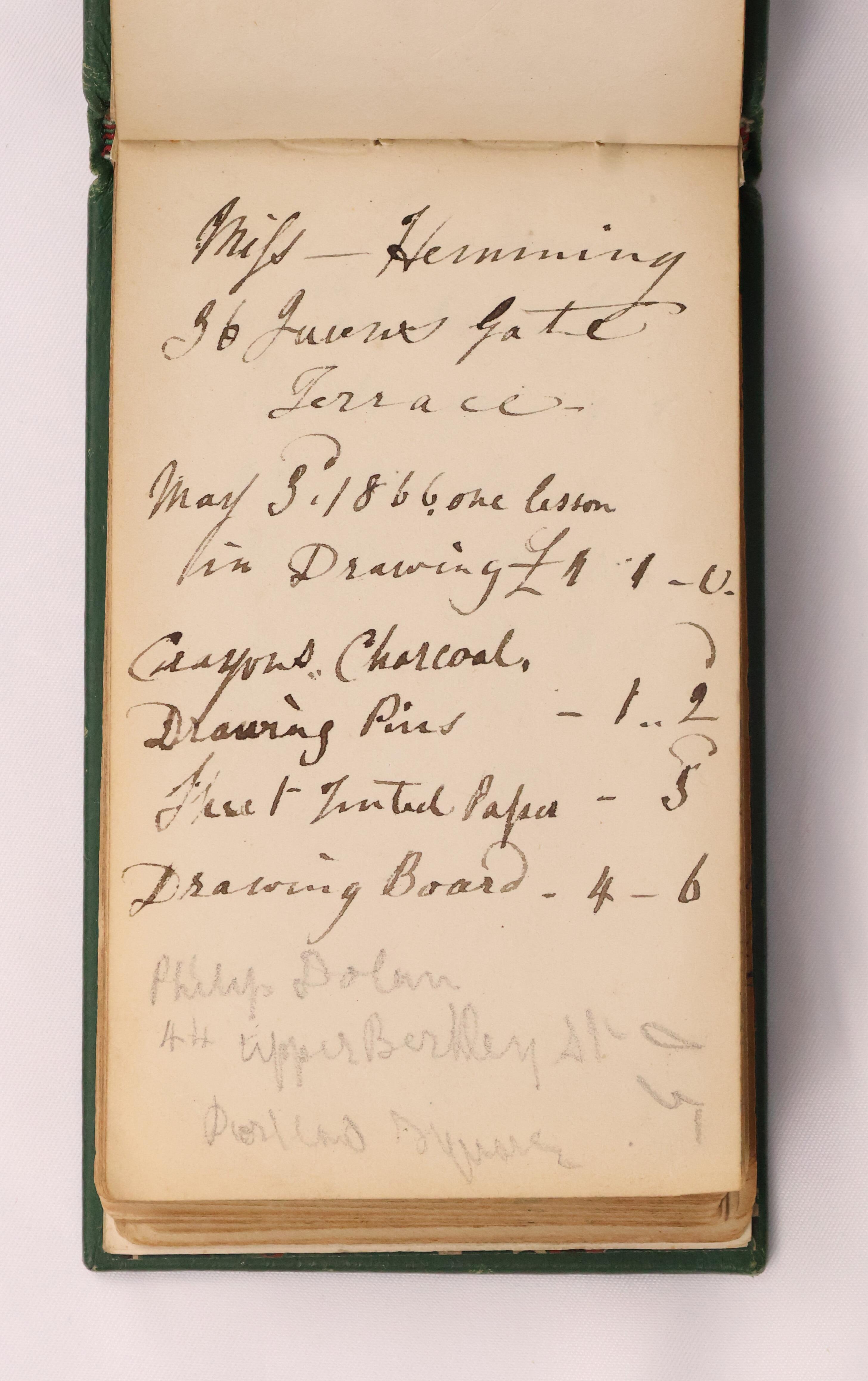
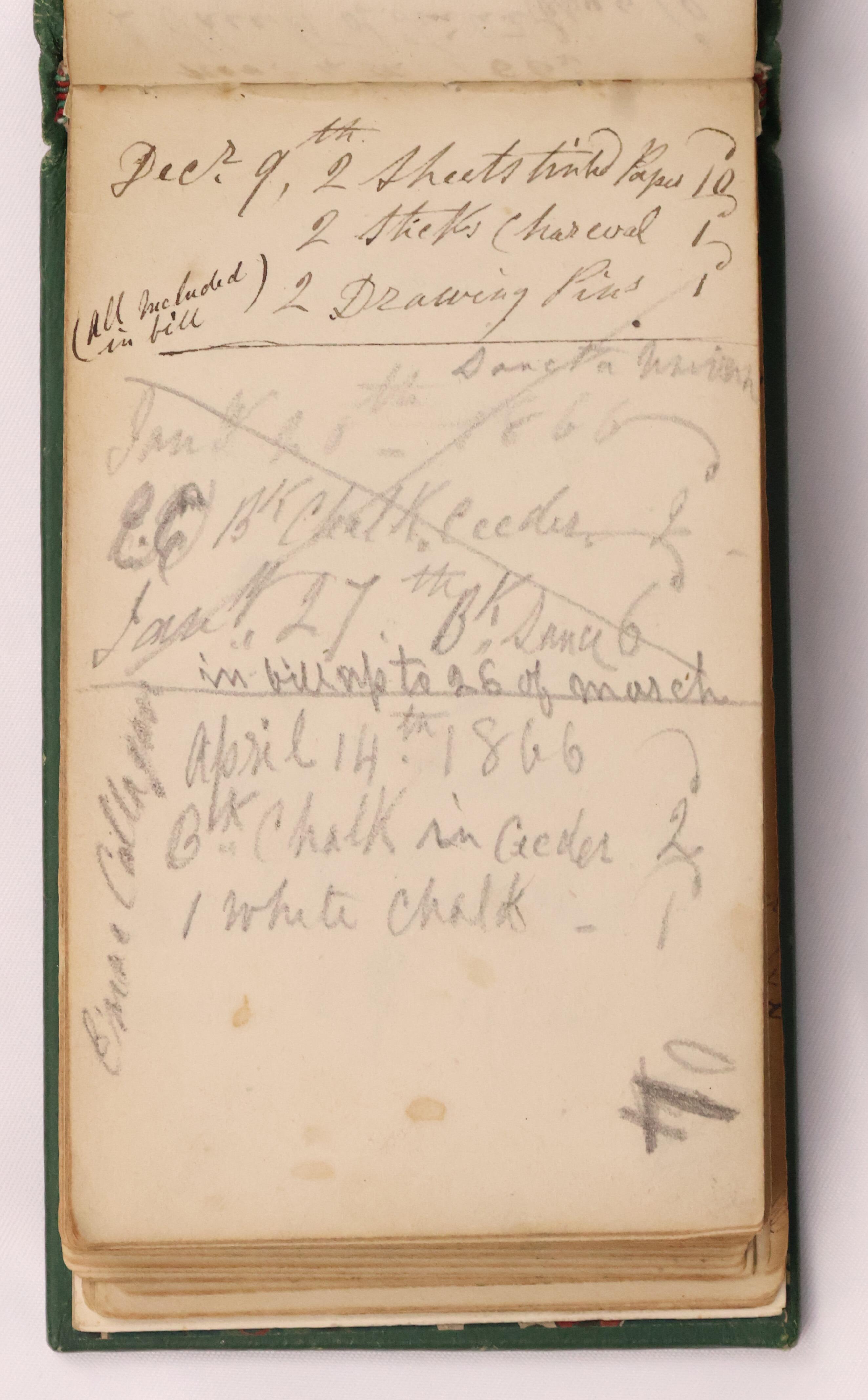
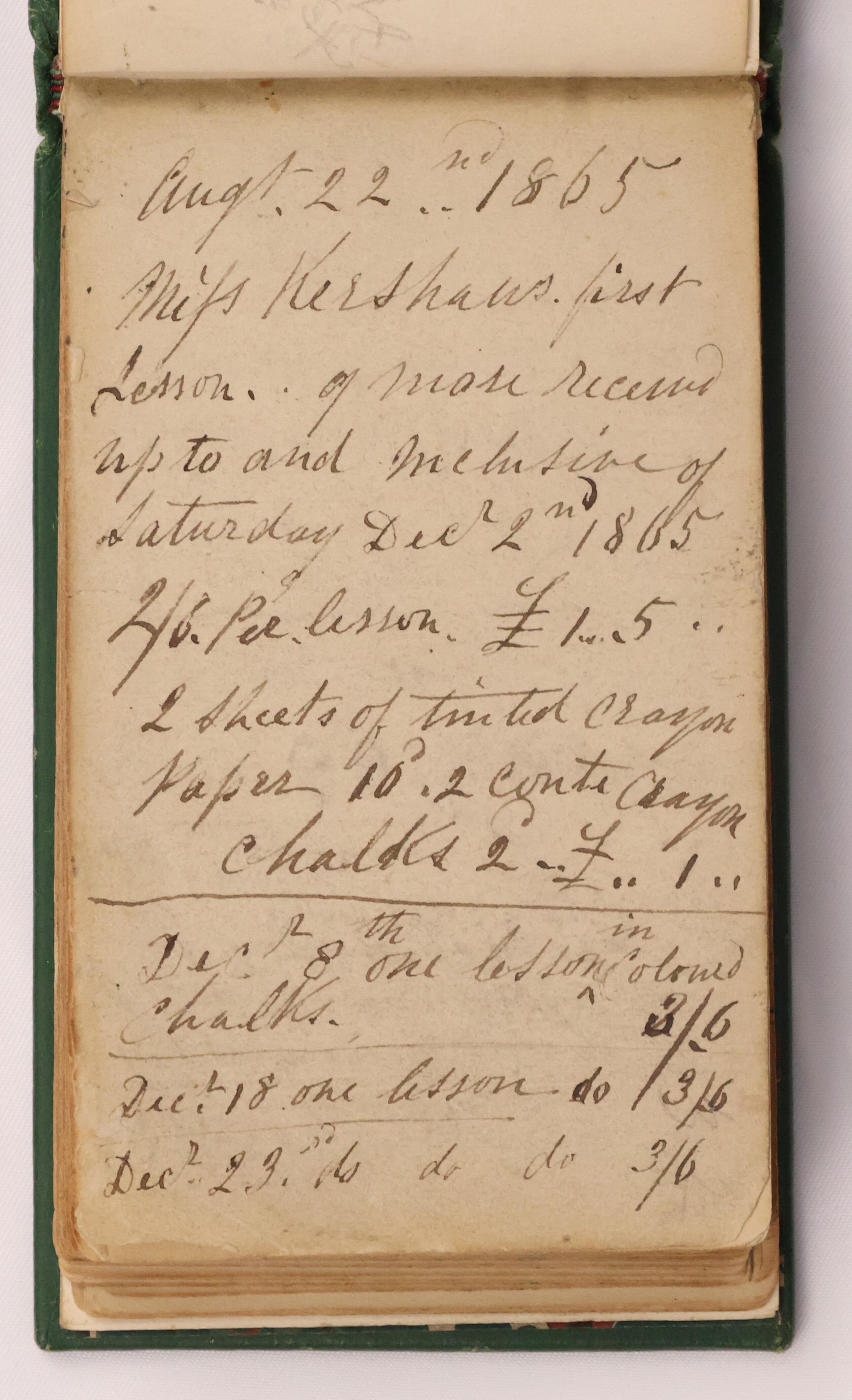
This volume, initiated at the same time that Palmer was concluding negotiations with Valpy, shows the artist in financial transition. There are signs of the life that he was leaving behind: his work as an art tutor, for example. A few pages record payments and expenses between August 1865 and April 1866 for one of his students, a Miss Kershaw. But there are also extensive notes for paintings that do not seem to correspond closely with those that survived. As with his earlier notebooks, many of his sketches centered on religious subjects distant from the pastoral scenes that constitute much of his catalogue. One sketch includes the notation, “Subjects from the life of Our Lord as Boy: carrying Water from the well, figures looking on or figures gossiping. the[y] knowing not that God is near.” Another idea: “A Daughter of Eve (looking at the branch of an Apple tree growing over a garden into the road side.” Did Palmer decline to pursue works he feared were not commercially viable, or did his son destroy paintings that evoked Palmer’s intense personal spirituality?
There are also detailed notes for a portrait, possibly of the wife of David Masson (1822–1907), the author of a biography of Milton:
Mrs Masson. Complexion about Mrs G.[Anne Gilcrist, 1828–1885?], a little warming rose in cheeks. Hair has been nearly black. a few grey hairs intermixed, very few. The flesh is seen for a little way up. [Here a vignette of hairline and outline of a nose] A little warmish colour in forehead. Eyebrows still darkish not -- quite so dark as hair. Eyes darkish brown but warm -- Brooch a little diamond in centre mostly dead gold but a little bit of burnish at edges…
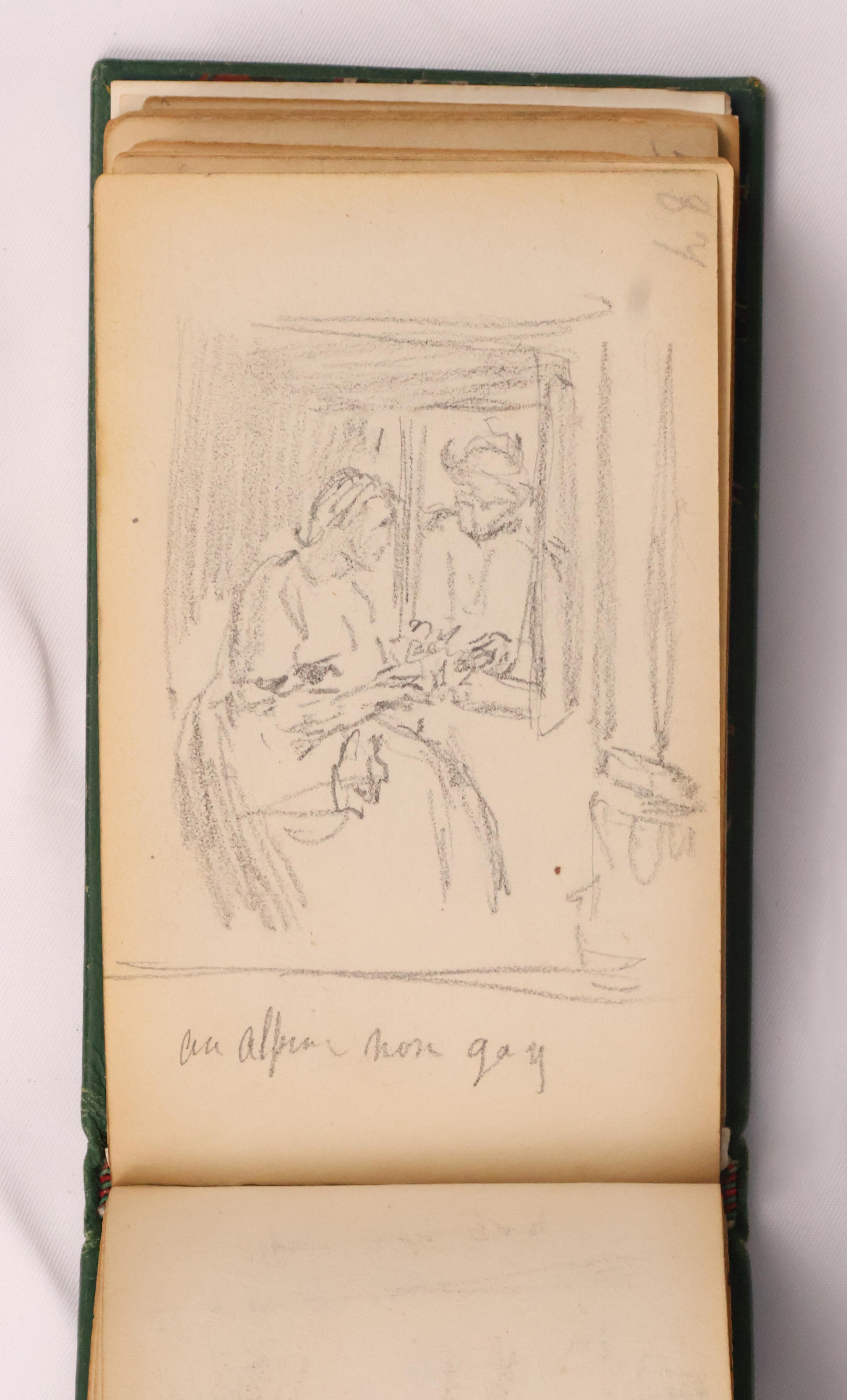
In addition to Palmer's descriptions of works that were abandoned or destroyed (or not yet identified), there are over a dozen full-page sketches and many small vignettes. Further study is required to determine which of these sketches represent aides-memoires for works the artist admired and which the working out of his own ideas. There is internal evidence to suggest that Palmer had this notebook in hand when he visited the London International Exhibition of 1871, where two of his watercolors for Il Penseroso were unveiled. We suspect that the artworks that Palmer referenced here only by number may be indexed to exhibition catalogues.
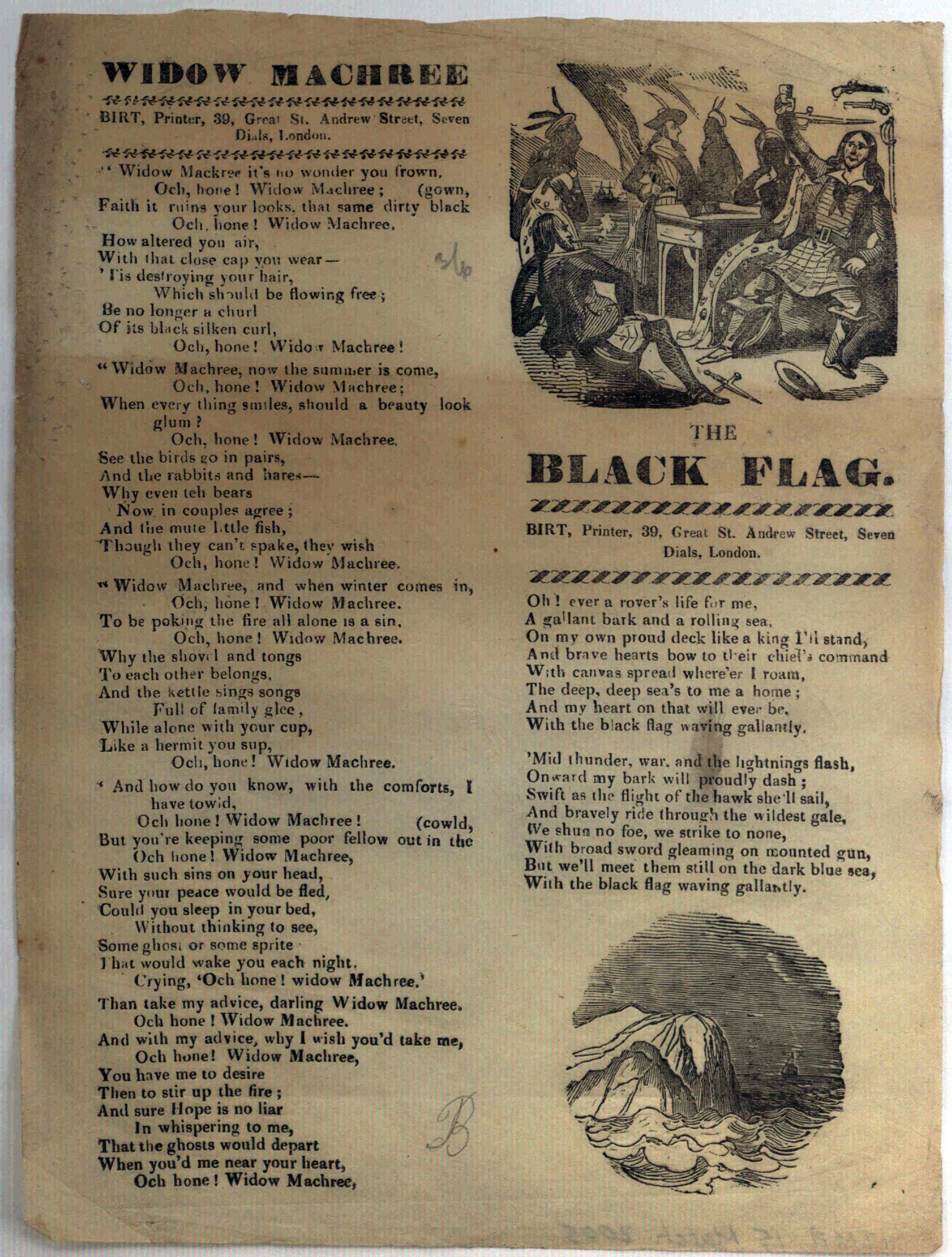
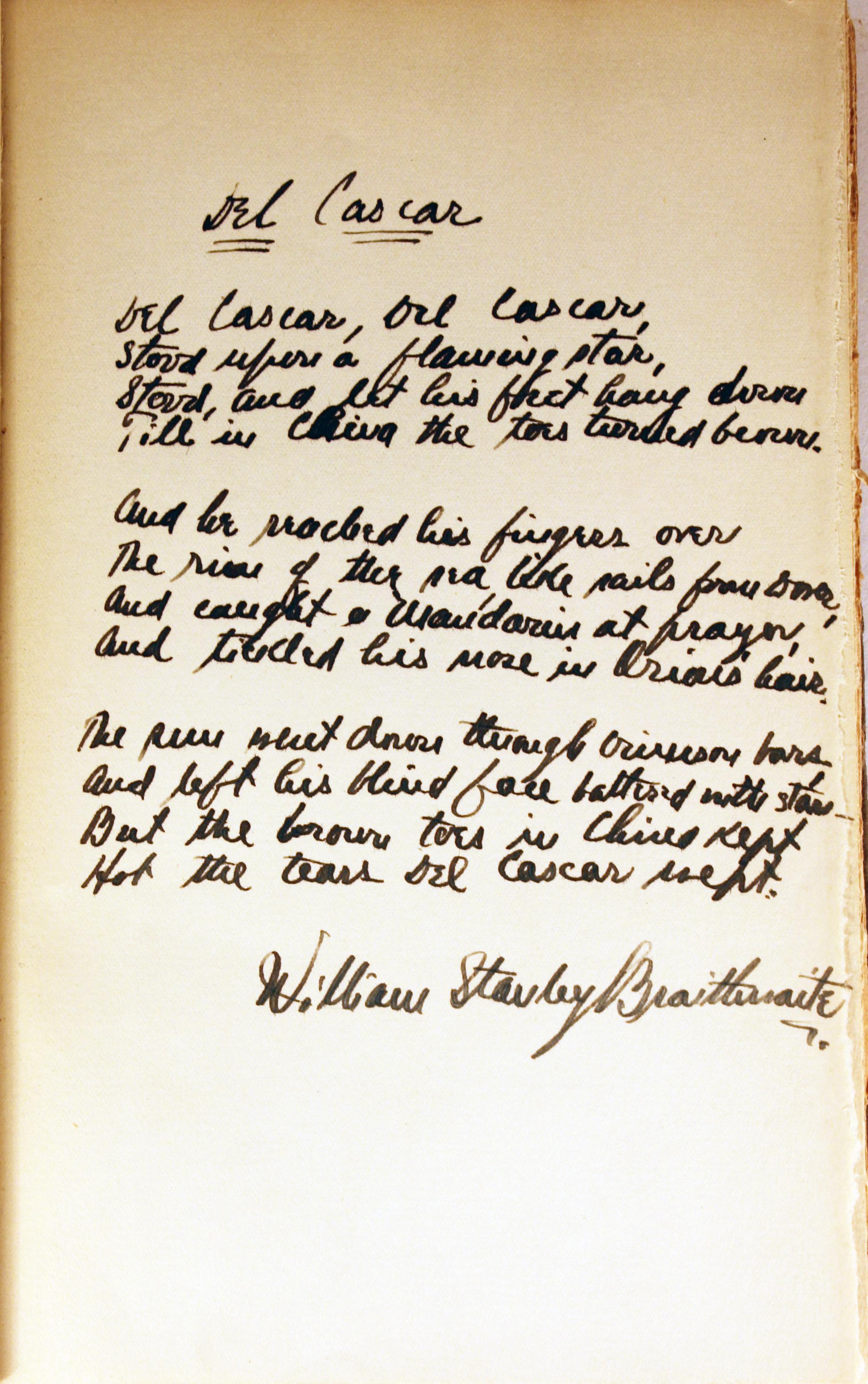
This song sheet (circa 1824-1841) may have been Palmer’s source for a chantey copied in the notebook.
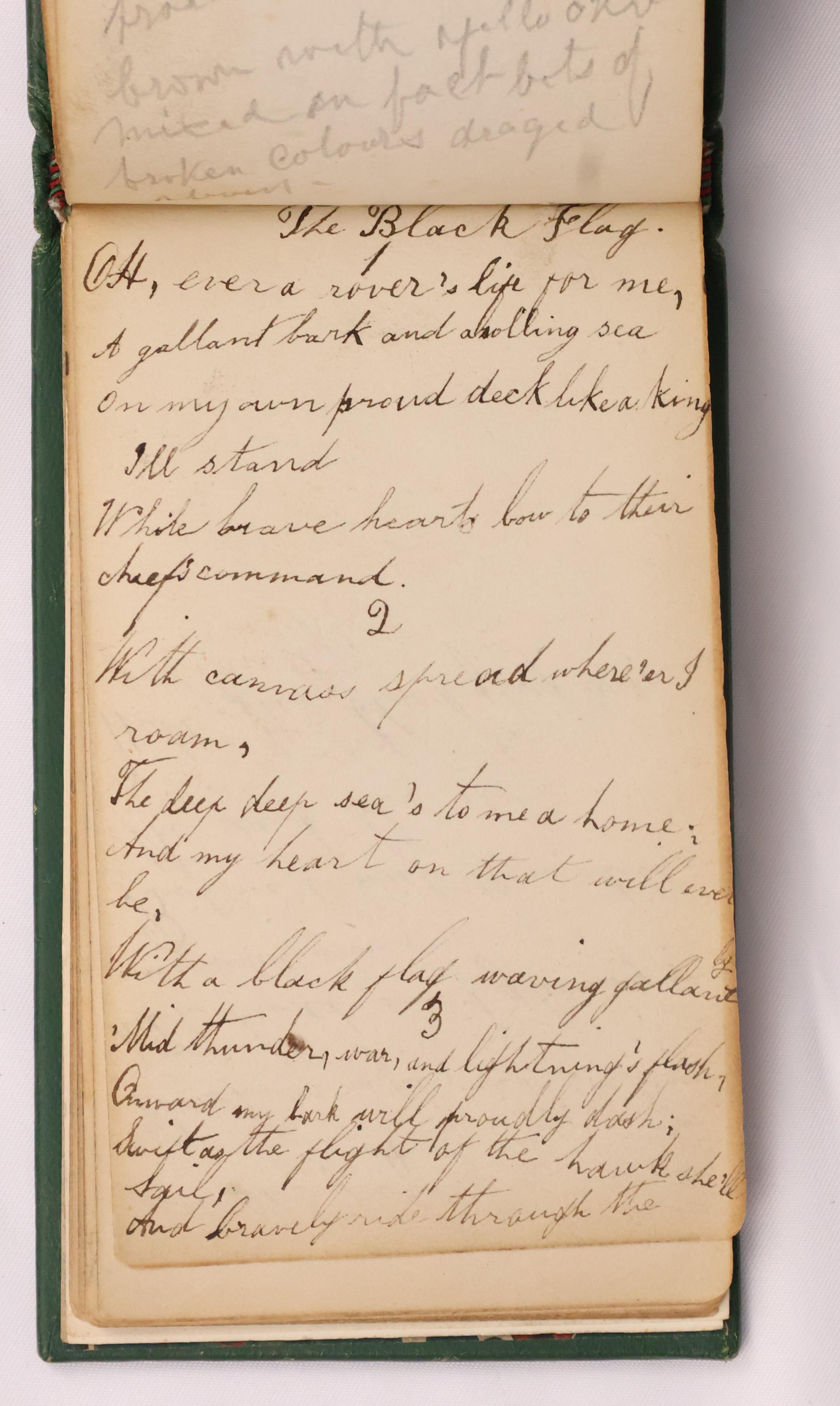
There are also personal notes, some of which are rather cryptic – even in his familiar correspondence Palmer tended toward Blakean diction. “The Park Catford Bridge, Lewisham Ken[t] belongs to the blue dog,” reads one. Other jottings are more prosaic: train schedules, the name of a London doctor, notes on a visit to an exhibition held by the gallerist Ernest Gombart (1814–1902), and the like. There is also a transcription of a spirited pirate ballad, The Black Flag. Did he copy this for his son’s amusement or was he contemplating another collaborative project like A book of favourite modern ballads, to which he had contributed in 1860?
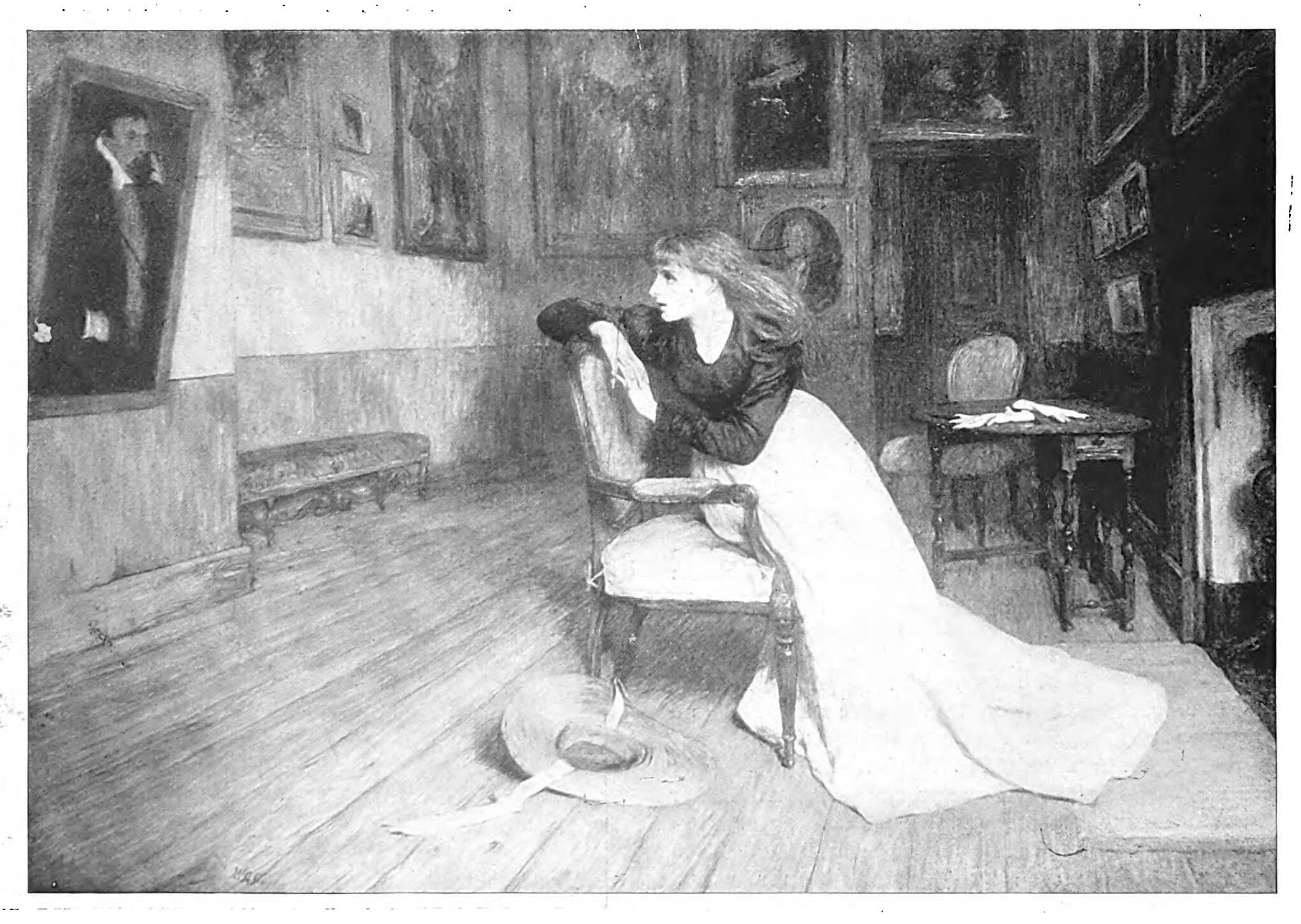
William Q. Orchardson, A Hundred Years Ago (1871): a painting that attracted Palmer's sustained attention
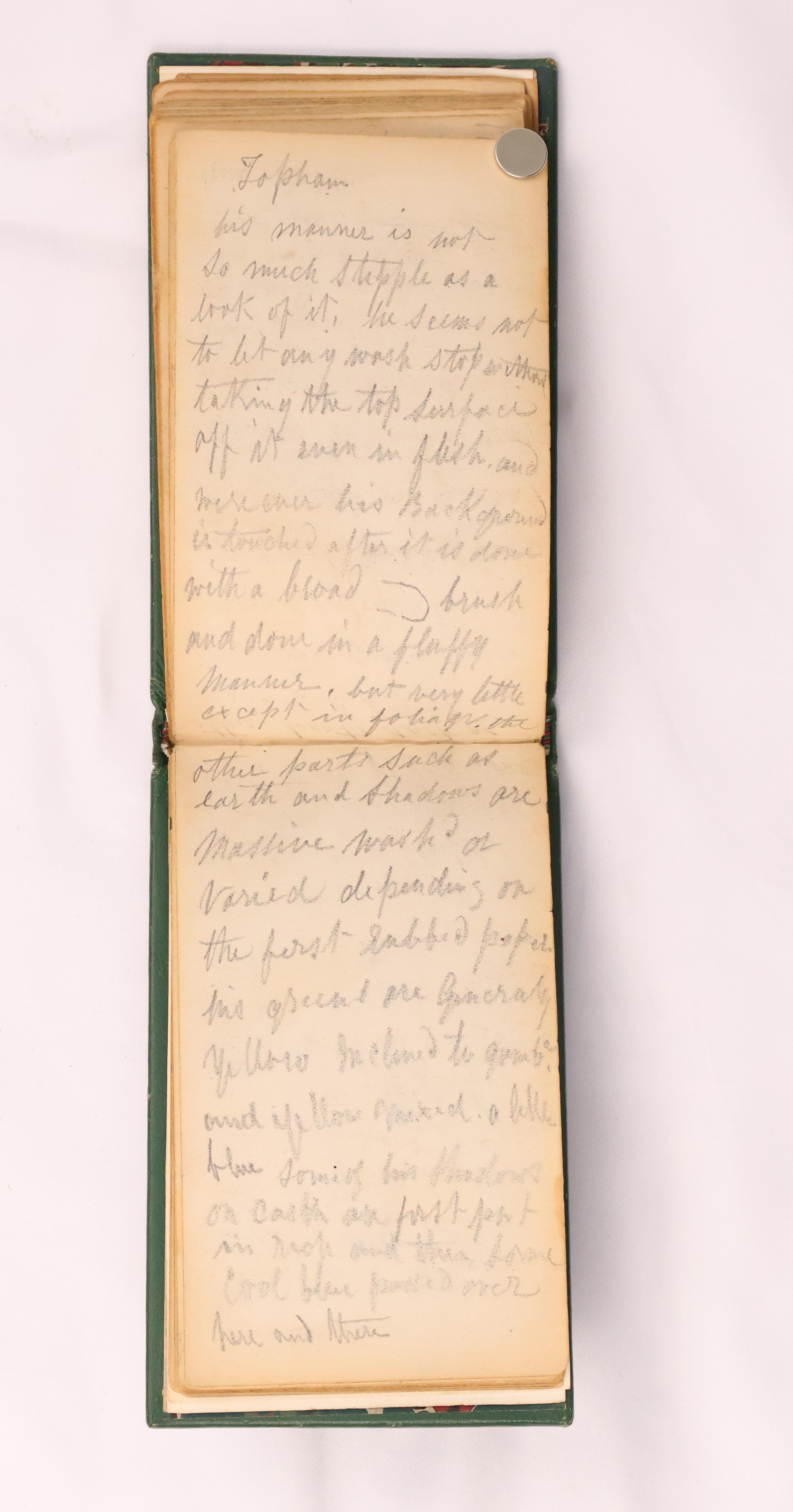
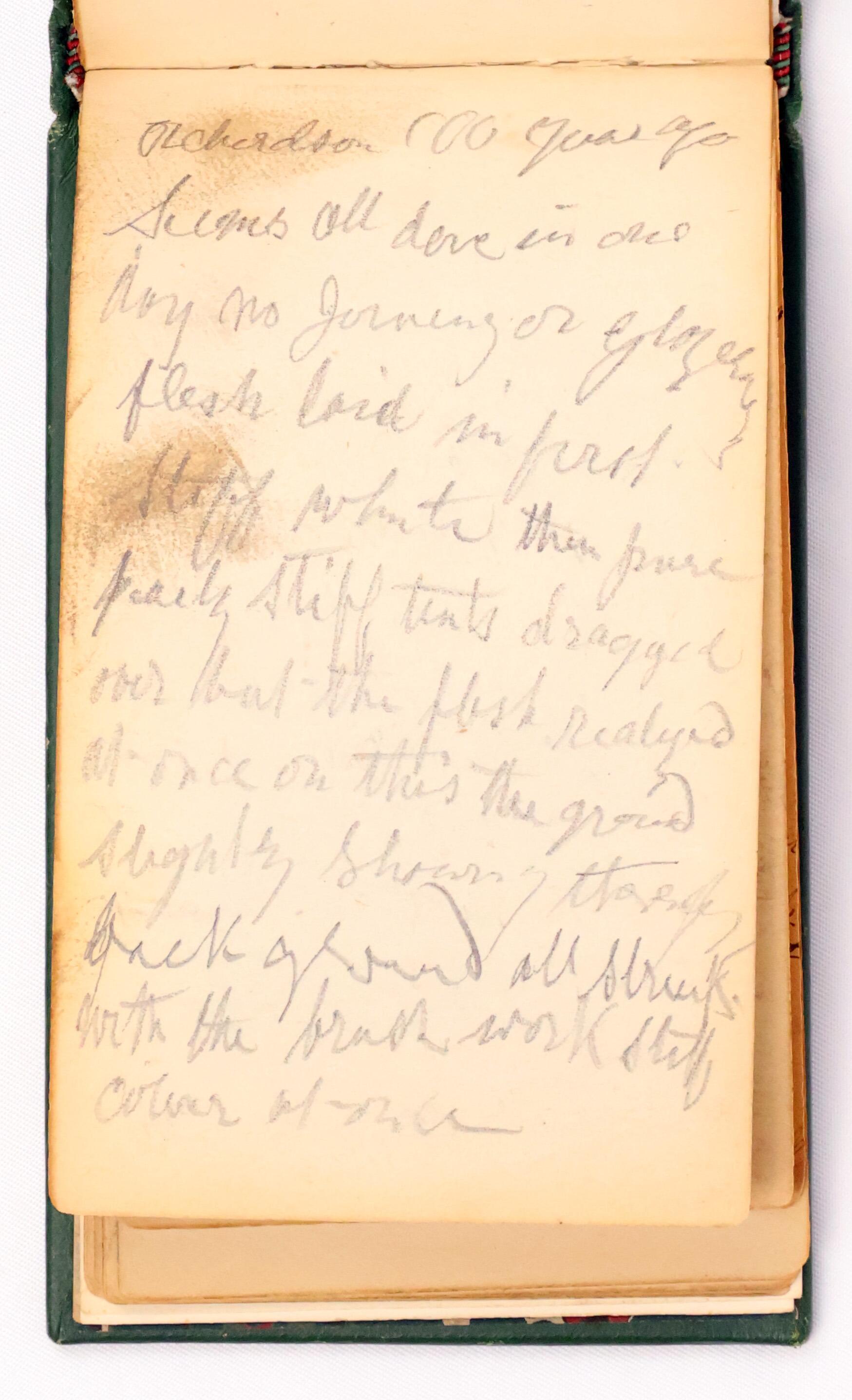
Perhaps most instructively, Palmer also used the notebook to record long and detailed analyses of paintings, chiefly by his contemporaries, and if the artists he writes about are not of the first renown – they include Jonathan Richardson the Younger (1694–1771), William Q. Orchardson (1832–1910), Frances William Topham (1808–1877), William Shakespeare Burton (1824–1916), Miles Birket Foster (1825–1899), and Frederic James Shields (1833–1911) – his observations, essays in petto, reveal his minute eye for technique and color. Here is his description of Orchardson’s A Hundred Years Ago, exhibited at the Royal Academy in 1871:
Seems all done in one day, no joining or glazing [?]. Flesh laid in first stiff white, then pure pearly, stiff tints dragged over, but the flesh realized at once on this: the ground slightly showing, thereby background all streaks. With the brushwork stiff colour at once. A wee bit fractious, the background is stiffly painted. It may have been laid on first then tinted slightly. Some parts seem to have been juicely worked and lights glazed over some parts which were laid a little darker. The head of hair tells dark against the wall. The lights of flesh is [sic] perhaps a little lighter than wall. Lakey tints for flesh, bones through like bituminish [?] shadow. Flesh peony in parts — tints of this kind seem passed over half-tones of flesh. Cool grey shadows on wall a good deal removed from white. Cologne earth and Brn. Pink might make it. The earthen floor is a sweet pearly ashy colour. Cologne earth and Vandyke Brn. might make it. [sketch, with annotations on color] Woman’s dress modification of Cologne earth. Van Brn.. Little stripes [Sketch] lighter and lakey touches. Broad stripes of bitumen brown with yellow okr. Mixed — in fact bits of broken colour drag[g]ed about.’
It is at such moments of close contemplation that the artist’s visual praxis is revealed: Samuel Palmer’s 1865-71 notebook served him as a memo pad, a commonplace book, a source-book, a preparatory sketchbook, and a whetstone for sharpening his critical tools. It survives today as a vital document offering an intimate glimpse into the systematic mind of this visionary artist.
Provenance
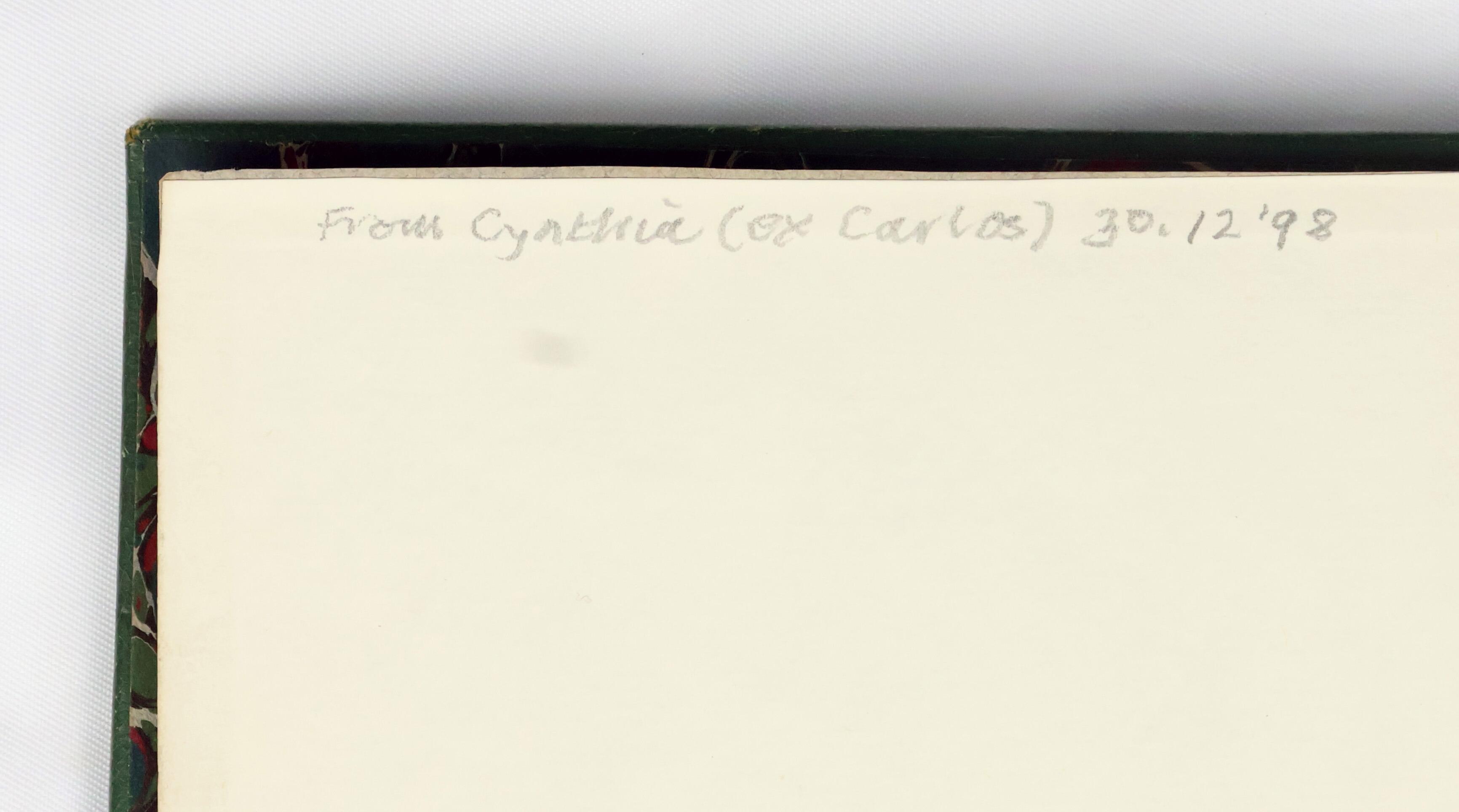
George Richmond (1809–1896), and by descent through the family [?]. Acquired by art historian Carlos Peacock (1909–1988) before 1968. Presented by “Cynthia” to the art collector Ernest Pearce (1930-2012), with the inscription “From Cynthia (ex Carlos) 30.12 ’98.” Sold by Pearce’s descendants through Ewbanks, sale of 23 June 2022, lot 2035, and thence to the trade.
Literature
Carlos Peacock. “Appendix: a Palmer notebook,” in Samuel Palmer: Shoreham and after, pp. 139-44.
Selected References
Butlin, Martin. Samuel Palmer’s sketch-book 1824. London: Trianon Press, 1962; reprinted, Thames & Hudson.
Campbell-Johnston, Rachel. Mysterious wisdom: the life and work of Samuel Palmer. London: Bloomsbury, 2011
[Cundall, Joseph, ed.] A book of favourite modern ballads, Illustrated with fifty engravings, from drawings by the first artists. London: W. Kent, 1860.
Lister, Raymond, ed. Catalogue raisonné of the works of Samuel Palmer. Cambridge: Cambridge University Press, 1988
-----. The letters of Samuel Palmer, 2 vols. Oxford: Clarendon Press, 1974
Little, James Stanley. The life & work of William Q. Orchardson, Royal Academician. The Art Annual for 1897. London: J. S. Virtue, Ltd, 1897.
Official catalogue, Fine Arts Department, London International Exhibition of 1871.London: J. M. Johnson & Sons, London, 1871
Palmer, A. H. The life and letters of Samuel Palmer, painter and etcher. London: Selly & Co., 1892
Palmer, Samuel. The parting light: selected writings, ed. Mark Abley. Manchester: Carcanet, 1985
Peacock, Carlos. Samuel Palmer: Shoreham and after. London: John Baker, 1968
Postle, Martin. "This very unstudent-like student": Palmer and the education of the artist," in Samuel Shaw-Miller and Sam Stiles, ed., Samuel Palmer Revisited. London: Routledge, 2010