

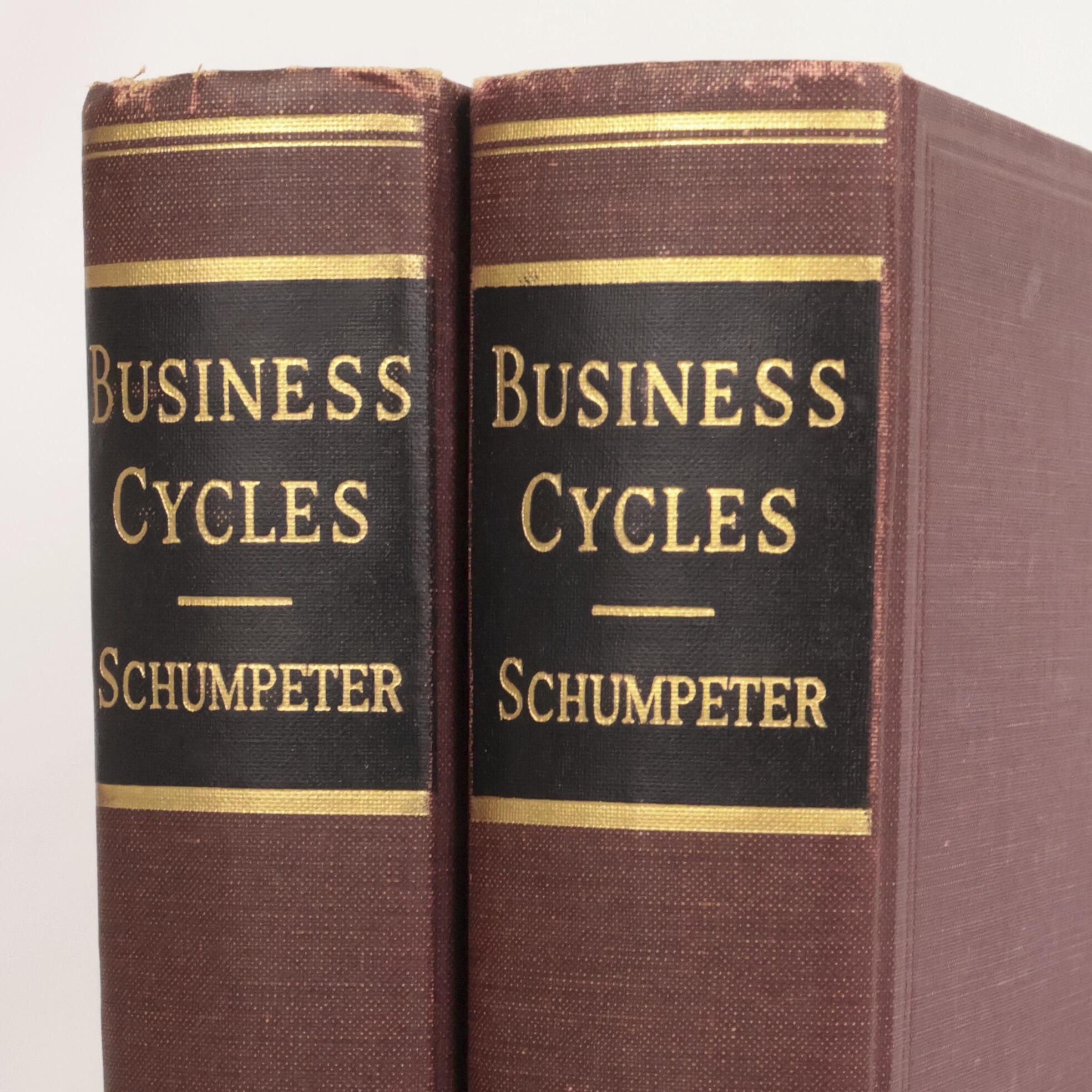


Schumpeter on Business Cycles : a significant association copy
Schumpeter, Joseph A. (1883–1950). Business Cycles: a Theoretical, Historical, and Statistical Analysis of the Capitalist Process. London and New York: McGraw-Hill Book Company, Inc, 1939. First editions. Two volumes. 24 cm; xvi, 448; x, [449]-1095, [1] pp. Original burgundy cloth, spines ruled and lettered gilt. In very good condition. Housed in a custom clamshell case.
From the library of Richard V. Clemence (1910–1982), with his ownership stamps and occasional notes.
A superb association copy of this landmark work in economic theory. Richard Clemence was both one of Schumpeter’s first graduate students at Harvard and one of his last. A native of Rhode Island, Clemence had attended Brown University, earning a master’s degree in economics before matriculating at Harvard in 1938. Schumpeter himself arrived at Harvard only a few years earlier, in 1932. Clemence’s graduate studies at Harvard were interrupted by military service, but he finally received his doctorate in 1948 with a dissertation on the theory of economic maturity. His readers included Joseph Schumpeter, who announced his retirement the following year.
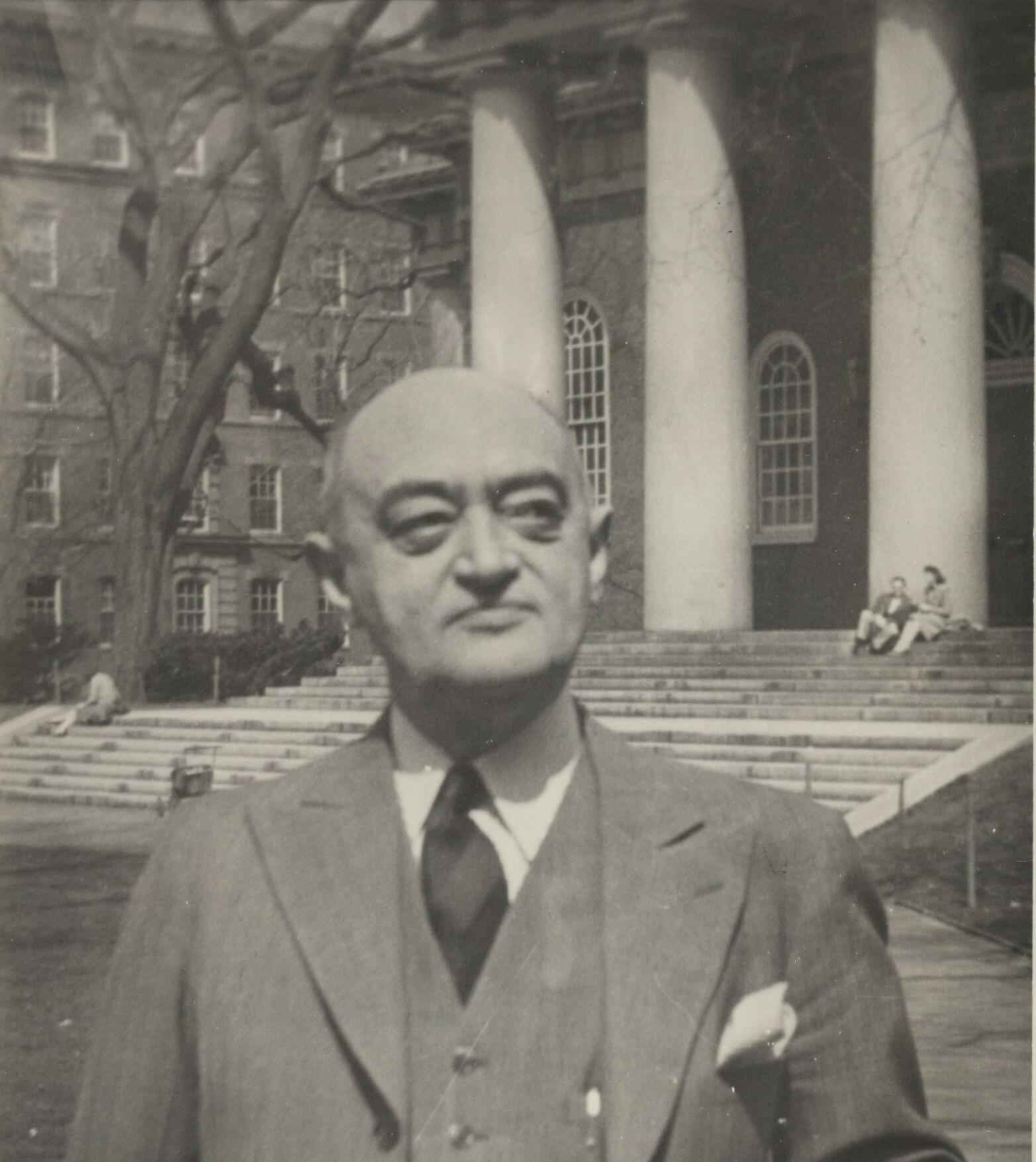
Joseph A. Schumpeter in Harvard Yard, circa 1948. Harvard University Archives.
Written over the course of seven years in the depths of the Great Depression, Business Cycles addressed the urgent questions of the day through detailed analysis of patterns of boom and bust in three countries (Britain, Germany and the United States) over the whole capitalist epoch –- a monumental undertaking. As business historian Thomas McCraw notes, writing the book “changed the way [Schumpeter] thought about capitalism. . . Business Cycles presaged the emergence of modern, rigorous business history – a new academic subdiscipline.” Most significantly, the book drew attention to the figure of the entrepreneur, whose activities disrupt economic equilibria through processes that Schumpeter first documented here and would later describe as “creative destruction.” The introduction of new products, processes, or technology, Schumpeter argued, generates waves of innovation that fuel investment booms and stimulate the market. Inherently volatile, Capitalism operates in long cycles of prosperity, recession, depression, and revival. A work of immense erudition, rich with economic and historical insight, Business Cycles “cannot be merely read,” wrote one contemporary reviewer; “it must be studied.” As McCraw notes, Schumpeter’s “years of intense labor on that book added immensely to his empirical knowledge. . . . His immersion in the histories of firms and industries led him to a uniquely powerful understanding of modern capitalism.” Three years after publishing Business Cycles, Schumpeter drew upon this “intellectual storehouse” to write his brilliant (and much more accessible) synthesis, Capitalism, Socialism and Democracy (1942).
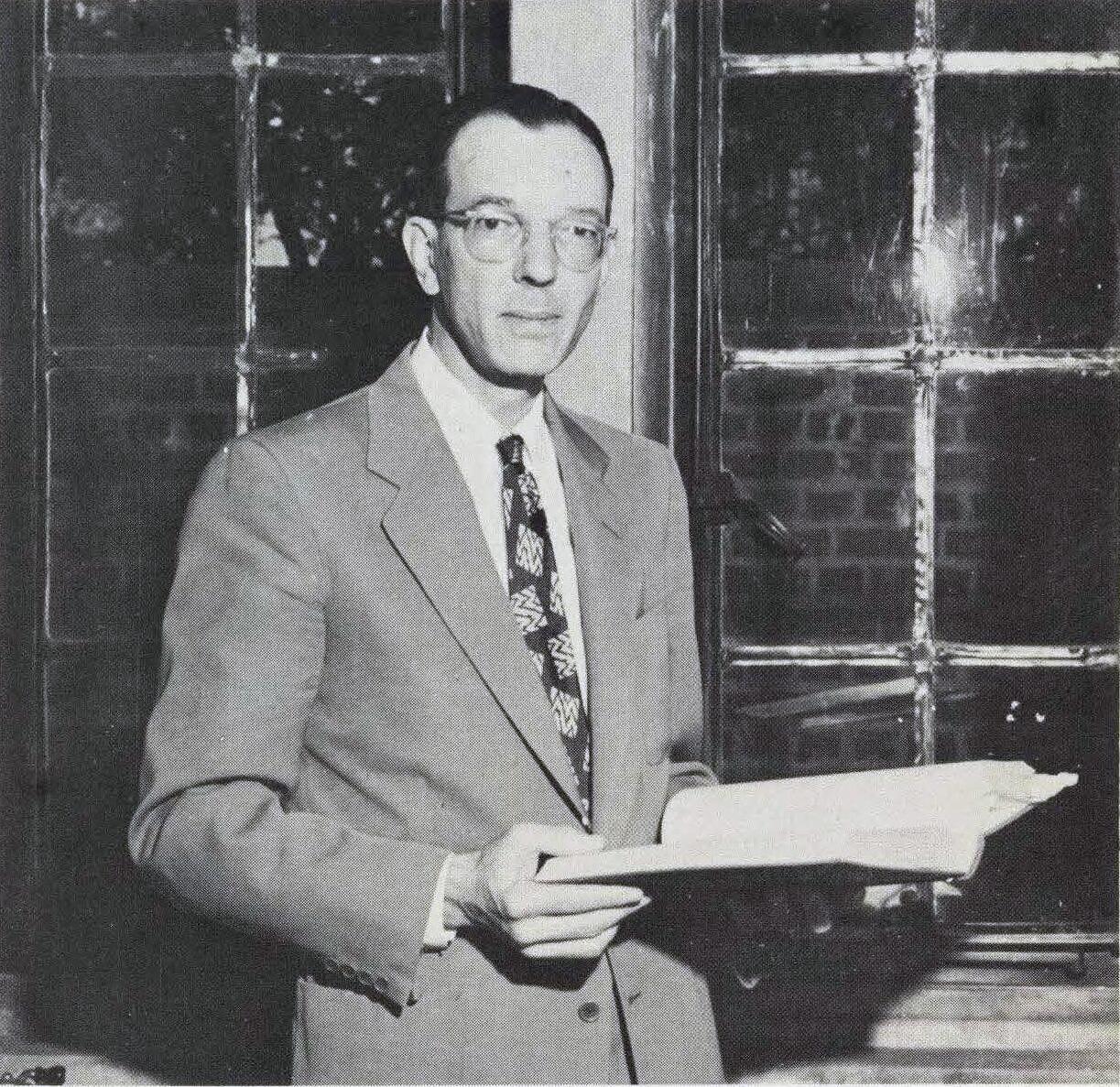
Richard V. Clemence at Wellesley College, 1957. He would retire in 1976 as A. Barton Hepburn Professor of Economics. The Wellesley Legenda 1957, p. 21.
McCraw relates how “at a Harvard seminar that Schumpeter’s students organized to discuss Business Cycles, it became evident that almost nobody had read the text,” much to the author’s fury and chagrin. (One of those students, future Nobelist Paul Samuelson, would later dismiss the book's emphasis on predictable wave periods as “Pythagorean moonshine.”) Richard Clemence distinguished himself from his classmates not only by reading the book but by devoting much of his career to exploring its ramifications and extending its methodology.
From his seat at Wellesley College, whose faculty he joined in 1947, Clemence promoted the ideas of his teacher through a series of books he published in rapid succession. His book The Schumpeterian system (1950) written with his former classmate Francis S. Doody, was one of the first to introduce the theory of business cycles to a wider readership. He included Schumpeter in the several collections of readings he edited on economic analysis (1950), business cycles and national income (1953), and economic change (1954). But perhaps most significantly, Clemence edited a collection of Schumpeter’s essays, most of which were written while the two worked together at Harvard. First published in 1951, it was recognized instantly as an essential text and today is assigned as required reading in M.B.A. programs worldwide.
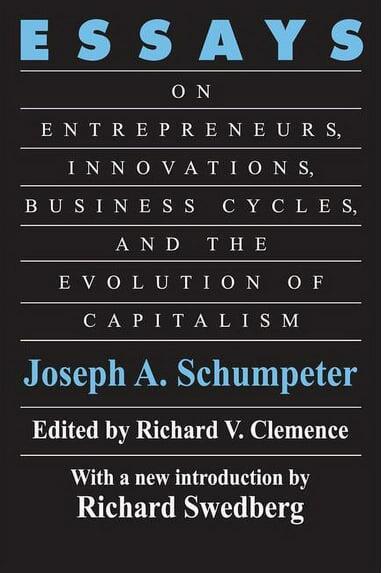
Clemence edited an essential collection of Schumpeter's essays
Clemence did not annotate his books heavily, but his stamps and sparse annotations in these two volumes mark them as significant artifacts of economic history.
Select Bibliography of Richard V. Clemence
1936. A critical examination of theories of consumer's choice with a new theory and method of analysis. Thesis (M.A.), Brown University.
1947. The theory of economic maturity and its application to the United States of America. Thesis (Ph. D.), Harvard University.
1950a. The Schumpeterian system [with Francis S. Doody]. Cambridge, Mass.: Addison-Wesley Press.
1950b. Readings in economic analysis, 2 volumes [ed.]. Cambridge, Mass., Addison-Wesley Press.
1951a. Income analysis. Cambridge, Mass., Addison-Wesley Press.
1951b. Essays of J. A. Schumpeter [ed.]. Cambridge, Mass., Addison-Wesley Press.
-----. reprinted as Essays on entrepreneurs, innovations, business cycles, and the evolution of capitalism. New Brunswick: Transaction Publishers, 1989.
1953a. The economics of defense; a primer of American mobilization. Harrisburg, Pa.: Stackpole Co.
1953b. Readings in business cycles and national income. [ed., with Alvin H. Hansen] New York: Norton.
1954. Economic change in America; readings in the economic history of the United States. [ed., with Joseph T. Lambie]. Harrisburg, Pa.: Stackpole Co., 1954
1971. The Ruth Stout no-work garden book [with Ruth Stout]. Emmaus, Pa.: Rodale.
Work Cited
McCraw, Thomas K. Prophet of innovation : Joseph Schumpeter and creative destruction. Cambridge, Mass.: Belknap Press of Harvard University Press, 2007
Product tabs
$0
$17,500
Recommend this product
Schumpeter on Business Cycles : a significant association copy
Related products
Rhode Island General Assembly Proceedings, August 1771
Rhode Island. General Assembly. August, 1771. At the General Assembly of the governor and Company of the English colony of Rhode-Island, and Providen...
view details
$450
View details

Practica criminalis canonica: Sixteenth Century Legal Notes on Sodomy
DIAZ DE LUCO, Juan Bernal (1495-1556). Practica criminalis canonica, in qua omnia ferè flagitia, quae à clericis committi possunt, cum eorum poenis d...
view details
$4,500
View details

Rhode Island General Assembly Proceedings, October 1770
Rhode Island. General Assembly. October 1771 [i.e. 1770]. At the General Assembly of the governor and Company of the English colony of Rhode-Island an...
view details
$375
View details

Photographs from the Evangelical Association, precursor to the United Methodist Church
[Breyfogel, Seneca P. (1823 – 1884)]. Photo album, c. 1860 to 1880. 5 ½ x 7 ¼ inches, decorative calf binding. The album contains 73 images, six of wh...
view details
$1,750
View details

Astronomy and Murder: Bickerstaff's Boston almanack for 1792
[West, Benjamin (1730-1813) and Amos Pope (1772-1837)] . Bickerstaff's genuine Boston almanack, or, Federal calendar, for 1792. [Boston] Printed by E....
view details
$600
View details

Thomas Jefferson, Observations sur la Virginie (1786), first edition in original binding
Jefferson, Thomas. Observations sur la Virginie, par M. J***, Traduites de L'Anglois [by abbé André Morellet]. Paris: Chez Barrois l'ainé, Paris, 1786...
view details
$7,500
View details

The Boston Chronicle: a Tory paper from the library of a prominent loyalist (1767-68)
The Boston Chronicle, volume 1, Nos. 1-54, plus supplements. 21 December 1767 to 26 December 1768. 28 cm (4to.) Irregularly paginated, with some pages...
view details
$15,000
View details

A 1797 Hudson Printing of George Washington’s Farewell Address
Washington, George. America's lecacy [sic]: being the address of G. Washington, on his declining a re-election to the presidency, to the people of th...
view details
$6,000
View details

Bill Ayers: From one weatherman to another
Ayers, Bill (b. 1944). Fugitive Days: A Memoir. Boston: Beacon Press, 2001. First edition. Very good in dustwrapper. Publicity and other materials lai...
view details
$175
View details
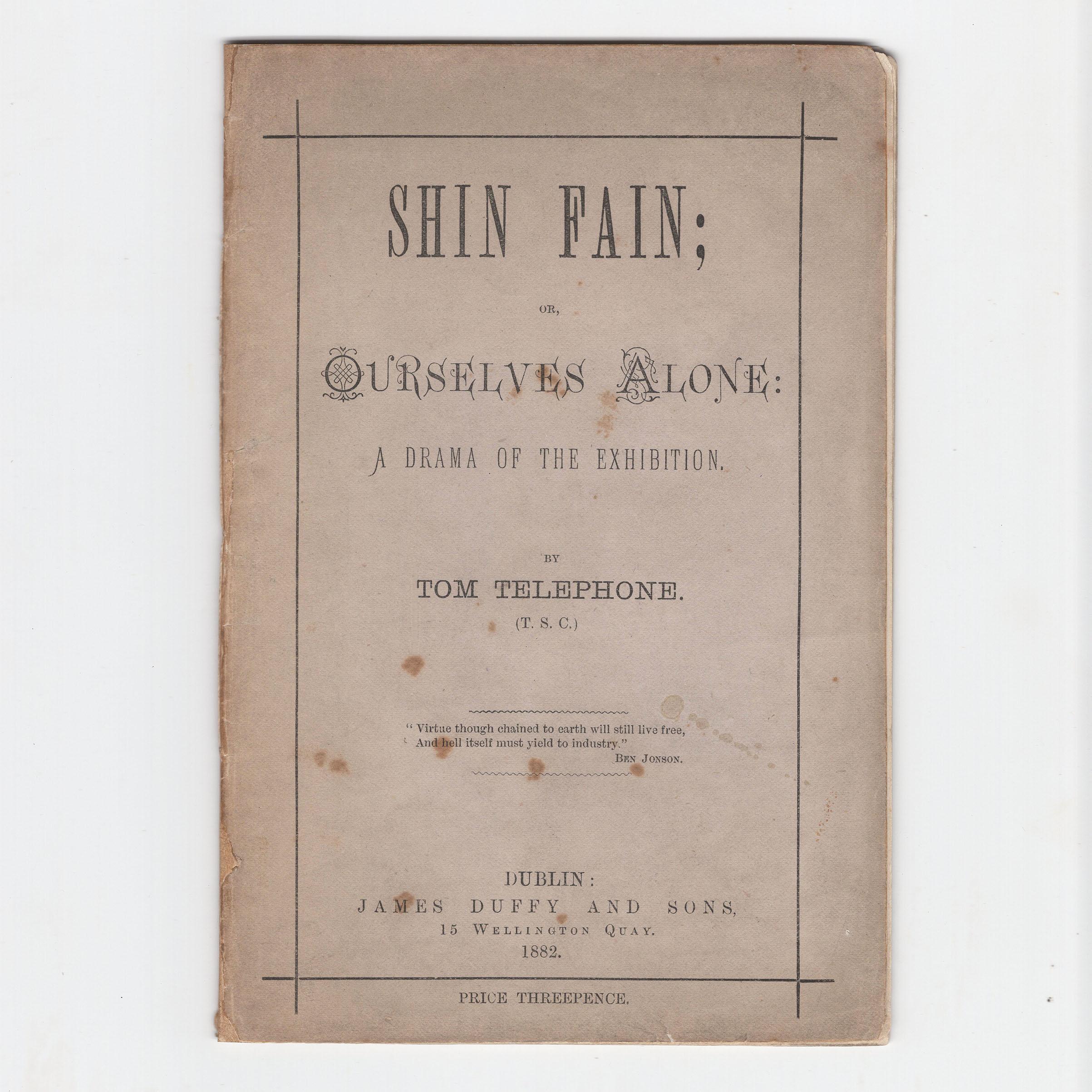
The origins of "Sinn Féin": Thomas S. Cleary's allegory of Irish independence
[Cleary, Thomas Stanislaus (1851–1898)]. Shin Fain; or ourselves alone: a drama of the exhibition, by Tom Telephone, pseud. Dublin: James Duffy and So...
view details
$2,750
View details

Rhode Island General Assembly Proceedings, June 1771
Rhode Island. General Assembly. June, 1771. At the General Assembly of the governor and Company of the English colony of Rhode-Island, and Providence ...
view details
$400
View details

Manuscripts by Elisha Deming Andrews, Vermont minister and Michigan pioneer
Andrews, Elisha Deming (1783-1852). An archive of twelve sermons, with additional manuscripts, 1806-1825. Over 250 pages. Very good condition. A m...
view details
$850
View details

A manual on mourning, appropriately bound
Dorrington, Theophilus (1654 – 1715). Consolations Address’d [sic.] to a Friend upon the Death of his Excellent and Pious Consort. Applicable also to ...
view details
$1,450
View details

Harvard College alumni register, annotated by Isaiah Thomas (1803)
Harvard University. Catalogus eorum qui in Universitate Harvardiana, Cantabrigiae, in republica Massachusettensi ab anno MDCXLII, ad annum MDCCCIII, a...
view details
$1,500
View details

Jonathan Edwards. Two Dissertations. First edition. (1765)
Edwards, Jonathan (1703 – 1758). Two dissertations: I. Concerning the end for which God created the world. II. The nature of true virtue. Boston: Prin...
view details
$3,750
View details

A gospel pioneer explores Africa
Rodeheaver, Homer A. (1880-1955). Singing black; twenty thousand miles with a music missionary. Chicago, Ill., Philadelphia, Pa., Rodeheaver Co., 1936...
view details
$45
View details