

Publishing Chekhov: Anna Yevreinova's struggle to fund Severny Vestnik
Yevreinova, Anna Mikhaylovna (1844–1919), et al. A gathering of five items relating to the Russian literary periodical Severny Vestnik, including four letters and one manuscript. St. Petersburg, 1888. 21 pp. total. Materials generally in very good condition. In chronological order, the file includes:
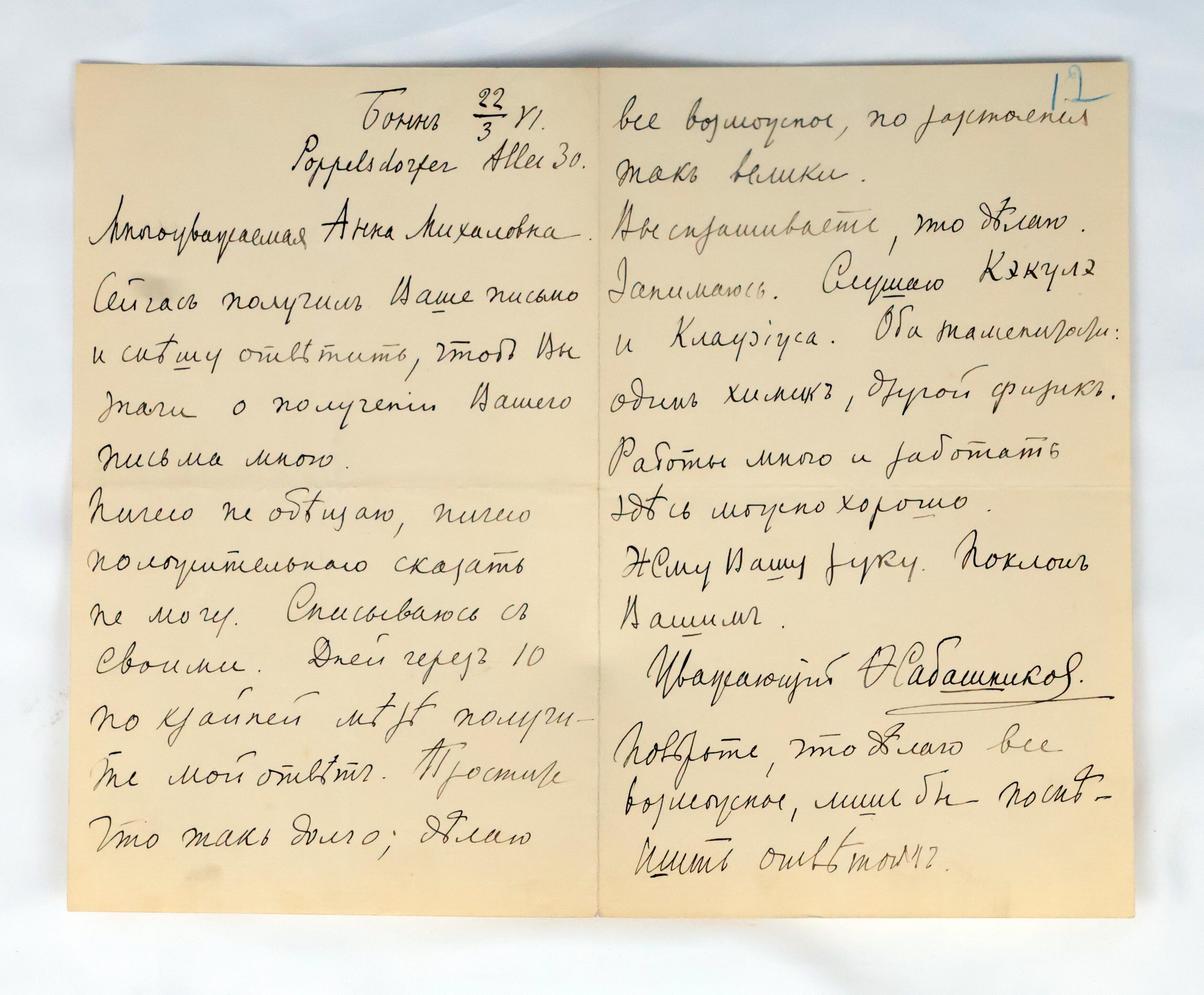
- Sabashnikov, Fyodor Vasilyevich (1869 - 1927). ALS to Anna Mikhaylovna Yevreinova, 22 June 1888, 2 pp.
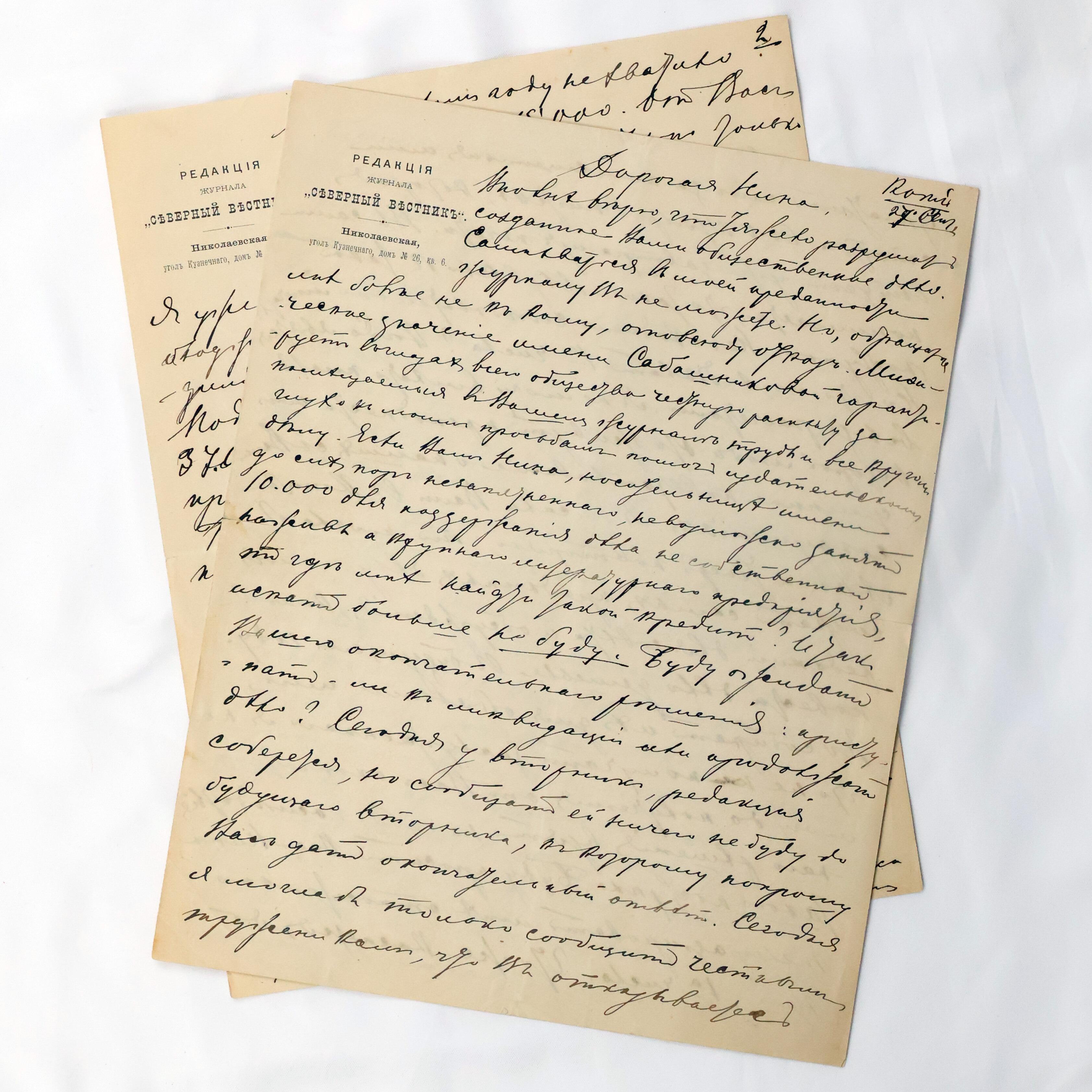
- Yevreinova, Anna Mikhaylovna. ALS to Antonina Vassilievna “Nina” Sabashnikova, 27 September 1888, 5 pp.
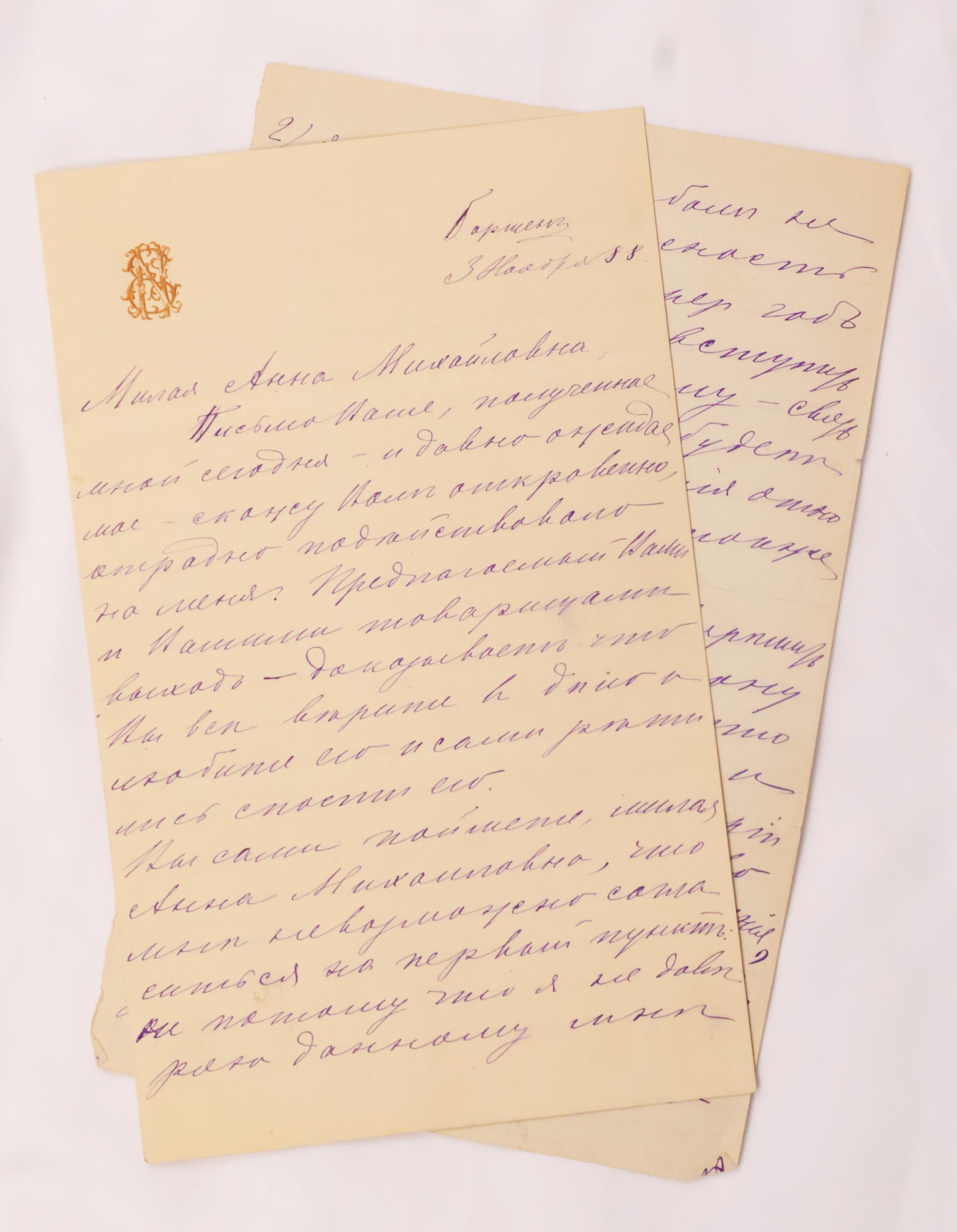
- Sabashnikova, Antonina Vassilievna “Nina” (1861-1945). ALS to Anna Mikhaylovna Yevreinova, 3 November 1888, 6 pp.
- Sabashnikov, Fyodor Vasilyevich. ALS to Anna Mikhaylovna Yevreinova, 21 November 1888, 4 pp.
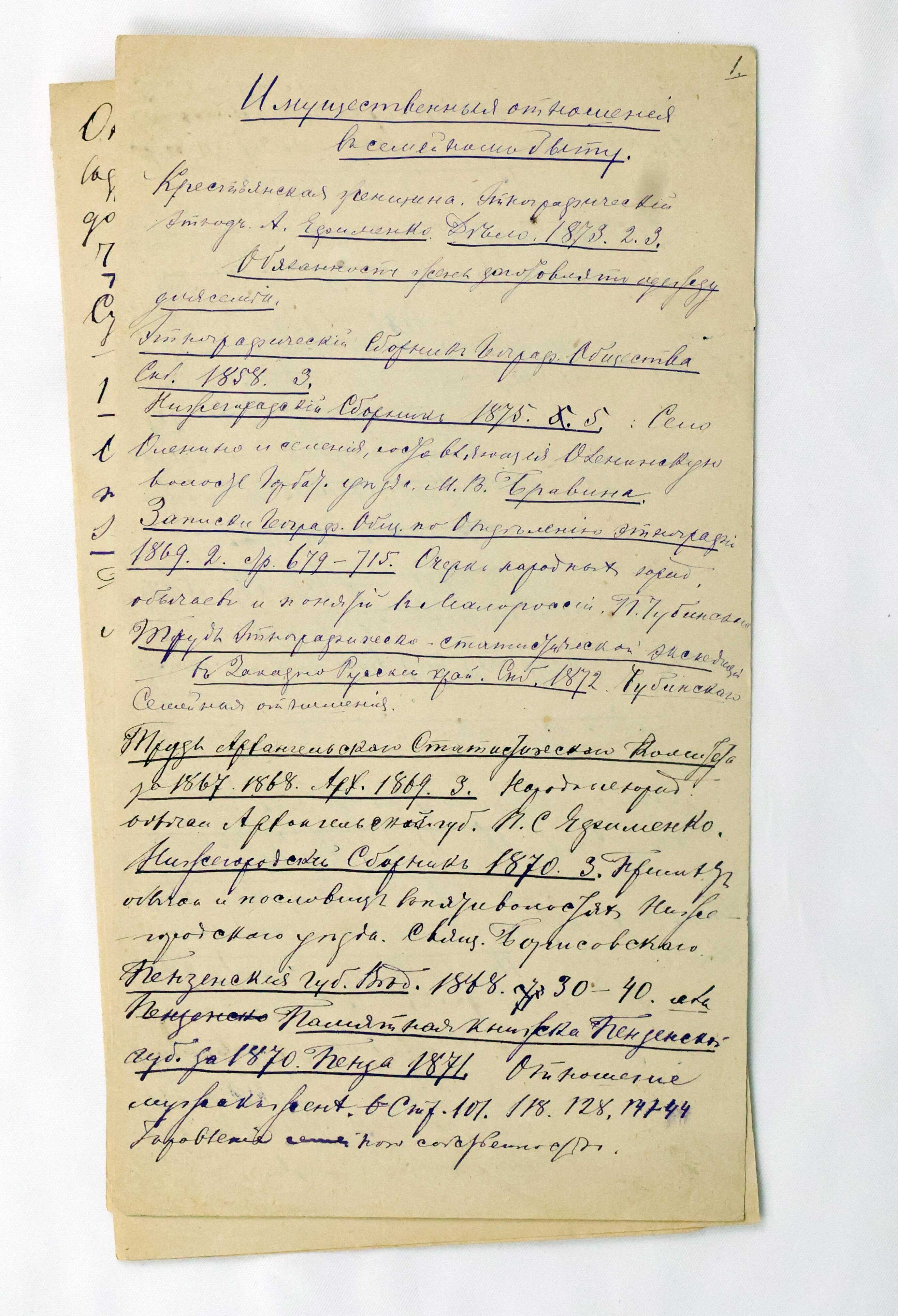
- Yevreinova, Anna Mikhaylovna. Bibliographical notes on property relationships in family life. Manuscript, n.d., 4 pp.
In 1884, the Russian literary magazine Otechestvennye Zapiski[Annals of the Fatherland] was suppressed by a tsarist government leery of its liberal Narodnik sympathies. The journal had been in print since 1818 and over almost 70 years had published such great writers as Ivan Turgenev, Fyodor Dostoyevsky, Ivan Goncharov, and Leo Tolstoy. Severny Vestnik [The Northern Herald] was one of the magazines that sprang up in its wake. The new journal became home to a group of intellectuals and creative writers, most notably Anton Chekhov (1860–1904).
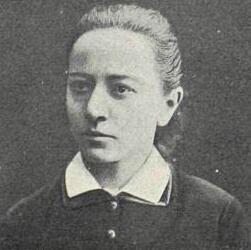
Anna Mikhaylovna Yevreinova
Severny Vestnik was founded by Anna Mikhaylovna Yevreinova. Her father was manager of the Peterhof Palace, and she was so strong-willed that she attempted suicide rather than enter into the marriage that her parents had arranged for her. Fleeing to Germany in 1869, she enrolled at the University of Leipzig and became in 1873 the first woman to obtain a doctoral degree in jurisprudence. Though she was barred from practicing in Russia, she wrote on women’s legal rights – a manuscript fragment from one of her works is included here. In 1905, she would join with other feminist intellectuals to found the Union for Women's Equality, advocating for woman’s suffrage.
The journal Yevreinova founded featured fiction, poetry, and essays. Sumptuously produced, each monthly issue weighed in at about 300 pages. Funding came from Yevreinova’s young friend, Antonina Vassilievna Sabashnikova, called Nina, who along with her brother Fyodor Vasilyevich Sabashnikov had recently inherited great wealth. (Fyodor is chiefly remembered today as the patron who presented da Vinci’s codex on bird flight to the Royal Library in Turin.) The editorial secretary was Yevreinova’s romantic partner, Maria Fedorova (1859–1934). That a major literary publication was run by women was extraordinary; that two of them were lesbian was unprecedented. Chekhov jokingly referred to Severny Vestnik as “that literary widows’ house.” The editorial board offered some gender balance. It included such luminaries as the poet Alexei Pleshcheyev (1825 – 1893), socialist philosopher Nikolay Mikhailovsky (1842–1904), and novelist Vladimir Korolenko (1853–1921).
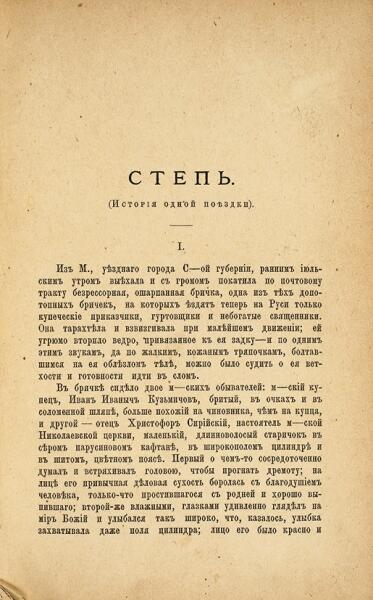
Yevreinova launched Chekhov's career with the publication of Степь (The Steppe).
Severny Vestnik is widely credited for launching Chekhov’s career. He was known only for the humorous short pieces he contributed to newspapers. But when the journal published The Steppe in March 1888, Chekhov came at last to the attention of the literary establishment. Yevreinova further promoted the young writer by commissioning the poet Dmitry Merezhkovsky (1865–1941) to write an essay on him for the November 1888 issue. In December of that year Chekhov was awarded the Pushkin Prize.
Ironically, as these letters suggest, Chekhov may have inadvertently contributed to the journal's demise. “I have to keep in mind that Severny Vestnik is low in funds and that I am one of its expensive contributors,” Chekhov wrote to his friend and publisher Aleksey Sergeyevich Suvorin in October 1888. He marveled that Yevreinova paid him the princely sum of 150 rubles for a mere 16 pages of text. Perhaps, he mused, she was too enthusiastic about his work. Recognizing Chekhov's extraordinary talent, Yevreinova also advanced him funds, which she did not bother to recoup. In March 1889 he thanked her for paying to publish Ivanov. “I received more than expected,” Chekhov wrote, “and I’m afraid you didn’t subtract my debt. I do owe the office a bit, you know.”
Unfortunately, the magazine’s expenses rose just as its finances dwindled. Under Yevreinova's editorship, the politically progressive journal embraced a democratic populism with articles on local life across the entire country. Cultivating a provincial readership may have been morally satisfying, but it was expensive. The income from subscriptions was not nearly enough to cover production and distribution costs. Suvorin and Chekhov observed Yevreinova’s growing desperation. The four letters in this archive document her attempts to raise funds from her wealthy patrons to keep Severny Vestnik afloat. The earliest letter here, dated June 1888, is from Fyodor Sabashnikov, who was only 19 years old at the time and pursuing his studies in Bonn. In this, and a second letter he sent in November he chats about his studies – he attended lectures in physics with Rudolf Clausius (1822–1888) and chemistry with August Kekulé (1829–1896), and complains that there is no Russian community in Bonn. (A melancholic, Fyodor had attempted suicide as a teenager and would ultimately die in an asylum for the indigent.) As to her request, he says in his June letter, he will be happy to do what he can to help but first he needs to consult with his sister Nina. By the time he sent his second letter in November, Nina Sabashnikova had settled the question of finances. Fyodor concludes his respectful letters by offering his respects for Anna Mikhaylovna’s partner, Maria.
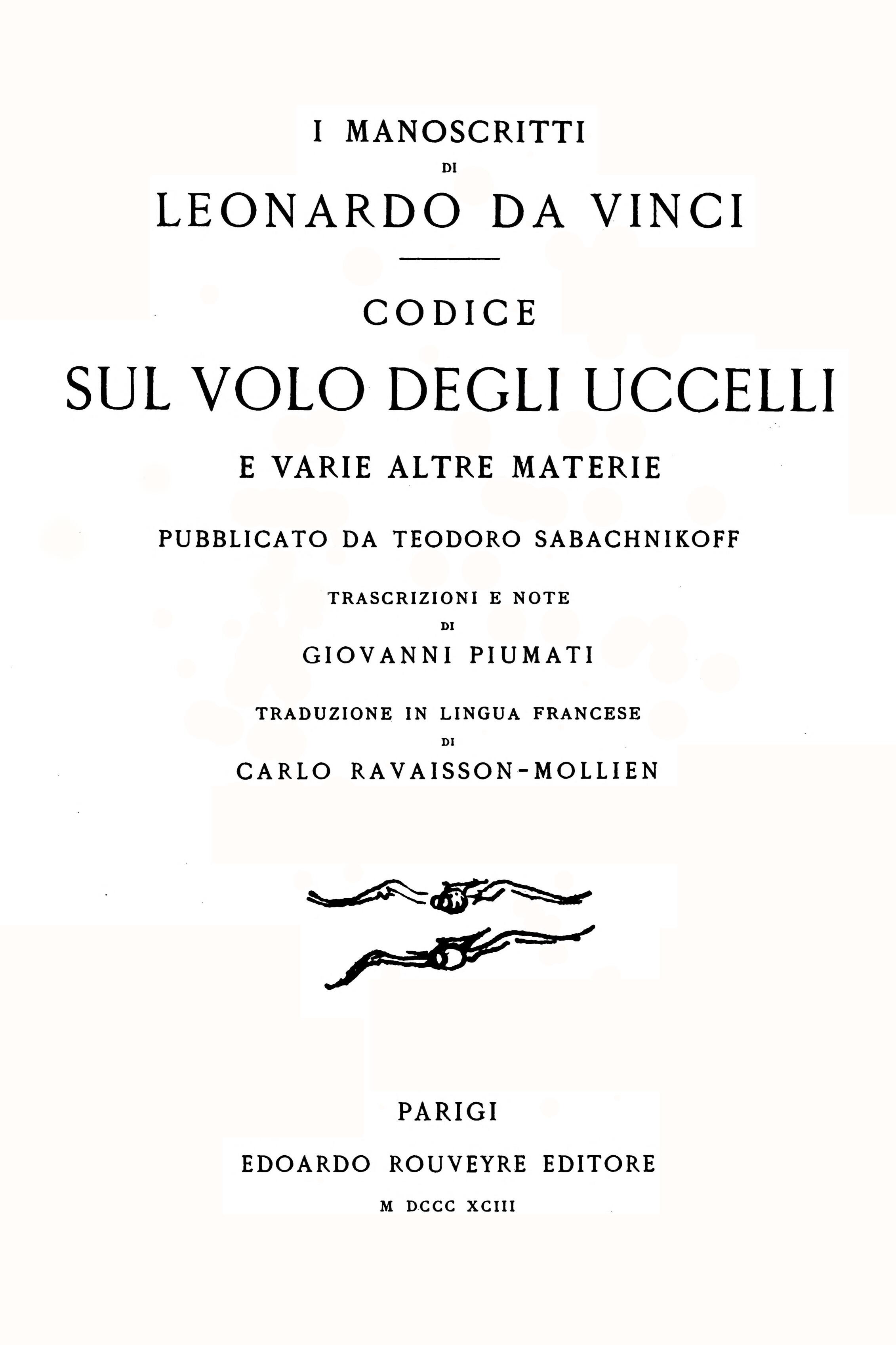
In 1892, Fyodor Sabashnikov (here "Teodoro Sabachnikoff") would use part of his inheritance to purchase and publish Da Vinci's codex on bird flight.
By September 1888, Yevreinova was in desperate straits. Her five-page letter to Nina offers an extended personal appeal, presenting financial and circulation figures, and making veiled threats about the personal consequences of failure. Even with 4500 subscribers, Severny Vestnik was running at a deficit: she needed 12,000 rubles by the end of the year just to pay the contributors and cover distribution costs. Her attempts to raise funds elsewhere had proven fruitless. The journal’s survival depended entirely on Nina Sabashnikova.
Вполнѣ вѣрю, что тяжело разрушить созданное Вами общественное дѣло. Сомнѣваться въ моей преданности журналу вы не можете. Но, обращаться мнѣ болѣе не къ кому, отовсюду отказъ. Мифическое значеніе имени Сабашниковой гарантируетъ всего общества честную расплату за помѣщаемыя въ Вашемъ журналѣ труды и все кругомъ глухо къ моимъ просъбамъ помочъ издательскому дѣлу.
Discontinuing the journal would come at considerable cost, both financial and personal. Reminding Nina that her name was on the masthead, Yevreinova writes of the shame that will befall the family in the high social circles (міръ) in which they moved were Severny Vestnik to fail:
Имѣете въ виду Нина, цто и для такой печальной обязанностн какъ хоронитъ “Сѣв. Вѣст.” необходимыя денъги. И такъ произойдетъ литературный скандалъ на весъ міръ. Слишком ужасно думать гдѣ скажется ваше имя…
Regrettably, Yevreinova’s entreaties came at a difficult time. Nina Sabashnikova was the magazine’s publisher and chief patron. But she had married Anna Mikhaylovna’s nephew, Aleksei Vladimirovich Evreinov (1852–1903), and he proved to be a gold digger. Dividing their time between Moscow and Borshchen, his estate in the Kursk oblast, Evreinov gradually assuming control of his wife’s substantial finances, curtailing her philanthropic activities. A few years later Nina would take as a lover and protector the rising statesman Vladimir Dzhunkovsky (1865–1938).
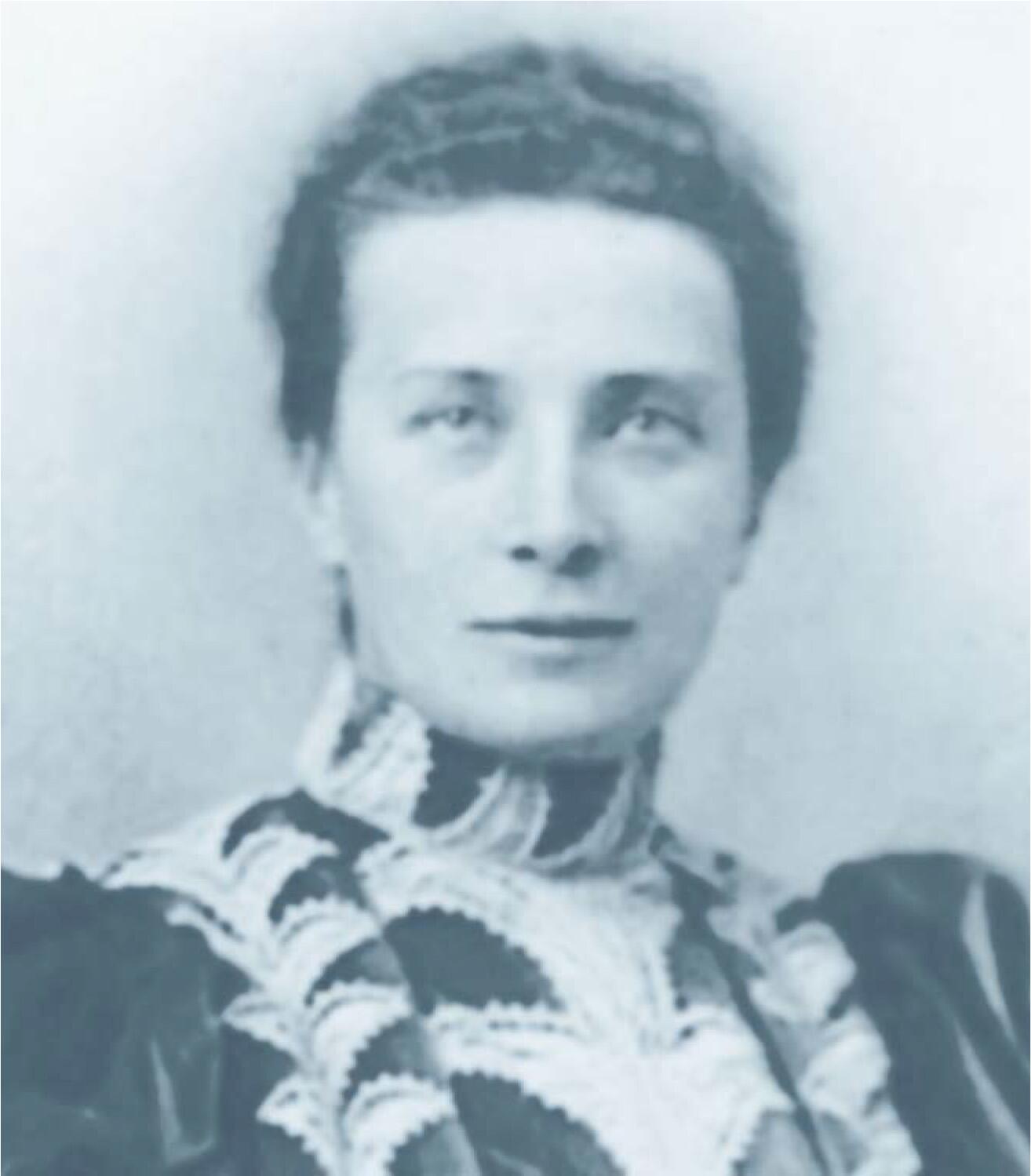
Antonina Vassilievna “Nina” Sabashnikova
Financial complications notwithstanding, Yevreinova’s appeal appears to have had the desired effect. Nina’s lengthy letter of November 1888 comes after the urgency of the moment has passed. Responding to a letter from Yevreinova about the future of Severny Vestnik, she considers two proposals. The first – that the editors contribute their own funds – she dismisses out of hand, noting that her wealth made it impossible to accept such an offer (“какъ человѣку болѣе состоятелъному чѣмъ всѣ члены редакліи, немыслимо приниматъ отъ нихъ денежныя жертвы”). However she gratefully accepts Plan B, which involved handing over ownership of the journal entirely to Yevreinova – a bequest, Nina points out, equivalent to 86,000 rubles. She agrees to keep open the possibility of returning to her position after a year or two, but expresses gratitude that surrendering control of Severny Vestnik to Yevreinova will ensure the continuity of the journal’s mission while granting Nina the peace of mind to enjoy her planned sojourn at the family compound in Siberia:
не мѣняемъ ни его направленія ни его характера н вмѣотѣ съ тѣмъ я опокойно и свободно могу или уѣхатъ на долгое время въ Сибиръ, и вмѣстѣ съ тѣмѣ окончательно не бытъ отрѣзанной отъ дѣла. …
Inviting Yevreinova to visit her at Borshchen to work out the details of transferring ownership, Nina again expresses pleasure at being relieved of responsibility for Severny Vestnik; “У меня точно гора съ плеча свалилась.” Beginning in 1889, Nina would no longer be named on the masthead of the journal.
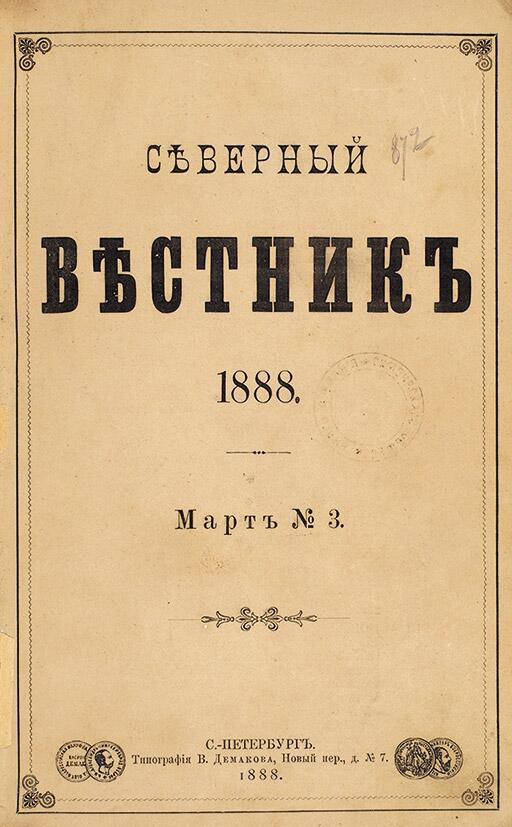
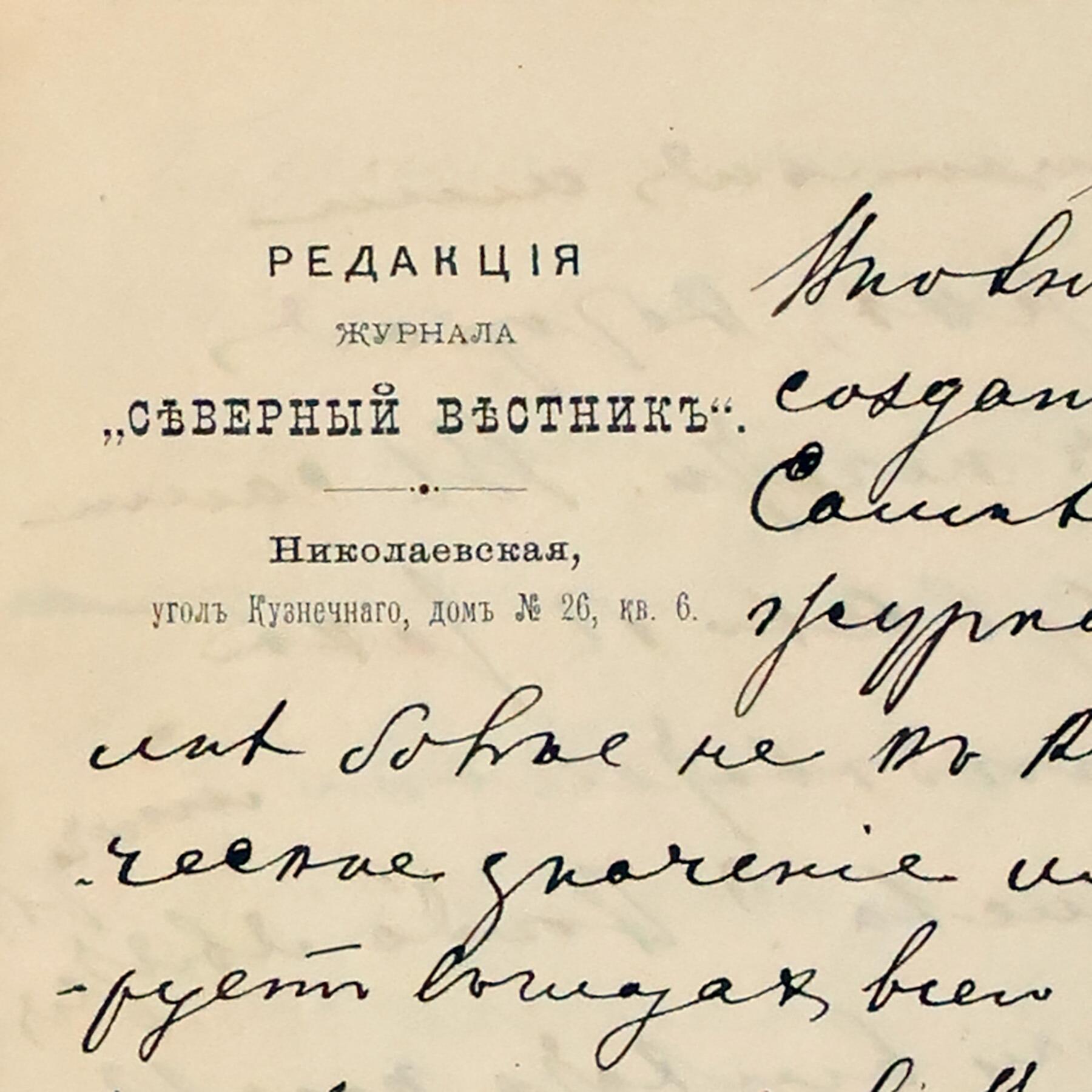
Cover of the March 1888 issue of Severny Vestnik.
Left largely to her own devices, Yevreinova kept Severny Vestnik alive for another year. But by March 1890, she had exhausted her resources. Chekhov, whose career she had done so much to promote, complained bitterly. “I have received a funereal letter from Plescheyev," he wrote to Suvorin,
The Severny Vestnik has passed away. The old man has lost his living and scolds Mme. Yevreyinov with the zeal of a young poet. I’m in a hole! First, why the devil did I rob myself? Why the deuce did I ‘support’ a publication that would perish? If I could have known that this would happen, I would have worked for the Vestnik Europa, where they would pay me more than 150 per folio, and not by instalments...
Yevreinova sold Severny Vestnik to a consortium headed by another female intellectual, Liubov Yakovlevna Gurevich (1866–1940), who would publish would take the journal into a new aesthetic direction. During the early 1890s, Severny Vestnik would emerge as the major organ of the Russian Symbolist movement.
These letters reveal a significantly different story about the shift in ownership than the one propounded by historians. Noting the changes to the masthead in 1889, Stanley J. Rabinowitz suggests that Sabashnikova "withheld funds for publication" in the context of quarrels between the editors over literary matters. This is a logical assumption based on the controversy raised by essays published by Merezhkovsky and changes to the editorial staff over the course of 1889. But the present correspondence exposes currents that are not reflected in the published record.
A fascinating look behind the scenes of one of the most important organs of Russian literature, and a rare opportunity to experience directly the voices of two dynamic women – Anna Yevreinova and Nina Sabashnikova – for whom few other sources survive.
Selected References
Baselica, Giulia. Fëdor Sabašnikov e il Codice sul volo degli uccelli di Leonardo da Vinci alla Biblioteca Reale di Torino, Studi Piemontesi, June 2005, pp. 97-103.
Chekhov, Anton. The life and letters of Anton Tchekhov, ed. S. S. Koteliansky and Philip Tomlinson. London: Cassell & Co., 1925
-----. Letters of Anton Chekhov, ed. Simon Karlinsky. London: Bodley Head, 1973
Edmondson, Linda Harriet. Feminism in Russia, 1900-1917. Stanford, Calif. : Stanford University Press, 1984.
Karlinsky, Simon. Russia's gay literature and culture: the impact of the October Revolution, in Hidden from history: reclaiming the gay and lesbian past, ed. Martin B. Duberman, Martha Vicinus, and George Chauncey Jr. London: Penguin, 1991, pp. 347–364
Kon, Igor S. The sexual revolution in Russia. New York: The Free Press, 1995
Rabinowitz, Stanley J. "Northern Herald": from traditional thick journal to forerunner of the avant-garde, in Deborah A. Martinsen, ed., Literary journals in imperial Russia. Cambridge: Cambridge University Press, 1998, pp. 207-27.
Robbins, Richard G., Jr. Overtaken by the night: one Russian's journey through peace, war, revolution & terror. Pittsburgh: University of Pittsburgh Press, 2017
Stites, Richard. The women's liberation movement in Russia: feminism, nihilism, and bolshevism, 1860-1930. Princeton: Princeton University Press, 1977
Спасибо Проф. Дина Гольдина за ее лингвистическую помощь!
Product tabs
$0
$4,500
Recommend this product
Publishing Chekhov: Anna Yevreinova's struggle to fund Severny Vestnik
Related products
George Bernard Shaw ghostwrites a preface for Lawrence of Arabia
Lawrence, T[homas] E[dward] (1888–1935) and Shaw, George Bernard (1856–1950). Draft foreword to Revolt in the Desert. Holograph manuscript, [Ayot St. ...
view details
$11,000
View details

H. P. Lovecraft, A rare postcard to Alfred Galpin, “my intellectual superior” (1922)
Lovecraft, Howard Phillips (1890 – 1937). Postcard to Alfred Galpin, 21 November 1922. With a postscript by A. M. Adams. In fine condition.A charming ...
view details
$2,250
View details

The script for a French opéra comique, adapted for the provincial stage
Étienne, Charles-Guillaume (1778 – 1845). Une heure de marriage: comédie en un acte, mêlée de chants. Paris: Chez Madame Masson, Libraire, An XII (18...
view details
$850
View details
On
hold
hold
The Burmese novels of Maurice Collis: a manuscript archive
Collis, Maurice (1889 – 1973). Archive for his six works of fiction. London, 1937 to 1970, including holograph manuscripts, corrected typescripts, cor...
view details
$18,500
View details

A Coded film script by Lynn Riggs
Riggs, Lynn (1899-1954) and W. P. Lipscomb (1887-1958). The Garden of Allah: Dialogue Continuity. American Version. [Culver City:] Selznick Internatio...
view details
$750
View details

Pennsylvania, the Promised Land: emigration songs from the earliest years of the Harmony Society in America
Neff, Jacob (1757–1818). Harmony Society hymnal. [Lancaster, Pennsylvania], 1804–06. Manuscript. 88 pp. of German verse with musical annotations. Smal...
view details
$0
View details

A manuscript copy of an influential essay on Moravian folk songs by František Bartoš and Leoš Janáček
Bartoš, František (1837 - 1906) and Leoš Janáček (1854 - 1928). Několik slov o lidových písních moravských [A few words about Moravian folk songs...
view details
$850
View details

Kipling the Sportwriter
$9,500
Kipling the Sportwriter
Kipling, Rudyard (1865–1936). ALS to Charles Henry Shinglewood Taylor (1883 – 1935), Engelberg, Switzerland, January 14, 1911. 7 pp. on two densely-wr...
view details
$9,500
View details
Free Love and New Masses: Ruth Chrisman Gannett in Bohemia
[Gannett], Ruth Chrisman (1896–1979). Pocket diary for 1926. 12mo.; 4.5 x 25 in.; approximately 180 pp. in easily legible black ink, with a few additi...
view details
$2,750
View details

Samuel Palmer: The sketchbook of 1865-71
Palmer, Samuel (1805–1881). Pocket notebook, 1865-71. 50 leaves, about 7 x 12 cm. The notebook has been partially paginated in pencil by Palmer: [pp] ...
view details
$37,500
View details

A revolutionary Tagalog manuscript from the Philippine-American War
Trinidad, Críspulo (1839-1925). Buhay ni Judit. Holograph manuscript, signed by the author and dated 22 September 1899. 16 x 22 cm; 99 pp. written on ...
view details
$8,500
View details

The literary archives of Dudley Barker and his alter ego, Lionel Black
Barker, Dudley (1910–1980). Literary archive, comprising one file of notes and correspondence on John Galsworthy and 46 manuscripts, 1935-1980. The ma...
view details
$9,500
View details

Correspondence from the 18th century Irish poet Mary O’Brien
O'Brien, Mary (fl. 1785–1790). Three autograph letters from the author and her husband Patrick O’Brien to Michael Bourke, 1785 and n.d. 3 pp. bifolia....
view details
$3,500
View details
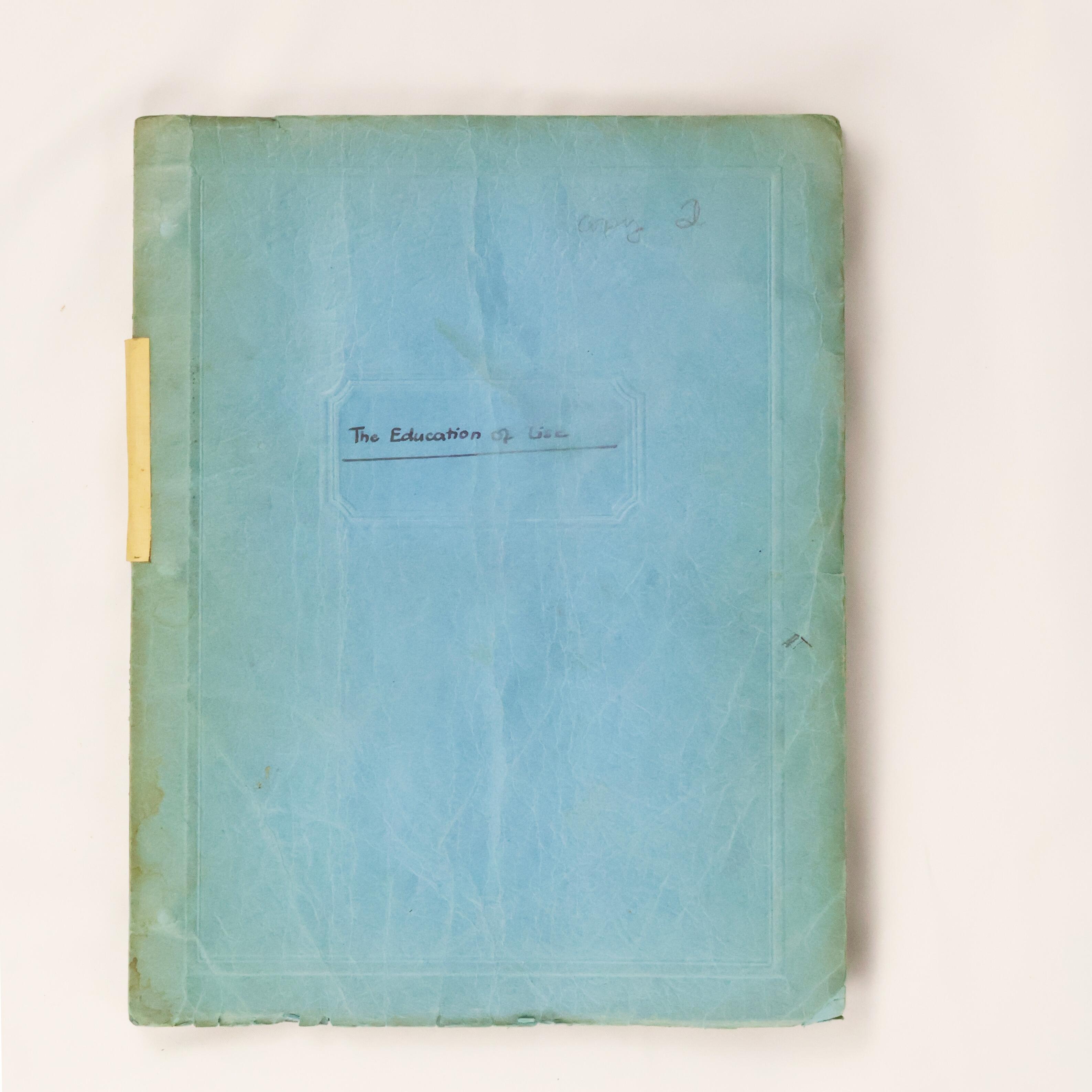
Five unpublished manuscripts by Madeleine L'Engle
L'Engle, Madeleine (1918–2007). A small archive of early plays and poems, circa 1941–1966. Five typescripts, comprising four plays and one collection ...
view details
$8,250
View details

Stan BRAKHAGE. Space as Menace in Canadian Aesthetics (1989), signed typescript.
BRAKHAGE, Stan (1933-2003). Space as Menace in Canadian Aesthetics: Film and Painting. Photocopy of the 25-page manuscript (typewritten, with holograp...
view details
$750
View details