


The far right echo-chamber of the 1960s
Edwards, Alice Mayo (1914 – 1994), collector. A small archive of far right literature, 1961 to 1968, including a number of rare publications including a long run of Tactics, the mimeographed newsletter edited by Edward Hunter. Over 100 items in all. Most materials 8 ½ x 11 in, the John Birch Society pamphlets being the major exceptions. Many are underlined or with slight annotation by Edwards. Overall in very good condition. Housed in a single banker’s box.
Before cable television and the blogosphere, extreme political ideas were circulated through mimeographed newsletters that encouraged the formation of local groups to host guest speakers and spread their concerns through word of mouth. This archive preserves the material collected by Alice Mayo Edwards of Bennington, Vermont, who was enbubbled in the anti-Communist echo chamber of the 1960s.
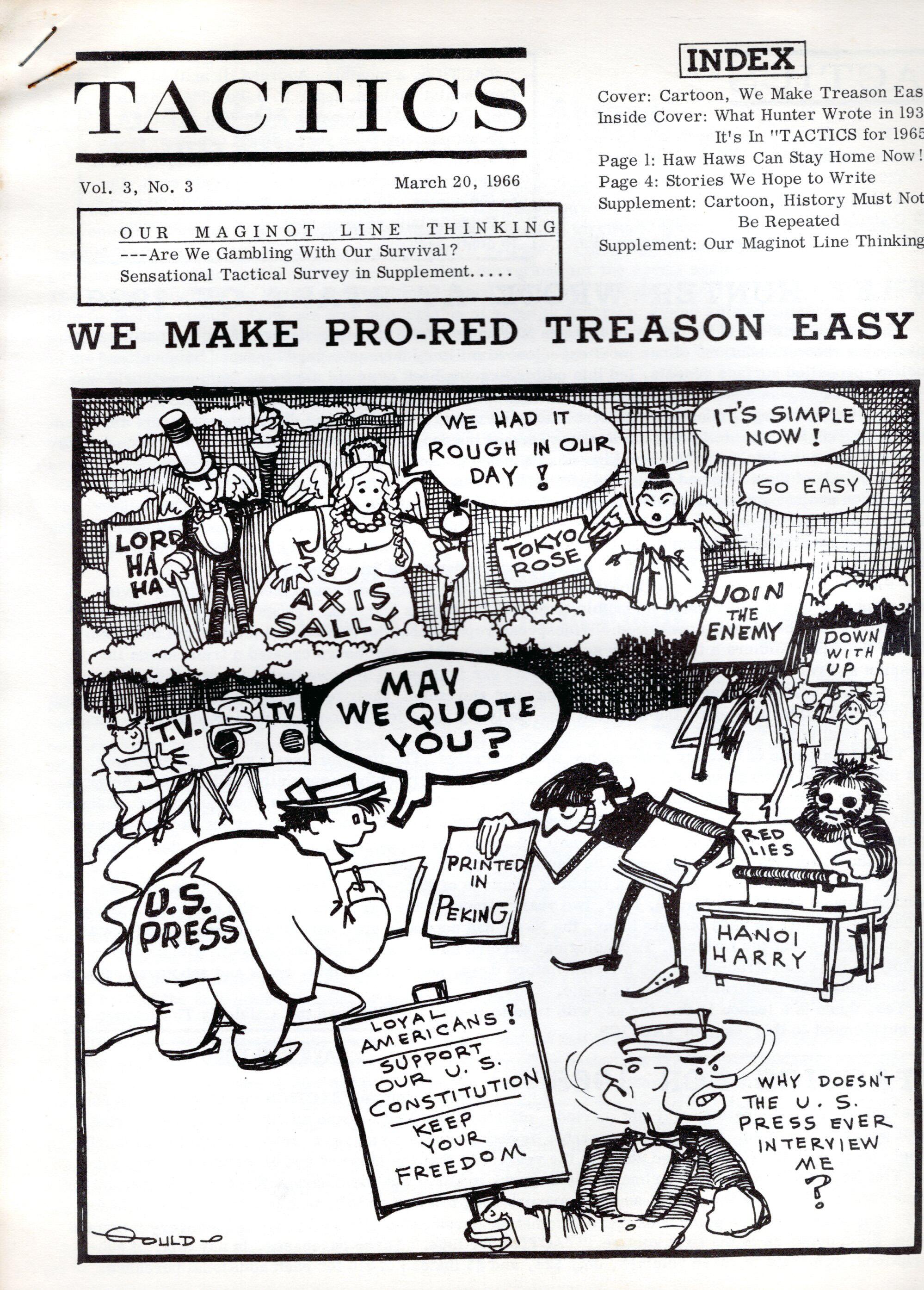
Then, as today, the far right believed failures in the mainstream media made alternative channels of communication necessary.
The archive includes the materials that she read – newsletters from pundit Dan Smoot, the former FBI agent turned right-wing radio host, and a long run of the personal 'zine of Edward Hunter, whose work on PsyOps and brainwashing inspired The Manchurian candidate. There are pamphlets of the John Birch Society and kindred groups. The archive offers some insight into how Alice Mayo Edwards used these materials. Many of the publications are underlined and have annotations. Most have a label affixed with her name and address, suggesting that she loaned them out. A few of the publications are here in multiples – there are two identical sets of offprints and mimeographs by Strom Thurmond, for example – and anti-Communist study guides, suggests that she may have led discussion groups. Frank A. Capell inscribed a prepublication copy of his American handbook for anti-Communists to her in 1962, probably on the occasion of a lecture. And there are some typescripts – either materials that Edwards prepared herself or received from speakers.
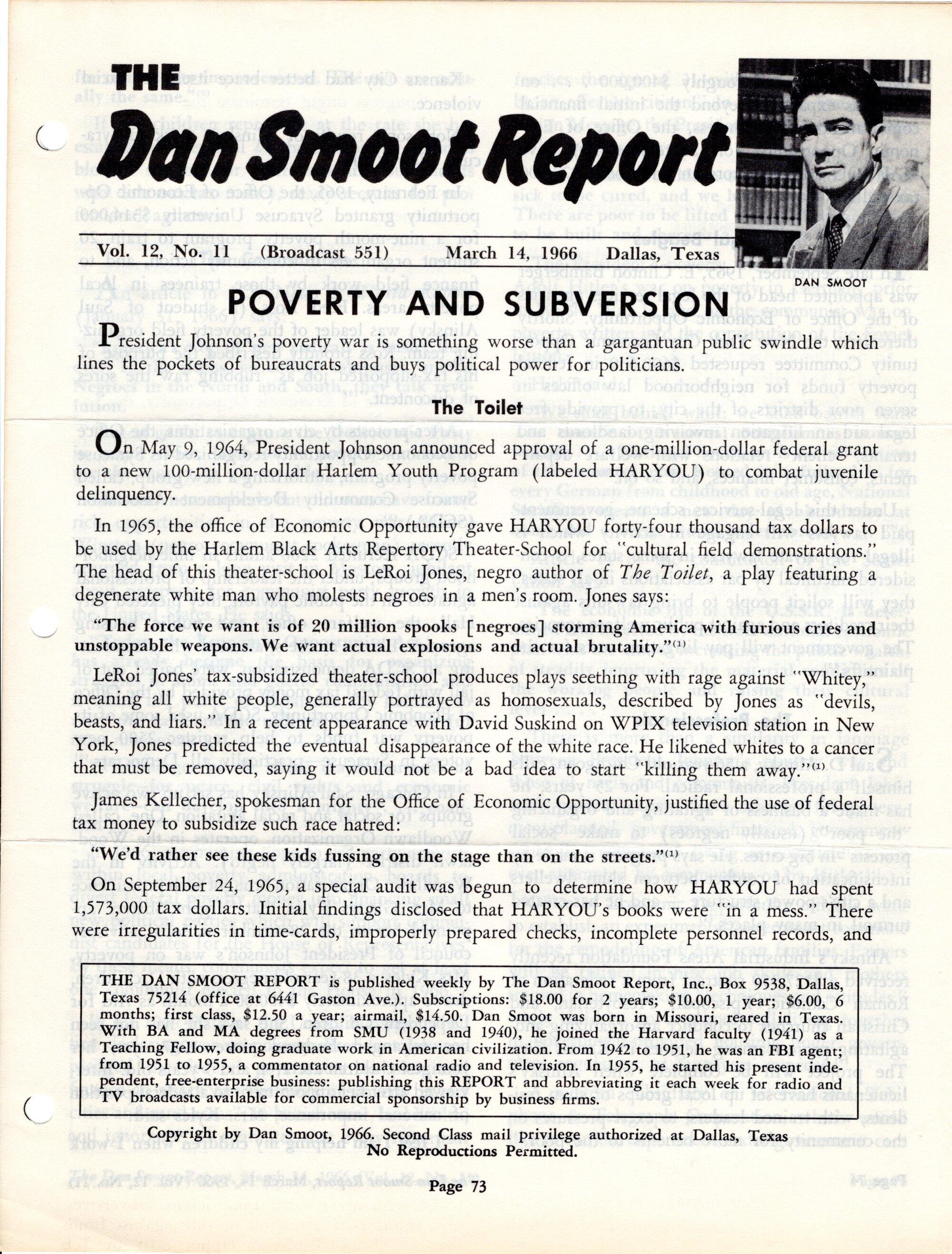
Among the singular pleasures of the Dan Smoot Report are his occasional reviews of what he considered aberrant literature. Here he offers a critique of a play by LeRoi Jones, who would later adopt the name Amiri Baraka. In another issue he lambastes Another Country, a novel by "negro 'integration' leader" James Baldwin as "indescribably filthy -- not just pornographic, but degenerate and nauseatingly obscene."
Born in Worthington, Massachusetts, Alice Mayo Edwards spent her youth in Massachusetts and Connecticut. During World War II, she worked for U.S. Electrical Motors in Milford, CT, “a major supplier of electrical motors to the Army, Navy, Air Force, Lend Lease, and Manhattan Project." She moved to Bennington, Vermont after the war. In 1962 she relocated to Manchester, VT, where she found work in retail shops. Like many who served their country, she participated in a number of civic groups and voluntary organizations. Concurrent with her immersion in the John Birch Society, Edwards headed fundraising campaigns for the local chapter of the American Cancer Society. In 1959 she was one of the original incorporators of the Bennington County Humane Society, and as chairman of the board for many years regularly spearheaded their events. She also served as a trustee of the Bennington library. In 1978 she was elected tax collector for the Town of Manchester. As she noted in a Bennington Banner profile in 1980, she was proud of her reputation as “a tough old bitch.” She never married.
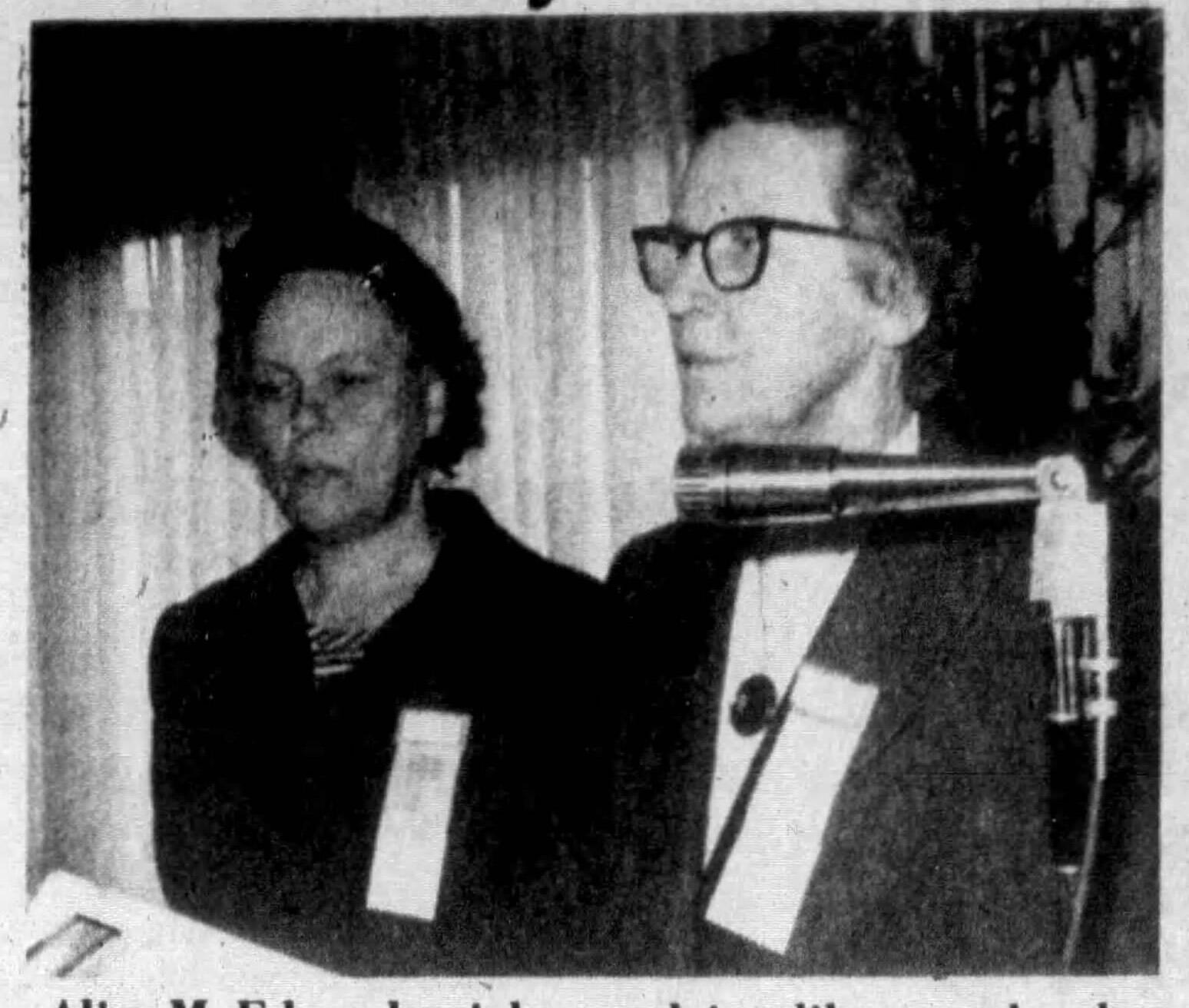
Alice Edwards (right) as president of the Bennington County Humane Society, 1978 (Bennington Banner)
The materials in this archive date back to 1961, when the Cold War was at its frostiest – the Bay of Pigs, the Berlin Wall, the first troops sent to Vietnam. By 1963, Edwards was deeply committed to the fight to defend America against its enemies abroad and their agents at home. Beginning on 19 April of that year, Edwards published a series of letters to her local paper to publicize her views. She called Communism “a Godless regime which is completely evil . . . [bent on] world domination.” She responded to critics who blanched at the rhetoric of the far right by noting that Capt. Eddie Rickenbacker, chairman of an anti-Castro group “was ‘super-patriotic’ enough to become a World War I flying ace,” and that John Birch Society founder Robert Welch “attended both the U.S. Naval Academy and Harvard Law School.”
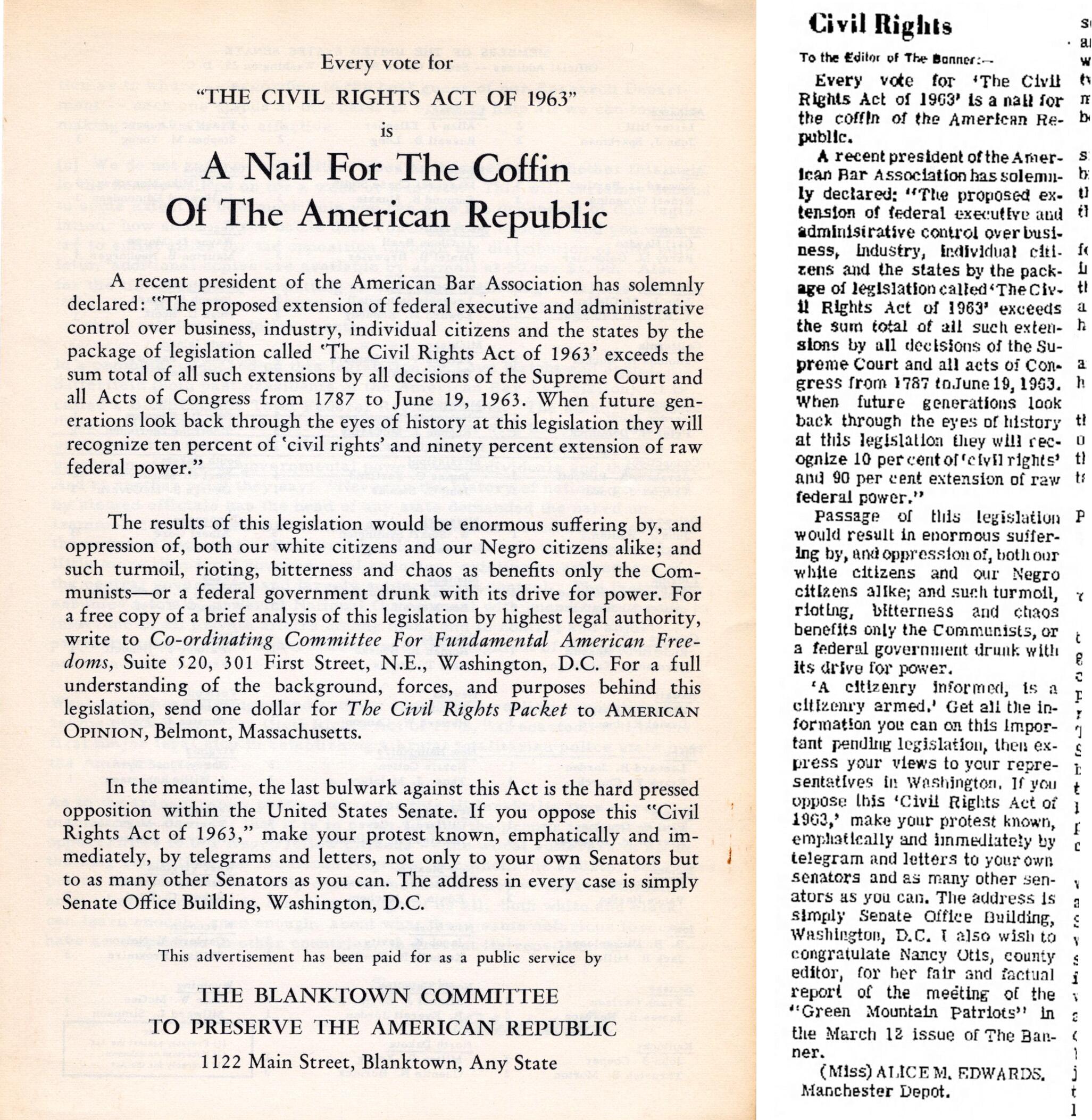
Edwards’s letter to the Bennington Banner published on March 26, 1964 (right), modifies a template circulated by the John Birch Society (left).
The extreme right of the period saw in every disruption of the political order the insidious hand of Communist subversion. In February 1964, the John Birch Society circulated a form letter for its members to place in local papers decrying proposed legislation for civil rights. In March 1964, Edwards published the form letter (with some emendations) under her own name. “Every vote for ‘The Civil Rights Act of 1963’ is a nail for the coffin of the American Republic,” she wrote, echoing Robert Welch’s text. “Passage of this legislation would result in enormous suffering…; and such turmoil, rioting, bitterness and chaos benefits only the Communists, or a federal government drunk with its drive for power.” Edwards appended to the form letter some praise for the Green Mountain Patriots, a conservative political group that had been recently organized. This evidently raised some hackles. Shortly afterwards the Banner published a correction to explain that her views on civil rights did not characterize the unanimous consensus of the group.
Edwards added her name to a 1964 advertisement endorsing Roger MacBride, a libertarian gubernatorial candidate who would quit politics to create the television show Little House on the Prairie. Her last public pronouncement on the evils of Communism – at least so as we have been able to find – was a letter published in the Bennington Banner in October 1965 lambasting critics who found a speaker who delivered a guest lecture at a church in Manchester, VT to be extreme. “Slave labor, starvation and death [in Russia] are extreme,” she retorted.
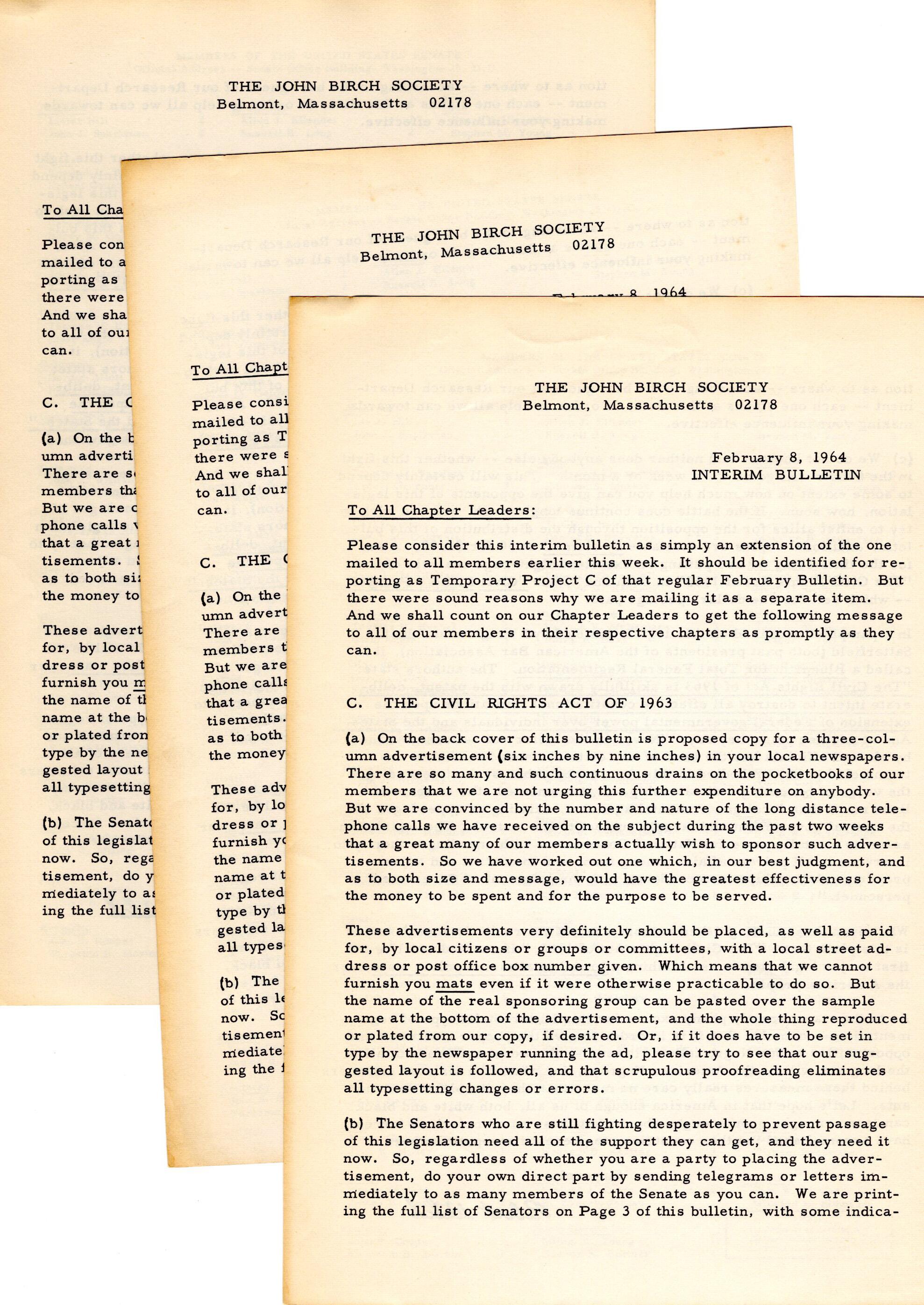
The presence of some duplicate materials suggests that Edwards sought to bring her neighbors into the fold.
As this archive demonstrates, Edwards continued to receive right-wing literature -- and read it closely – through 1968 at least. Was her silence in the public sphere after 1965 motivated by a decision to scale back her political activism in favor of her humanitarian causes? Or was she censored by newspaper editors determined not to provide partisan extremists with a forum? Either way, this rich archive offers a meaty resource for the study of popular politics in an era when communications were less technologically advanced but no less virulent.

Selected Sources
Edwards, Alice M. Letter to the editor: Super patriots, Bennington Banner, 15 April 1963, p. 4.
-----. Letter to the editor: Controlled news. Bennington Banner, 29 March 1963, p. 4.
-----. Letter to the editor: The Castro regime, Bennington Banner, 17 May 1963, p. 4.
-----. Letter to the editor: Violates Monroe Doctrine, Manchester Journal, 6 June 1963, p. 13.
-----. Letter to the editor: The Far Right, Bennington Banner, 18 February 1964, p. 4.
-----. Letter to the editor: Civil rights. Bennington Banner, 26 March 1964, p. 4.
-----. Letter to the editor: Correction, Bennington Banner, 2 April 1964, p. 4.
-----. Letter to the editor: Slave labor, starvation and death are extreme, Bennington Banner 1 October 1965, p. 4.
Advertisement: We the undersigned supporters of Roger MacBride…, Bennington Banner, 3 September 1964, p. 13.
Rotarians hear confession of Humane Society, Bennington Banner, 22 November 1978, p. 3
Manchester tax collector can take the abuse, Bennington Banner, 02 June 1980, p. 6.
[Obituary], Bennington Banner, 26 March 1994, p. 16.

Product tabs
$0
$4,500
Recommend this product
The far right echo-chamber of the 1960s
Related products
Stan BRAKHAGE. Space as Menace in Canadian Aesthetics (1989), signed typescript.
BRAKHAGE, Stan (1933-2003). Space as Menace in Canadian Aesthetics: Film and Painting. Photocopy of the 25-page manuscript (typewritten, with holograp...
view details
$750
View details
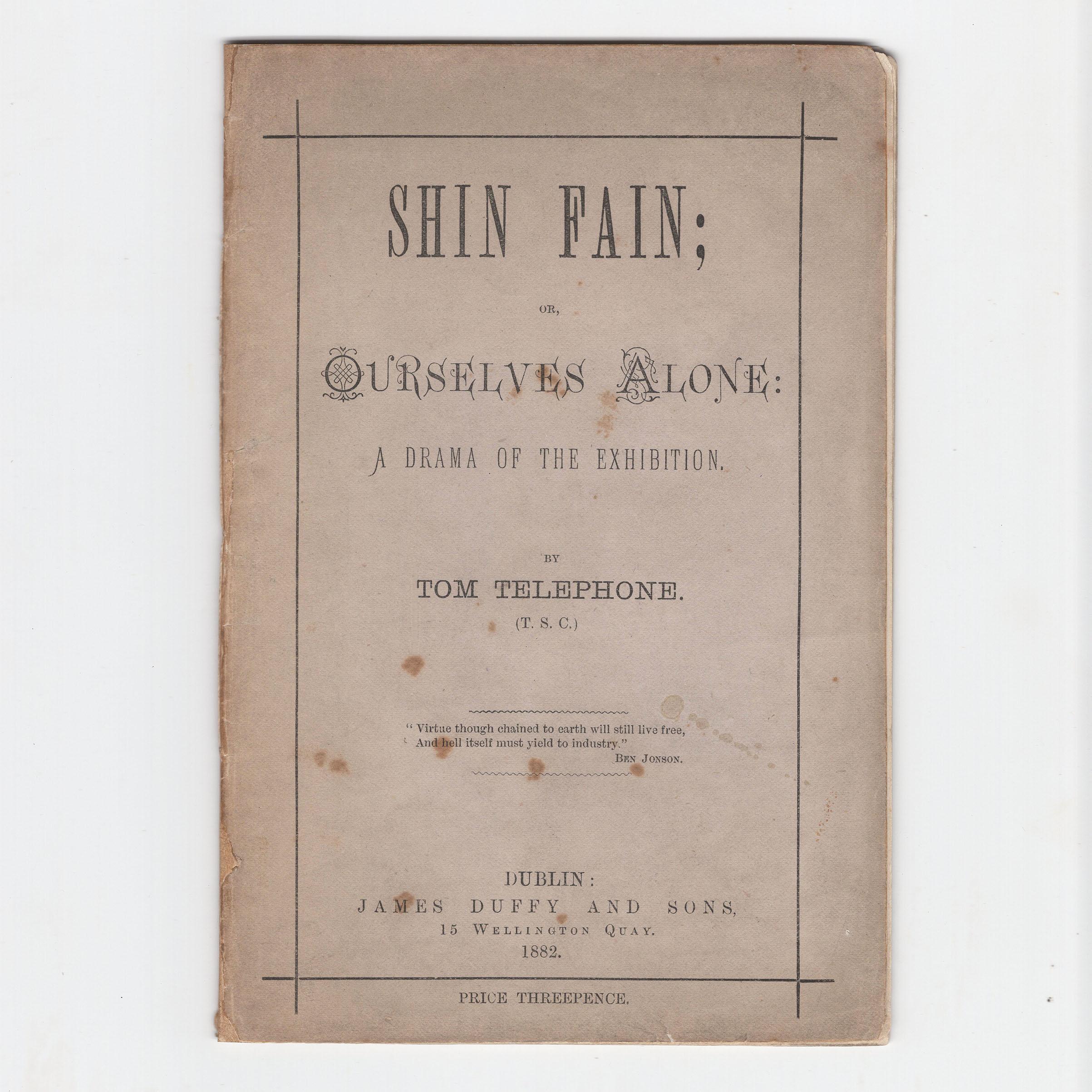
The origins of "Sinn Féin": Thomas S. Cleary's allegory of Irish independence
[Cleary, Thomas Stanislaus (1851–1898)]. Shin Fain; or ourselves alone: a drama of the exhibition, by Tom Telephone, pseud. Dublin: James Duffy and So...
view details
$2,750
View details

Bill Ayers: From one weatherman to another
Ayers, Bill (b. 1944). Fugitive Days: A Memoir. Boston: Beacon Press, 2001. First edition. Very good in dustwrapper. Publicity and other materials lai...
view details
$175
View details

A slave sale mandated by the Louisiana Supreme Court
Sale of Slave by Suc[cessors] of Woodruff to Dr. James G. Belden, dated 1 April 1858. Holograph manuscript on printed form folded to make 4 pages. A ...
view details
$3,500
View details

A manual on mourning, appropriately bound
Dorrington, Theophilus (1654 – 1715). Consolations Address’d [sic.] to a Friend upon the Death of his Excellent and Pious Consort. Applicable also to ...
view details
$1,450
View details

Jonathan Edwards. Two Dissertations. First edition. (1765)
Edwards, Jonathan (1703 – 1758). Two dissertations: I. Concerning the end for which God created the world. II. The nature of true virtue. Boston: Prin...
view details
$3,750
View details

The literary archives of Dudley Barker and his alter ego, Lionel Black
Barker, Dudley (1910–1980). Literary archive, comprising one file of notes and correspondence on John Galsworthy and 46 manuscripts, 1935-1980. The ma...
view details
$9,500
View details

Manuscript for an unpublished masterwork in American medicinal botany
Havard, Valery (1846–1927). Medical and Economic Botany. Typescript, ca. 1897-98. 1291 numbered leaves on thin laid paper, with holograph emendations ...
view details
$0
View details

Samuel Palmer: The sketchbook of 1865-71
Palmer, Samuel (1805–1881). Pocket notebook, 1865-71. 50 leaves, about 7 x 12 cm. The notebook has been partially paginated in pencil by Palmer: [pp] ...
view details
$37,500
View details

Thomas Jefferson, Observations sur la Virginie (1786), first edition in original binding
Jefferson, Thomas. Observations sur la Virginie, par M. J***, Traduites de L'Anglois [by abbé André Morellet]. Paris: Chez Barrois l'ainé, Paris, 1786...
view details
$7,500
View details

Original painting of the American bark Fury, with the captain’s ledgers
Wilson, Samuel H. (1836 – 1888). Ledgers of disbursements for the bark Fury and other vessels under his command, 1865 – 1887. 140 numbered pages, cont...
view details
$3,750
View details

Correspondence Archive of Massachusetts Governor Increase Sumner (1771-1792)
Sumner, Increase (1746-1799). A small archive of 28 letters, mostly invitations sent to Sumner and his family, 1771-1792. Included is also a candid l...
view details
$2,250
View details

Rhode Island General Assembly Proceedings, June 1771
Rhode Island. General Assembly. June, 1771. At the General Assembly of the governor and Company of the English colony of Rhode-Island, and Providence ...
view details
$400
View details

George Bernard Shaw ghostwrites a preface for Lawrence of Arabia
Lawrence, T[homas] E[dward] (1888–1935) and Shaw, George Bernard (1856–1950). Draft foreword to Revolt in the Desert. Holograph manuscript, [Ayot St. ...
view details
$11,000
View details
On
hold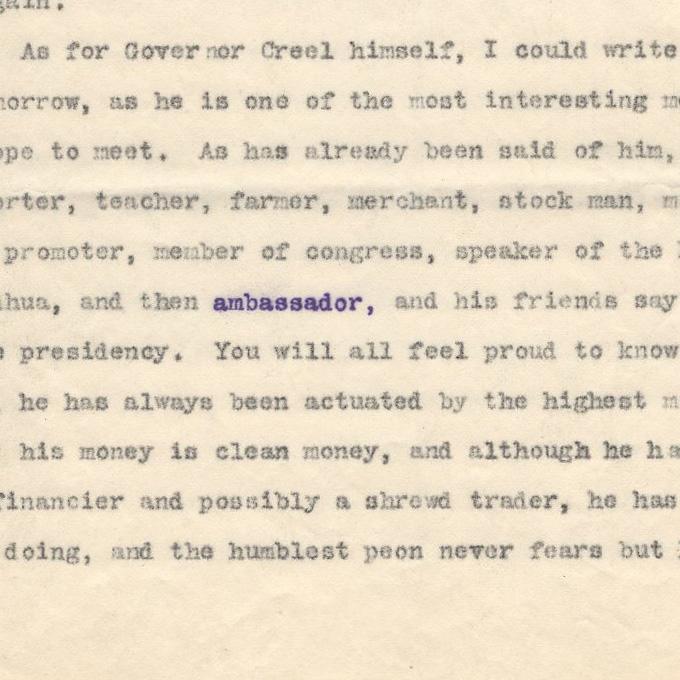
hold
Visiting Enrique Creel, Governor of Chihuahua
Creel, Hattie Virginia (1856-1915). Lengthy TLS to “Cousin Lucy” on visiting their cousin Enrique Creel in Chihuahua, Mexico, nd [circa 1909], carbon ...
view details
$850
View details

Rhode Island General Assembly Proceedings, August 1771
Rhode Island. General Assembly. August, 1771. At the General Assembly of the governor and Company of the English colony of Rhode-Island, and Providen...
view details
$450
View details

Document Signed by Alexander Hamilton as Secretary of the Treasury, 1793
Hamilton, Alexander (1755 – 1804). Signed Treasury Receipt addressed to Samuel Gerry, Collector at Marblehead. Partially printed document dated June 2...
view details
$8,500
View details

Consumer culture, art, and subjectivity in Kazimierzowo, Chicago
Porembski, Olga V. (1924-2011). Rose Rosinski and Bruno Zidek, April 11, 1942. 96 leaves, 11½ x 14 in. (29 x 26 cm.) Homemade scrapbook comprised pri...
view details
$1,250
View details

Manuscript Archive for Atomsk, a Cold War novel by intelligence operative Paul Linebarger
Linebarger, Paul Myron Anthony (1913 - 1966). Atomsk: A Novel of Suspense by "Carmichael Smith." Original manuscript archive for the novel published p...
view details
$25,000
View details