


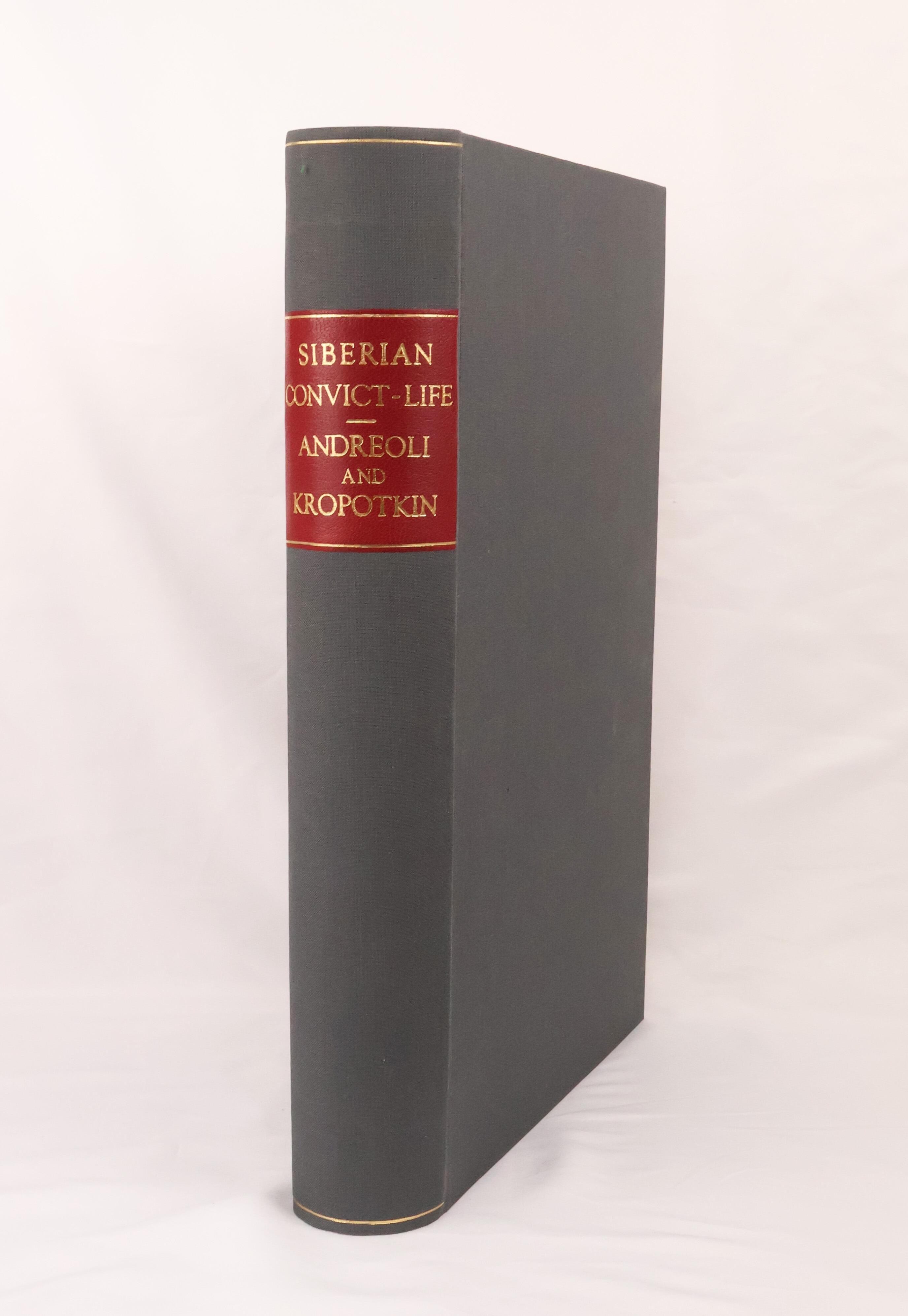
A memoir of Siberian prisons by Kropotkin and Andréoli
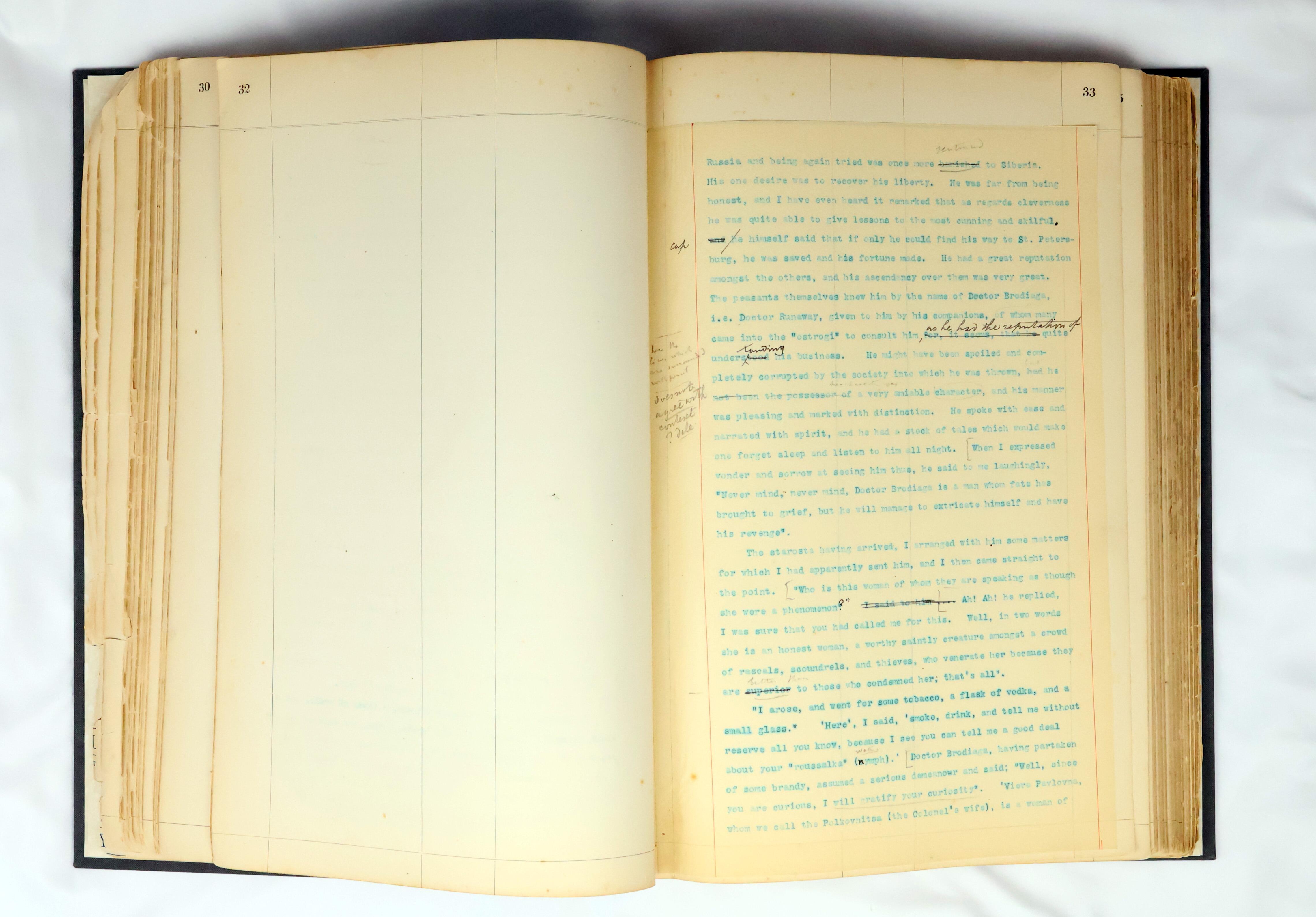
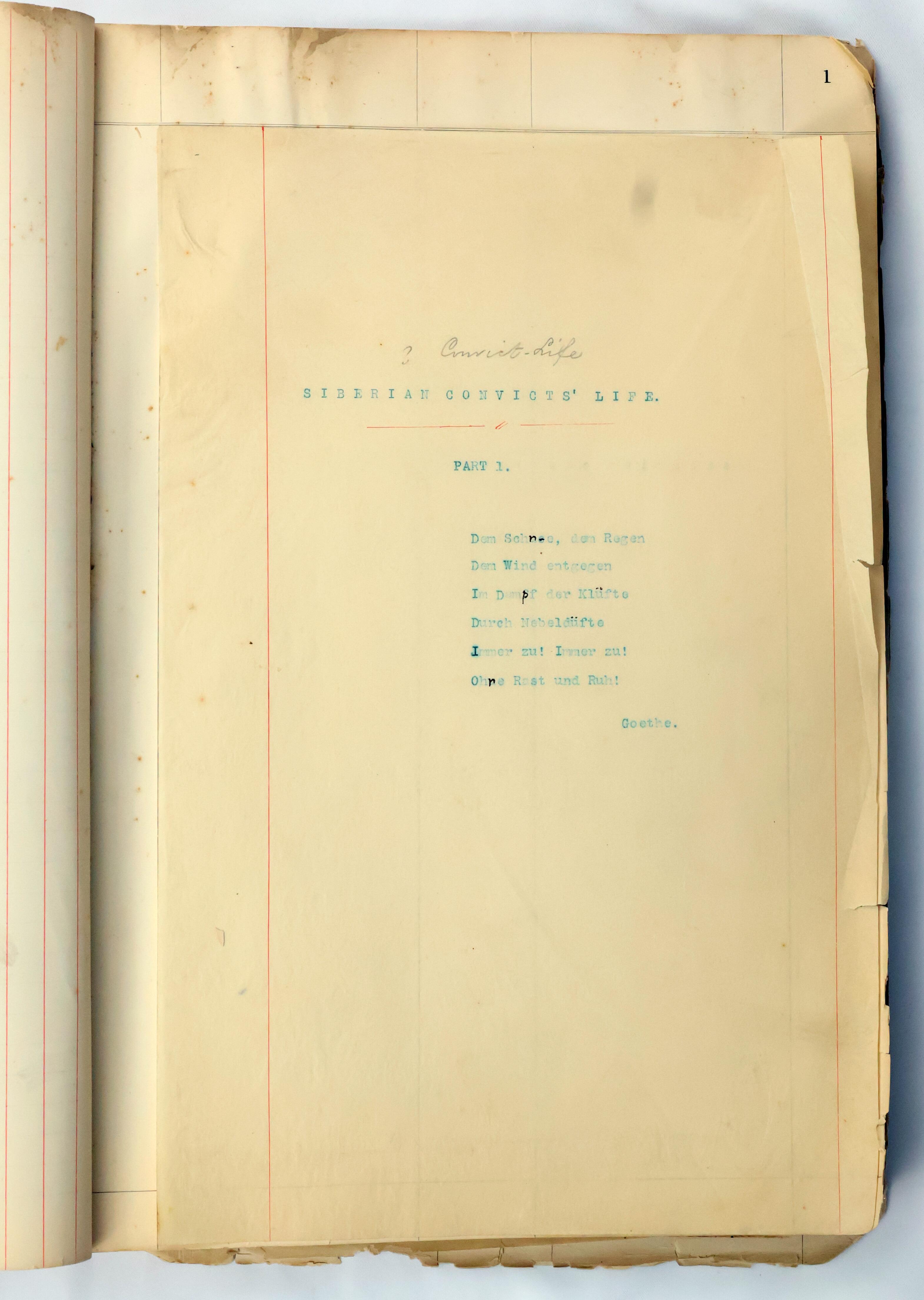
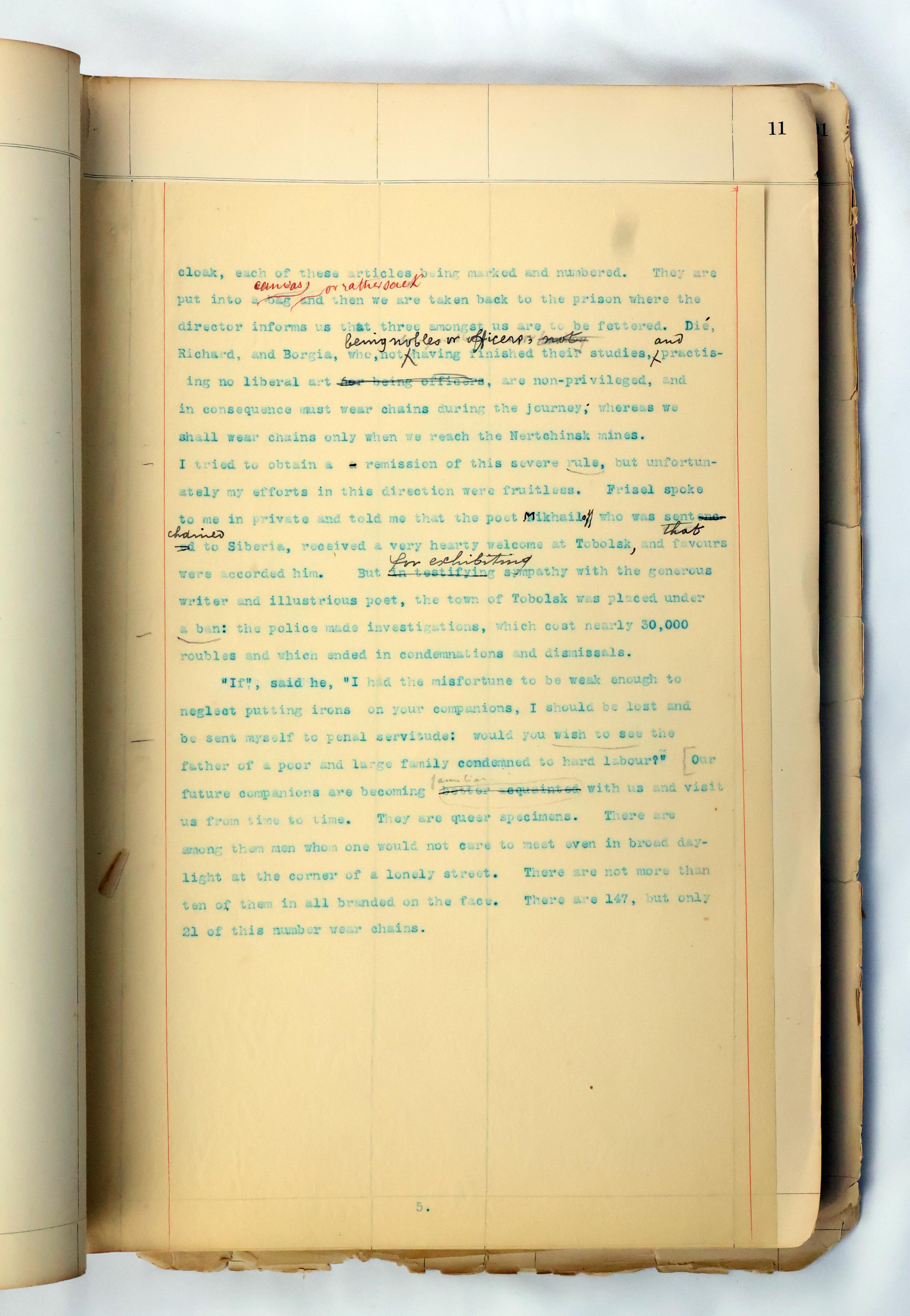
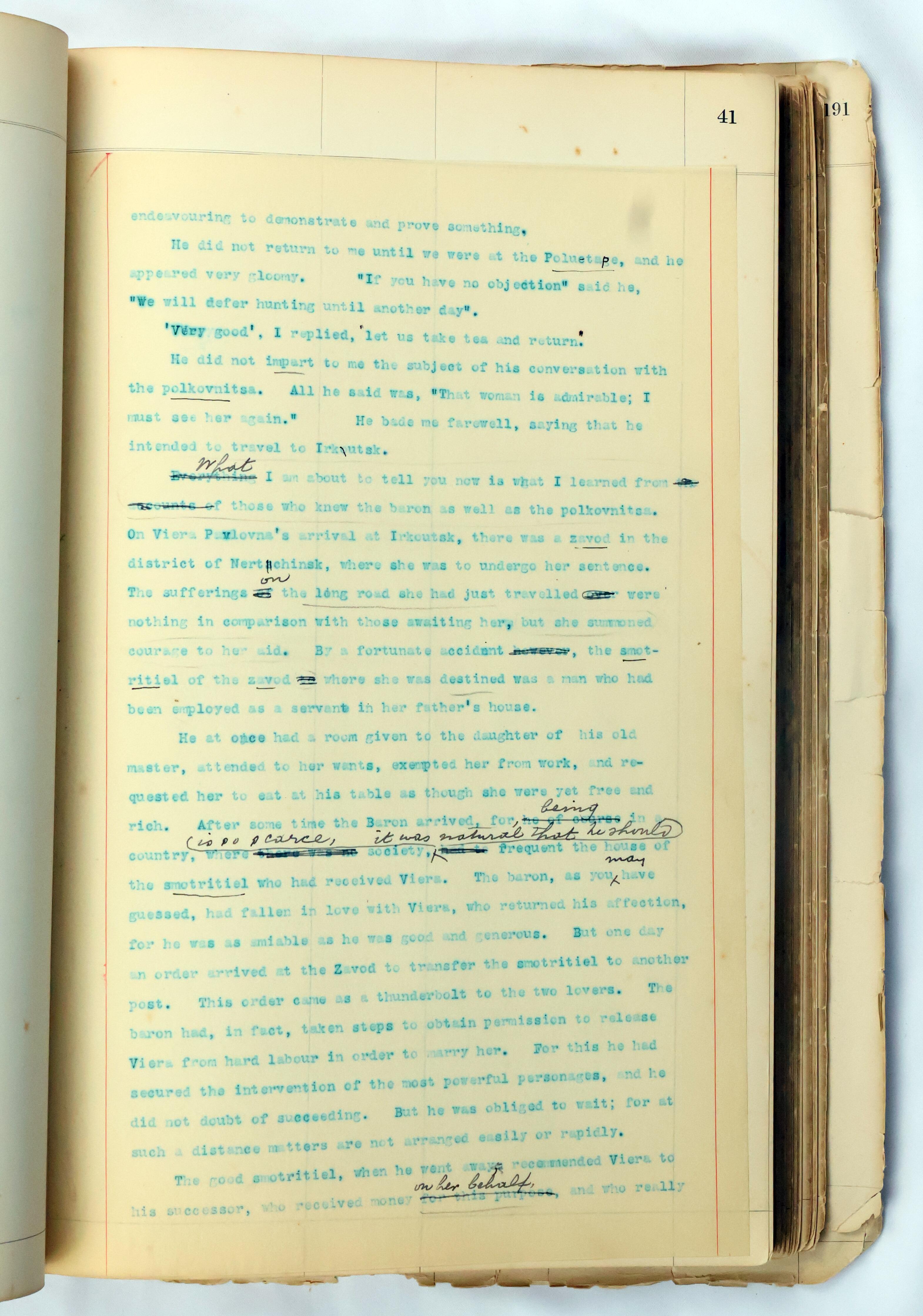
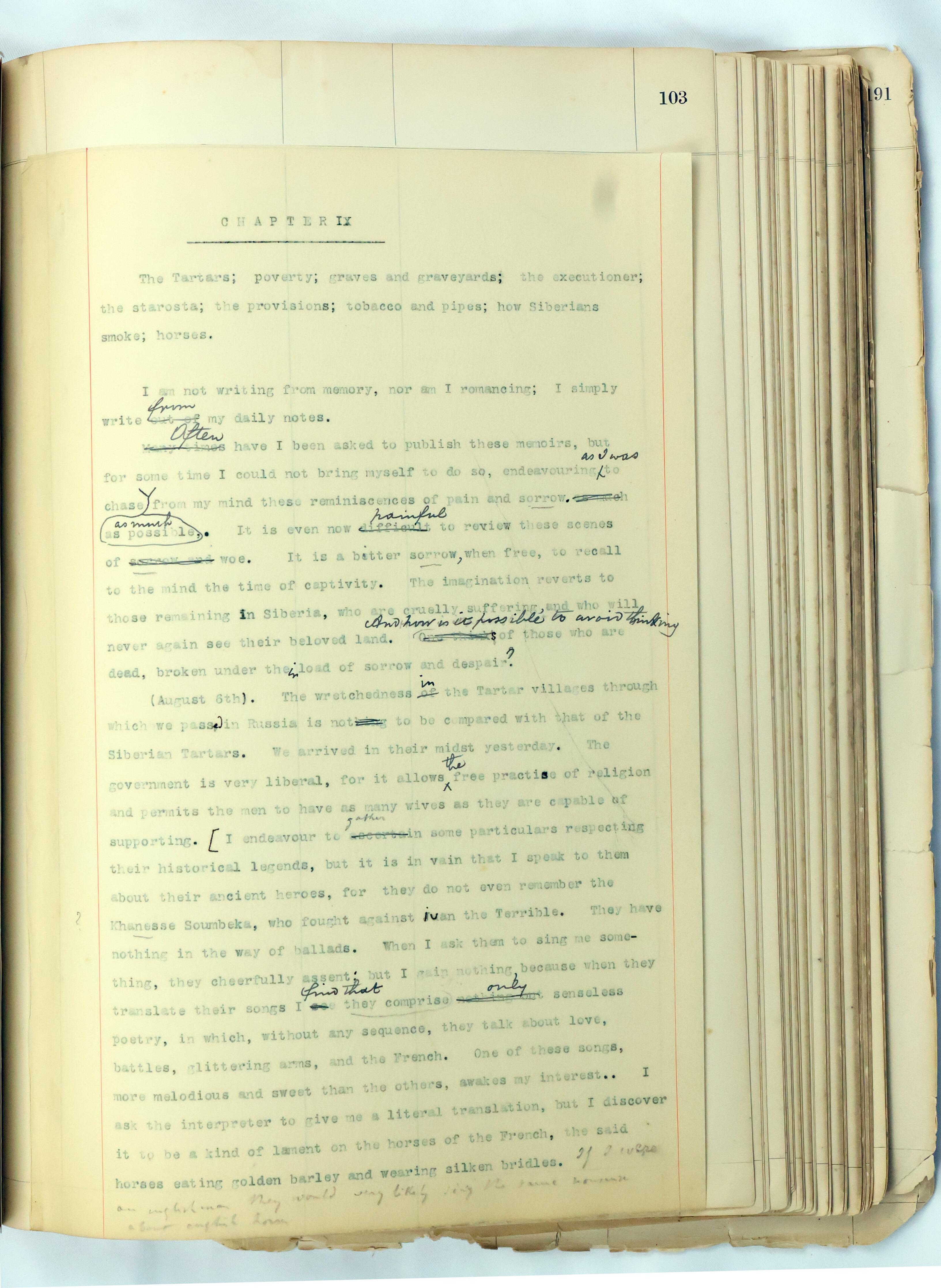
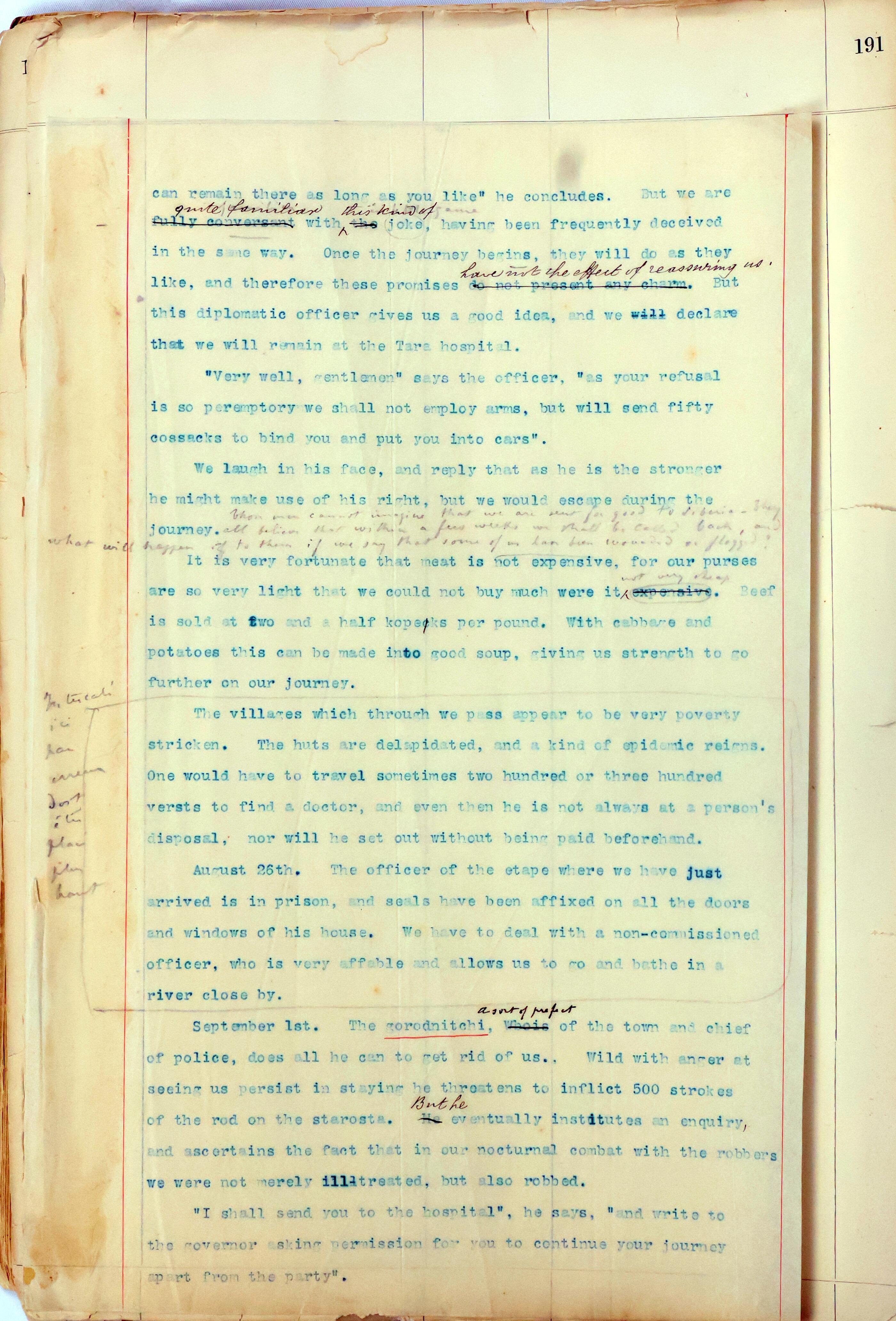
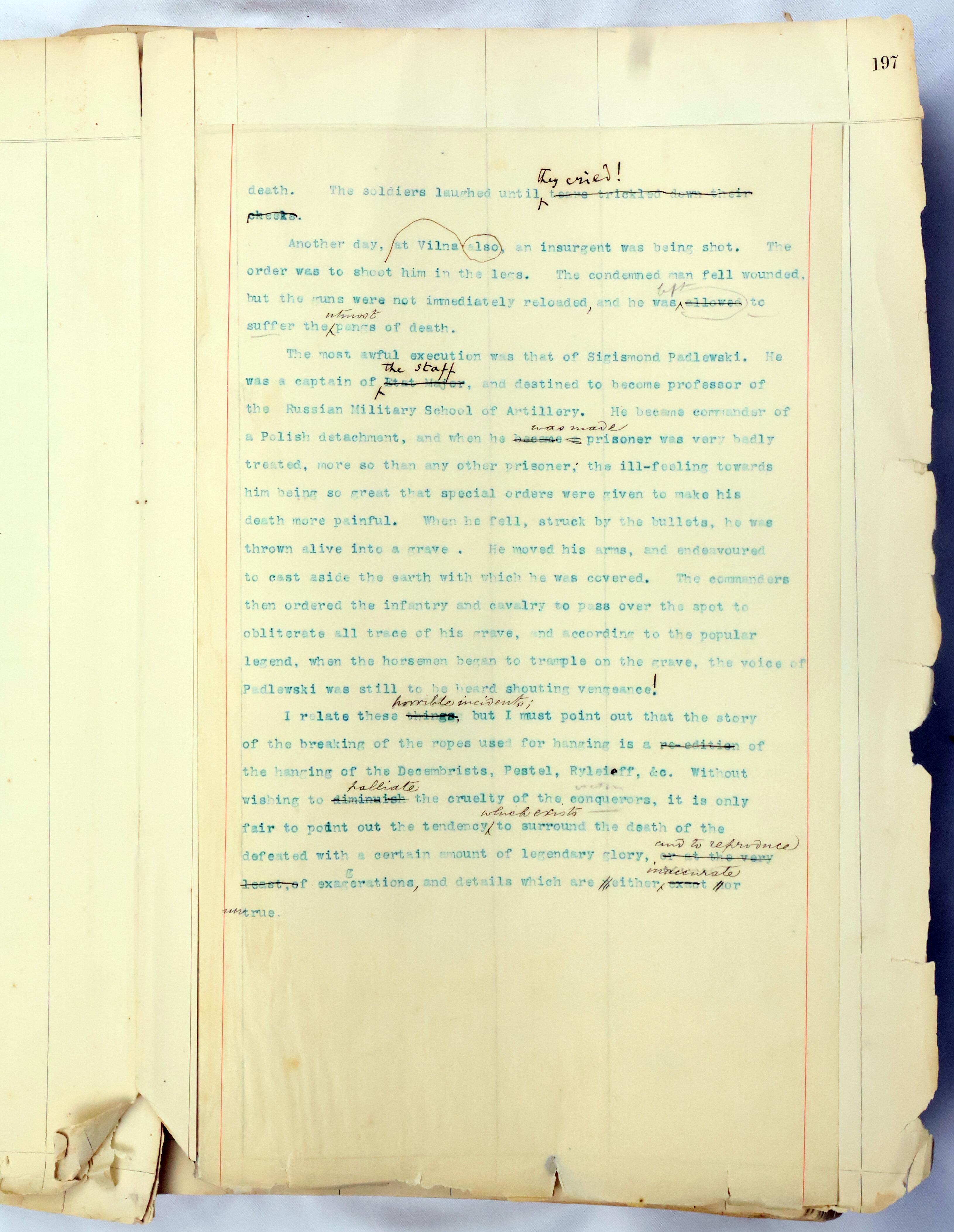
[Andréoli, Émile (1835–1901) and Pyotr Alexeyevich Kropotkin (1842–1921)]. Siberian Convict Life. Corrected typescript, circa 1886. 99 pp., each page mounted on the recto of a leaf of a ledger, collated thus: [handwritten title page]+[9] thumb-indexed blanks + pp. 1-198. Although this is clearly the work of Andreoli and Kropotkin (see below), neither of their names appears anywhere in the text. The typescript itself appears to be a carbon copy on onion skin paper ruled with red marginal borders, heavily corrected in two hands. The typescript generally is in good condition, lightly aged and with creases. The pages on which the typed sheets are mounted are still supple, but they are quite worn at the edges, the result of the ledger having been disbound for many years. The work is newly rebound in Gulag grey.
The typescript for an unpublished memoir of Siberian prison based on the French text of Émile Andréoli, translated by the anarchist Pyotr Kropotkin, with extensive corrections by both.
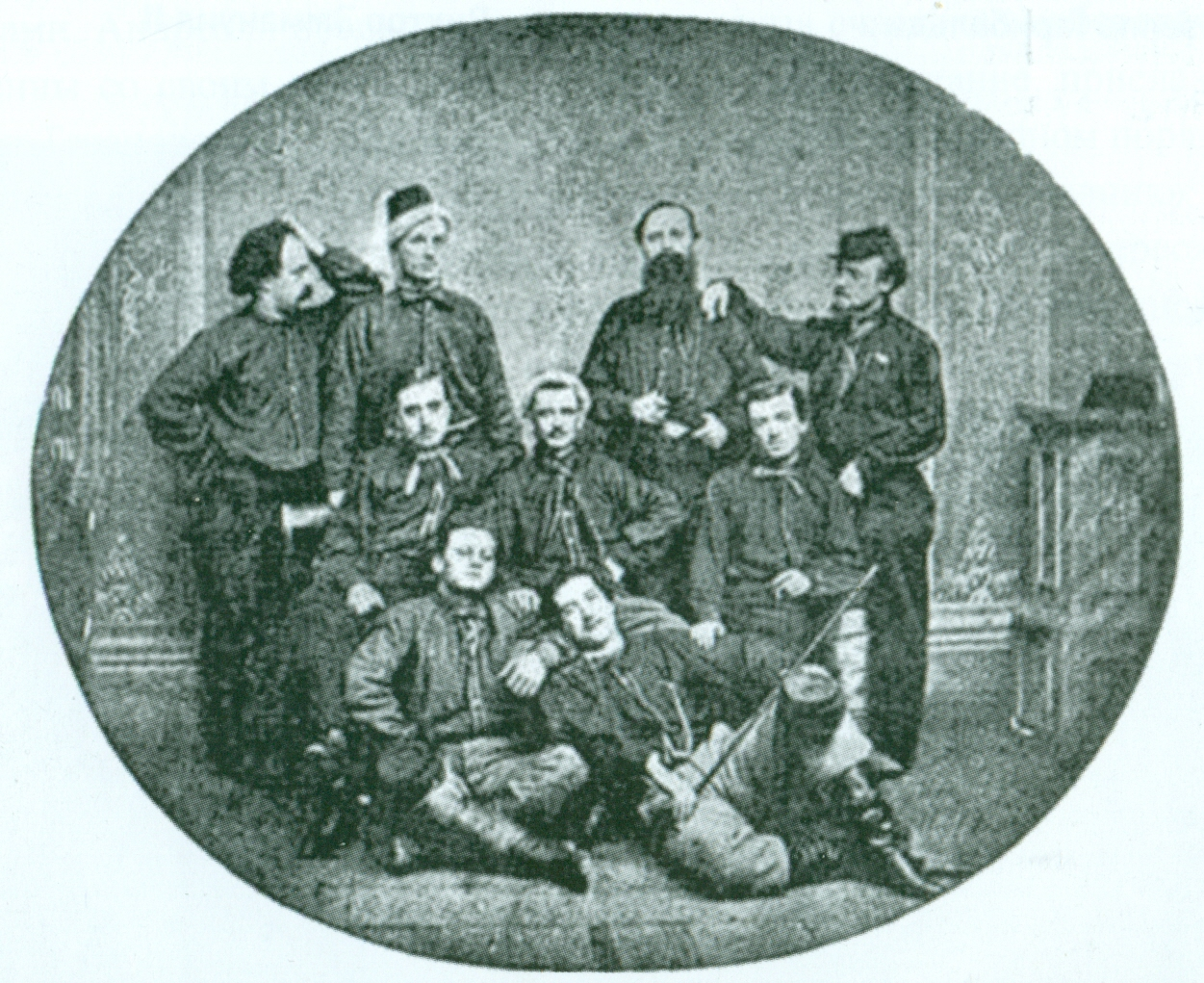
Italian soldiers under Francesco Nullo’s command bound for Poland, 1863. Andréoli, in profile, is standing at left. His doomed commanding officer Luigi Caroli is reclining at right, holding a sword.
Émile Andréoli, a native of Besançon of Italian descent, was teaching at a Parisian lycée when he – like many other young men who idolized Guiseppi Garibaldi – was moved by news of the January Uprising in Poland. He signed up with the forces led by the Italian military hero Francesco Nullo (1826–1863) to help the nationalstis overthrow the yoke of tsarist oppression, but the Battle of Krzykawka in March 1863 undid his dreams of glory. Nullo was killed, and Andréoli along with the other combatants in the detachment led by Luigi Caroli (1834–1865), was captured. Initially condemned to death, the foreign soldiers received the ostensibly lighter sentence of twelve years of hard labor at a prison camp near Irkutsk, where the survival rate was notoriously low. Caroli would be one of the first to die.
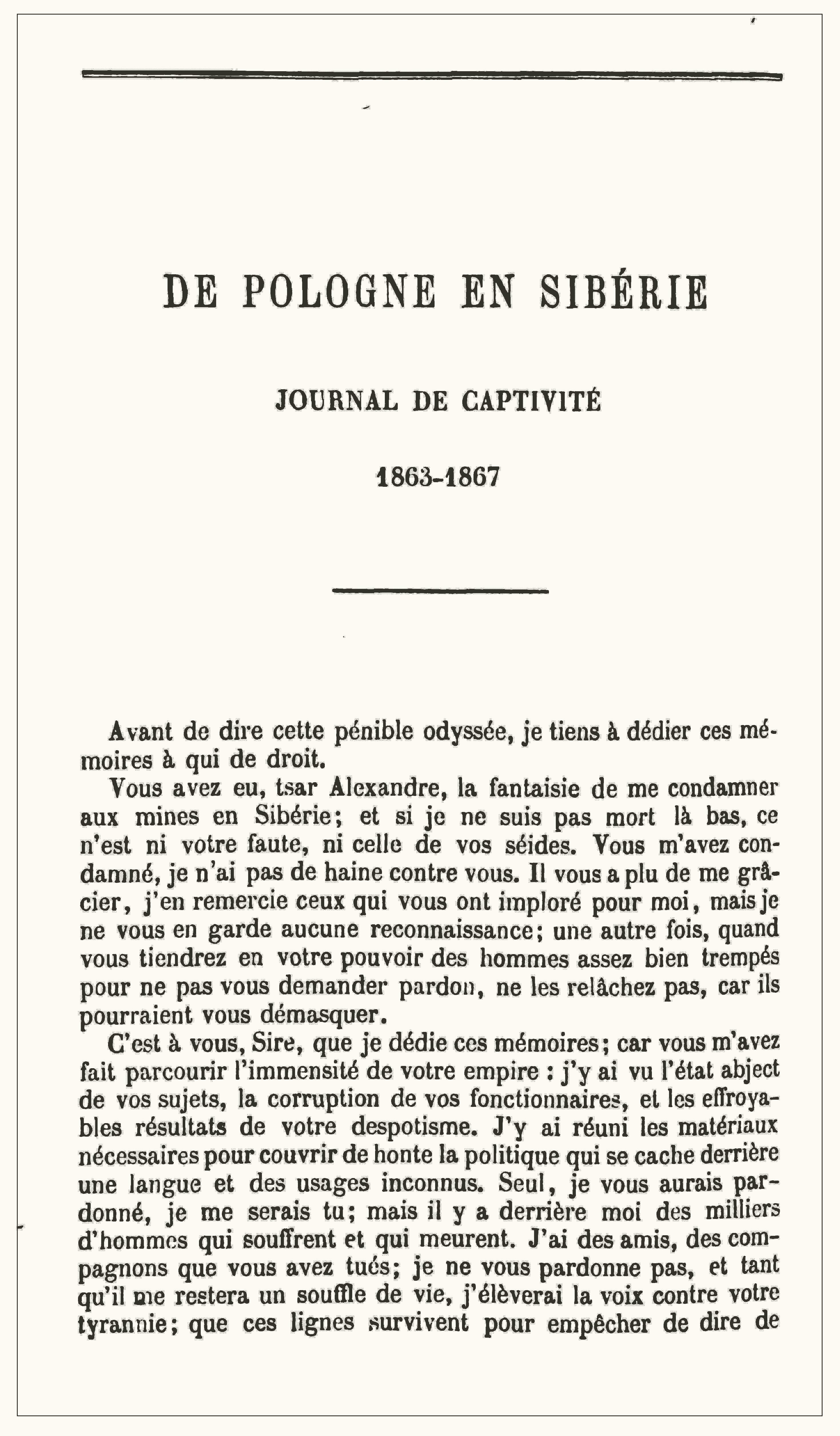
First page of the original serialization of Andreoli's Siberian diaries in the Revue moderne
After four years, Andréoli obtained early release thanks to the intervention of the French government, and he was returned to Paris. He set about documenting his experiences. Andréoli’s memoir first saw print as a serial in the Revue Moderne from August to October, 1868. It was published in book form the following year and translated into Italian in 1869. In the years since, Andréoli’s text has been a key source for histories of the January Uprising and of the katorga system of penal servitude in Imperial Russia. Karolina Firlej-Bielańska translated portions in Polish for her 1923 history of Nullo’s expedition, and the entire text has also recently been issued in Russian.
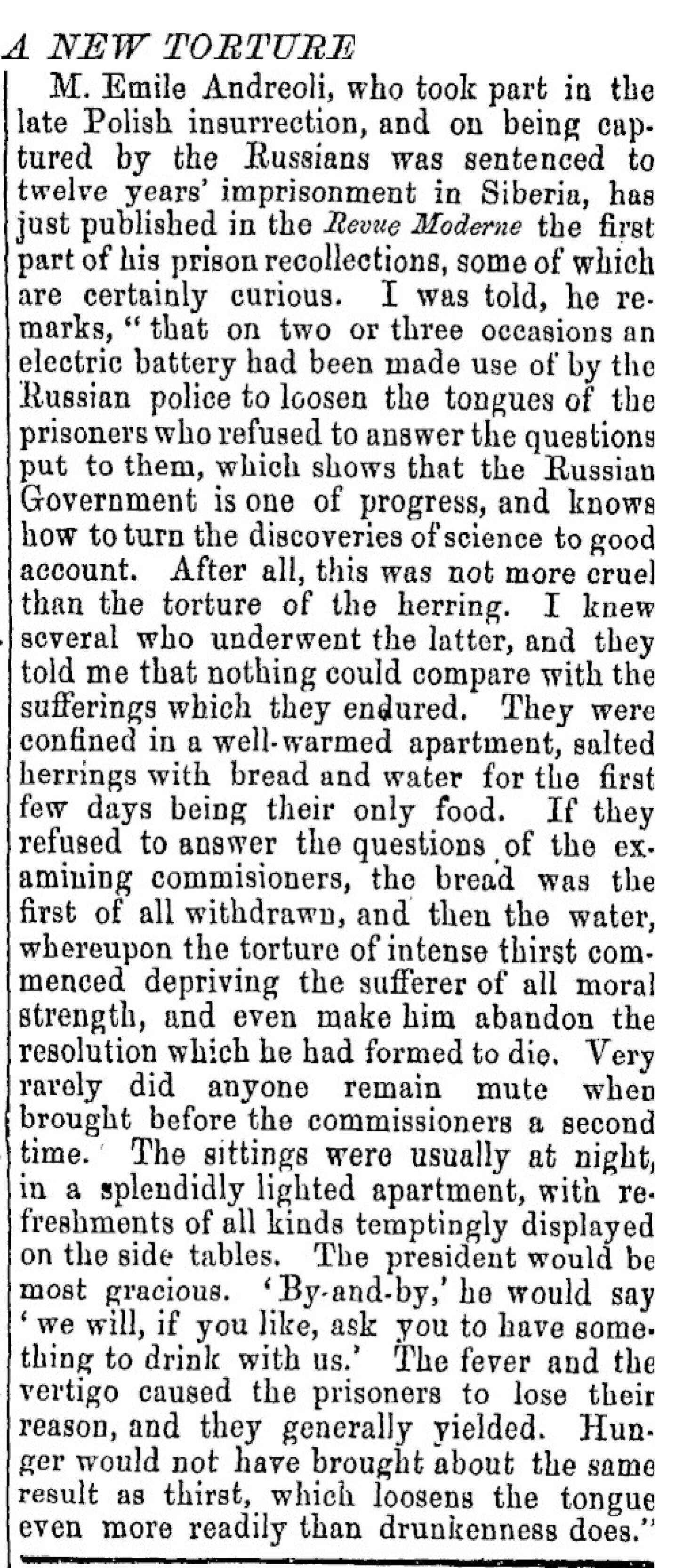
Wellington Independent, v. XXIV, n. 2798, 16 February 1869, Page 4
Andréoli’s discussion of Siberian prisons did not make as much of an impact on the Anglophone world as it did on the Continent. Some newspapers at the time reprinted his incidents of atrocity. In 1882, the English adventurer Henry Lansdell would draw upon the memoir briefly for his generally discussion of the katorga system in his wildly popular travelogue of Siberia. Lansdell’s account was generally benevolent. (For example: “The Russians introduce or allow the introduction into their prisons of an ameliorating influence, in the form of local committees, for furthering the temporal welfare of the prisoners.”) When the anarchist aristocrat Pytor Alexeyvich Kropotkin, himself no stranger to the privations of prison and exile, read the book he was incensed. “Mr. Lansdell, who has crossed Siberia a few years ago, and, after having hastily cast a glance on a few Siberian prisons, published a book, in which he tried to represent Russian and Siberian prisons under a smiling aspect,” Kropotkin wrote. “No wonder that his description did not agree with mine.” In a series of articles for The Nineteenth Century, Kropotkin administered a powerful corrective, drawing in part upon Andréoli’s account. “I hope to publish soon an episode of Polish exile of which I was an eye-witness, and which, I am afraid, will rather confirm M. Andreoli's revelations,” Kropotkin promised.
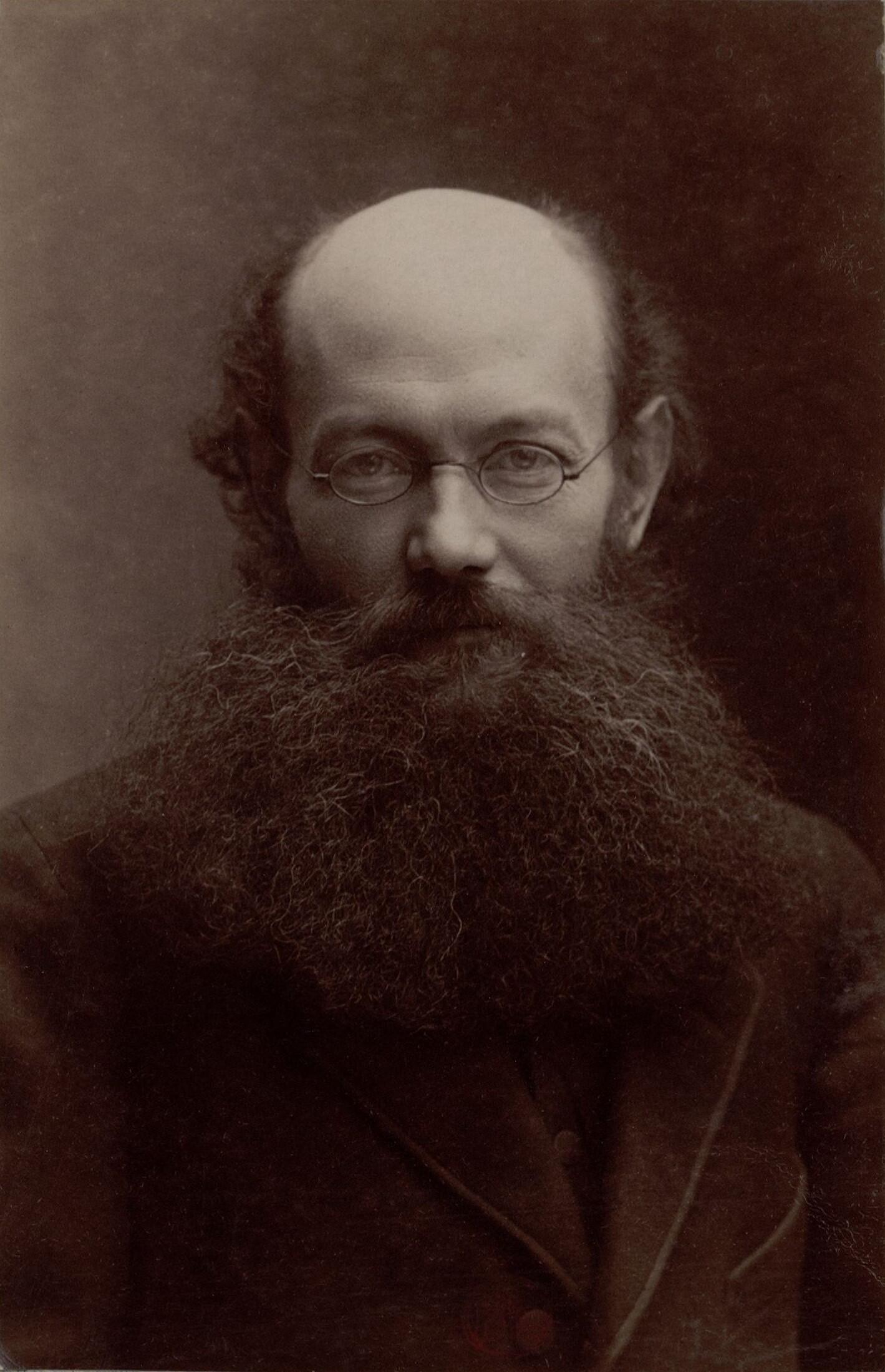
Kropotkin in 1886, photographed by Felix Nadar
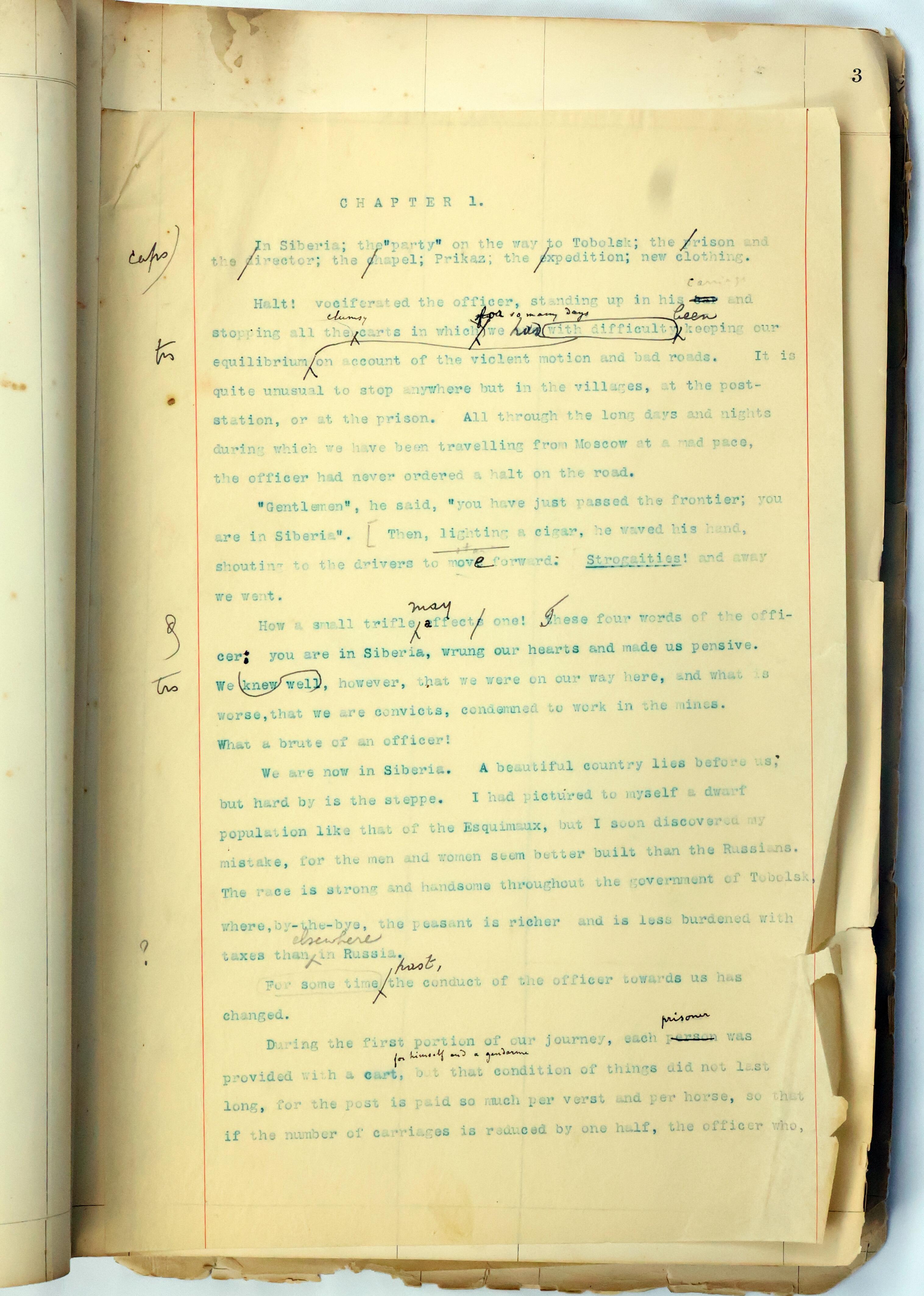
The present manuscript was the result. Siberian convict life was never published but likely intended for Freedom: A journal of anarchist socialism, the newspaper Kropotkin founded in 1886. Both he and Andréoli were living in London at the time, and the two appear to have collaborated on the text. Siberian convict life is based primarily on selections from Andréoli’s published text (chapters 14 to 35 to be precise): it opens with his arrival in Siberia and omits his battlefield exploits. It contains significant new material including statistics by Kropotkin and detailed passages, some of which are novelistic:
“Halt!” vociferated the officer, standing up in his carriage and stopping all the clumsy carts in which for so many days we had been keeping our equilibrium with difficulty on account of the violent motion and bad roads. It is quite unusual to stop anywhere but in the villages, at the post-station, or at the prison. All through the long days and nights during which we have been travelling from Moscow at a mad pace, the officers had never ordered a halt on the road. “Gentlemen”, he said, “you have just passed the frontier; you are in Siberia.” Then, lighting a cigar, he waved his hand, shouting at the drivers to move forward. Strogaities! and away we went. How a small trifle may affect one! These four words of the officer: you are in Siberia, wrung our hearts and made us pensive. We well knew, however, that we were on our way here, and what is worse, that we are convicts, condemned to work in the mines. What a brute of an officer!
Other new passages bear the marks of lived experience:
It is very fortunate that meat is not expensive, for our purses are so very light that we could not buy much were it not very cheap. Beef is sold at two and a half kopeks per pound. With cabbage and potatoes this can be made into good soup, giving us strength to go further on our journey.
The extensive markings appear to represent a dialogue of sorts between the collaborators. In the margins alongside one lengthy passage that does not appear in the published version is a pencil annotation by Andréoli suggesting that the new text be placed “plus haut.” Passages in translation clearly were rendered made with an eye to English readers: for example a reference to “la dernière de nos sous-préfecture” in the original version appears in this manuscript as “the meanest of the English cities.”
Russian historian Ben Phillips examined the present manuscript in the course of researching his 2016 doctoral dissertation. He reported:
This manuscript, entitled ‘Siberian Convicts’ Life’, is currently in a private collection in London. … Although it is undated and the translation unattributed to Kropotkin, the marginal handwriting is recognisably his, and given the material’s provenance there is no reason for supposing it dates to any other period than that in question [i.e. the mid-1880s]. … the manuscript features a second set of annotations, apparently from Andreoli himself, which further suggest that the project was not abandoned in haste. Kropotkin’s own notes replicate many of the statistical claims used in his Nineteenth Century articles.
Phillips found the result unsatisfactory in terms of historical accuracy. The text, he writes,
is extremely light on detail and highly emotional, portraying Siberia as “the land of torture, where anyone who commands may be an executioner in whatever way he likes, for his mission is to torment both soul and body.” He is extremely critical of almost all previous accounts of Siberian exile, yet himself epitomises the very tendency towards prurient exaggeration and sentimentalism of which he complains. … That Kropotkin ultimately never published Andreoli’s memoir is hardly surprising: what is surprising is that, as a fluent French speaker, he undertook the project in the first place and (to judge by his numerous marginal notes and statistical digressions) tried hard to produce something with the appearance of documentary merit.
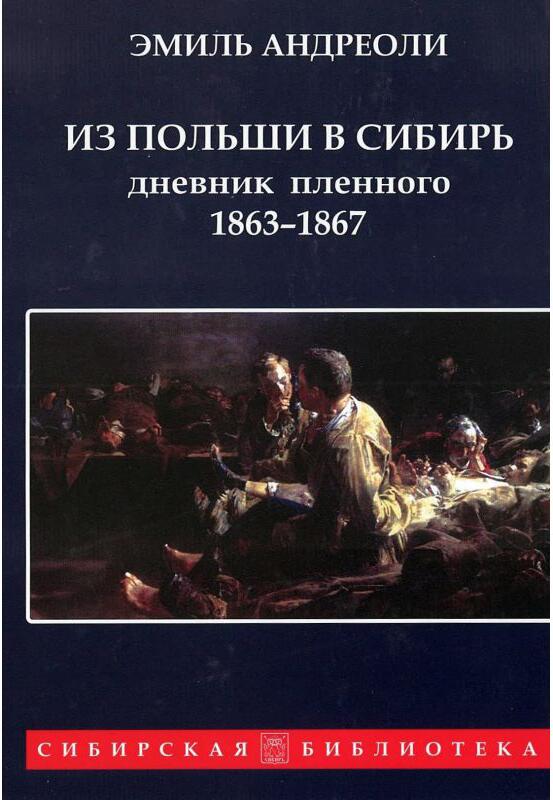
A Russian translation of Andréoli’s memoir was published in 2011
Matters of documentary accuracy aside, this extraordinary collaboration between the young French adventurer who got more than he bargained for and the great Russian anarchist who claimed more than he could prove offers ample resources for further research. Given the great importance of Émile Andréoli's memoir to the study of Garibaldinos in Poland, and of Pyotr Kropotkin to the history of prison reform, this final revision of a work that has appeared in French, Italian, Polish and Russian but not English is ripe for publication.
Selected References
Agazzi, Alberto. Gli Italiani e l'insurrezione polacca del 1863, Studi Garibaldini 4, Bergomum XXXVII (1963) pp. 35-48.
Alborghetti, Federico. La spedizione degli Italiani in Polonia nel 1863. Bergamo : dalla Tip. Pagnocelli, 1863.
Andrault-Schmitt, Claude. Du Poitou au bagne de Sibérie : l’odyssée d’Émile Andréoli, un érudit engagé en Pologne (1863-1866). Revue historique du Centre-Ouest, 2024, Les aventuriers de l’Europe : des vikings aux insurgés, XXI, pp. 223-297
Andréoli, Émile. De Pologne en Sibérie: journal de captivité, 1863-1867, serialized in Revue moderne, 48-49 (1868)
-----. De la Pologne à Siberie. Paris : Bibliotheque Nouvelle, 1869
-----. [tr.] Da Polonia alla Siberia. Giornale di prigione (Bergamo, 1869, translated from French)
-----. [tr.] Из Польши в Сибирь: Дневник пленного: 1863-1867, tr. Aleksej Stepanovič Gulin. Čita: Èkspress-izdatel'stvo, 2011
-----. Le gouvernement du 4 septembre et la Commune de Paris : 1870-1871. Paris : A.
Firlej-Bielańska, Karolina. Nullo i jego towarzysze (Warszawa 1923)
Kropotkin, Pyotr Alexeyvich. Russian prisons, Nineteenth Century 13 (January 1883), pp. 27-44
-----. The Fortress prison of St Petersburg, Nineteenth Century 13 (June 1883), pp. 928-949
-----. Outcast Russia, Nineteenth Century 14 (December 1883), pp. 964-976
-----. The exile in Siberia, Nineteenth Century 15 (March 1884), pp. 475-493
-----. In Russian and French prisons. London: Ward and Downey, 1887
Lansdell, Henry. Through Siberia. 2 vol. London: Sampson Low, Marston, Searle and Rivington, 1882
-----. A Russian prison, Contemporary Review 43 (February 1883), pp. 275-288
Liszewscy, Ewa and Bogumił. Viva la Polonia! : cudzoziemcy w Powstaniu Styczniowym 1863 r. Zakrzewo: Replika, 2018
Phillips, Ben. Political exile and the image of Siberia in Anglo-Russian contacts prior to 1917. Ph.D. thesis, University College London, 2016
-----. Siberian exile and the invention of revolutionary Russia, 1825–1917. London: Routledge, 2022
Product tabs
$0
$8,750
Recommend this product
A memoir of Siberian prisons by Kropotkin and Andréoli
Related products
Original painting of the American bark Fury, with the captain’s ledgers
Wilson, Samuel H. (1836 – 1888). Ledgers of disbursements for the bark Fury and other vessels under his command, 1865 – 1887. 140 numbered pages, cont...
view details
$3,750
View details

A slave sale mandated by the Louisiana Supreme Court
Sale of Slave by Suc[cessors] of Woodruff to Dr. James G. Belden, dated 1 April 1858. Holograph manuscript on printed form folded to make 4 pages. A ...
view details
$3,500
View details

Consumer culture, art, and subjectivity in Kazimierzowo, Chicago
Porembski, Olga V. (1924-2011). Rose Rosinski and Bruno Zidek, April 11, 1942. 96 leaves, 11½ x 14 in. (29 x 26 cm.) Homemade scrapbook comprised pri...
view details
$1,250
View details

A most exquisite corpse
$8,500
A most exquisite corpse
Lise Deharme (1898–1980), Paul Éluard (1895–1952), Georges Hugnet (1906–1974) and Raymond Queneau (1903–1976). Cadavre exquis, [Paris], circa 1925-193...
view details
$8,500
View details

Manuscript for an unpublished masterwork in American medicinal botany
Havard, Valery (1846–1927). Medical and Economic Botany. Typescript, ca. 1897-98. 1291 numbered leaves on thin laid paper, with holograph emendations ...
view details
$0
View details

A Whittier between the Devil and Lowell factory girls
Whittier, [ _____ ], letter to William West, July 9, 1832. A lengthy, substantial, and amusing letter written on three sides of a single sheet, 39 cm ...
view details
$125
View details

Samuel Palmer: The sketchbook of 1865-71
Palmer, Samuel (1805–1881). Pocket notebook, 1865-71. 50 leaves, about 7 x 12 cm. The notebook has been partially paginated in pencil by Palmer: [pp] ...
view details
$37,500
View details

Correspondence from the 18th century Irish poet Mary O’Brien
O'Brien, Mary (fl. 1785–1790). Three autograph letters from the author and her husband Patrick O’Brien to Michael Bourke, 1785 and n.d. 3 pp. bifolia....
view details
$3,500
View details
William Stanley Braithwaite / Winifred Virginia JACKSON / H. P. LOVECRAFT: the racial politics and family romance of Boston poetics
Braithwaite, William Stanley (1878-1962). "Del Cascar," manuscript poem in Anthology of Magazine Verse for 1921. Boston: Small, Maynard & Company,...
view details
$2,750
View details

A revolutionary Tagalog manuscript from the Philippine-American War
Trinidad, Críspulo (1839-1925). Buhay ni Judit. Holograph manuscript, signed by the author and dated 22 September 1899. 16 x 22 cm; 99 pp. written on ...
view details
$8,500
View details

A Calligraphic Manuscript for a Pioneer in Religious Education
[Athearn, Walter S.] To Our Friend Walter S. Athearn, Dean, Boston University School of Religious Education and Social Service, 1918-1928. Four vellu...
view details
$350
View details

Manuscripts by Elisha Deming Andrews, Vermont minister and Michigan pioneer
Andrews, Elisha Deming (1783-1852). An archive of twelve sermons, with additional manuscripts, 1806-1825. Over 250 pages. Very good condition. A m...
view details
$850
View details
On
hold
hold
The Burmese novels of Maurice Collis: a manuscript archive
Collis, Maurice (1889 – 1973). Archive for his six works of fiction. London, 1937 to 1970, including holograph manuscripts, corrected typescripts, cor...
view details
$18,500
View details

The Letters of Lewis Carroll: Morton Cohen's annotated proofs
Dodgson, Charles L. (1832–1898). The letters of Lewis Carroll. Two volumes. Edited by Morton N. Cohen [1921–2017] with the assistance of Roger Lancely...
view details
$1,500
View details

A 30-year Play-by-Mail collection
Price on Request
A 30-year Play-by-Mail collection
Persons,
Kelly S. (b. 1955), collector. Play-by-Mail Games archive, circa 1972–2005. An
extensive collection representing the activities of one dedica...
view details
Price on Request
View details

Charles COTTON. Signed document (1663). A bond to the creditor who acquired Beresford Hall
Cotton, Charles (1630-1687), Bond for the performance of covenants between Charles Cotton and Joseph Woodhouse, dated August 1, 1663. Parchment, about...
view details
$5,000
View details
Publishing Chekhov: Anna Yevreinova's struggle to fund Severny Vestnik
Yevreinova, Anna Mikhaylovna (1844–1919), et al. A gathering of five items relating to the Russian literary periodical Severny Vestnik, including four...
view details
$4,500
View details