


A Jesuit Father's unpublished memoir of the Earling exorcism
Bunse, Frederick J., S. J. (1863–1935). A.M.D.G. [Ad maiorem Dei gloriam] The Earling possession case: an exposition of the exercism [sic] of "Mary" a “demoniac” and certain marvelous revelations fortelling [sic] the near advent of Antichrist and the coming persecution of the Church in the Years 1952–1955. Buffalo, N.Y.: Frederick J. Bunse [c. 1933-34]. [1]+21 pp; 9 x 15 in. Carbon typescript on legal-sized paper stapled in a simple paper wrapper with a typed title. Some holograph corrections; ink faded on some pages; very good.
An extraordinary unpublished account of the most notorious exorcism in American history, presenting extensive detail not otherwise recorded and offering unique insight into popular Catholicism at mid century.
Begone, Satan!
“La plus belle des ruses du diable est de vous persuader qu’il n’existe pas,” observed Baudelaire. But among American Catholics in the first half of the twentieth century, few were under the delusion that the Devil was imaginary. The explosive news of a lengthy exorcism conducted over a harrowing 23 days in 1928 made nationwide headlines when a detailed account in English was published in 1935. The energumen – a technical term referring to the person possessed – has been variously identified as Emma Schmidt or Anna Ecklund; in the present typescript she is called “Mary,” born in 1882. The exorcism was performed by Theophilus Riesinger, O.F.M. Cap. (1868–1941) with assistance from Joseph Steiger (1881–1938), the pastor of St. Joseph’s Parish, who hosted the exorcism at the Convent of the Franciscan Sisters in Earling, Iowa.
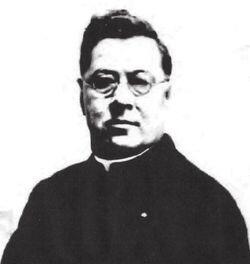
Fr. Steiger: the assistant at the Earling exorcism and the source for Carl Vogel’s Begone, Satan!
The first account drew on Fr. Steiger’s testimony, given while he was visiting Germany. It was written by Msgr. Carl Vogl (1874–1941), editor of the Catholic periodical Altöttinger Liebfrauenbote (and a staunch opponent of the Nazis) and published first as a series of articles in 1931 then collected as a pamphlet. Celestine Kapsner O.S.B. (1892–1973) translated Vogl’s work into English, publishing it in 1935 with the approval of the censor and the imprimatur of the bishop of St. Cloud, Minnesota. Begone Satan! became something of a best seller. Widely distributed and frequently reprinted, it brought public attention to the events in Earling. William Peter Blatty drew upon the work for his novel The exorcist, and Vogl's account has recently been adapted as a feature film.
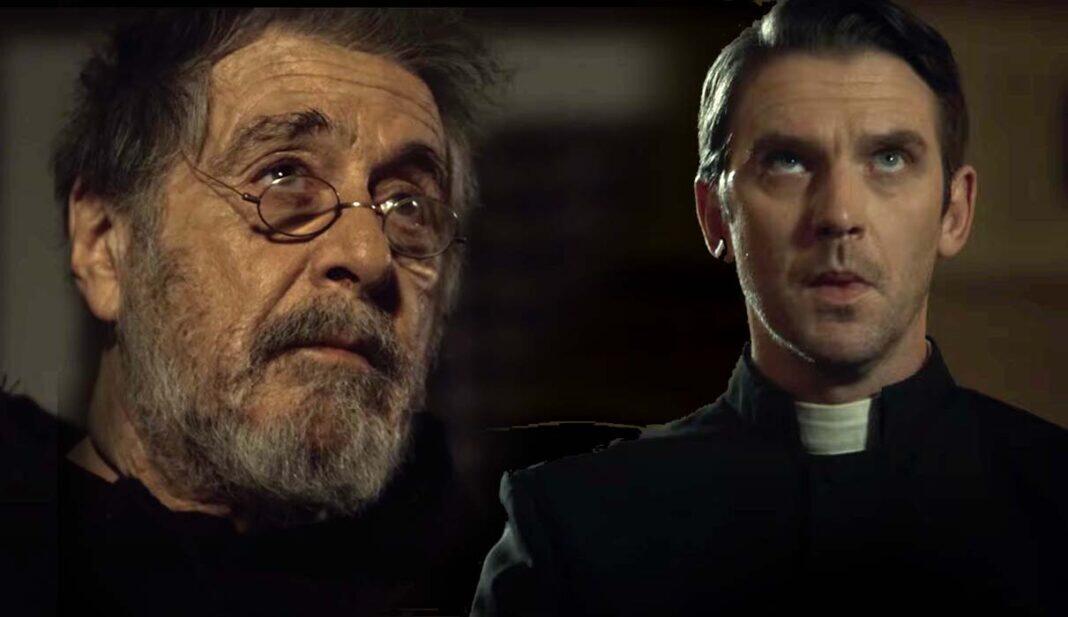
Al Pacino as Fr. Theophilus Riesinger and Dan Stevens as Fr. Joseph Steiger in The Ritual (dir. David Midell, 2025)
The Bunse Manuscript
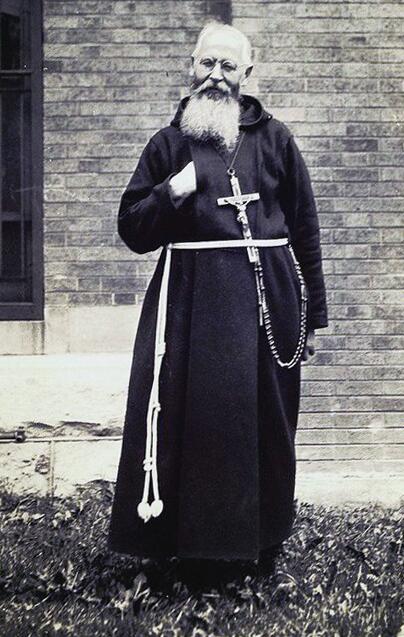
Fr. Riesinger: the exorcist at Earling, and the source for the present manuscript
The present manuscript, written to correct the record presented in Begone Satan!, offers Fr. Riesinger’s own testimony. Among the many revelations of the text is that the exorcisms did not begin in 1928: Fr. Riesinger had first performed the rites over Mary X in 1908. Nor did they conclude after the spiritual marathon Fr. Steiger described. “Mary was free but only a very short time, perhaps a day or two … The second and most trying period of the Earling exorcisms was soon to begin for the honor of God, the welfare of the Church, and the salvation of Souls.” The hosts of Hell returned to Earling in 1929 and the exorcisms resumed, with “billions and billions of devils cast into the abyss.” They were still ongoing as the author was writing this account. “Lucifer shouted in despair: ‘Oh, that these exorcisms would take an end!’”
Another revelation of Bunse’s account is that like her contemporary, the stigmatic Margaret Reilly (1884–1937), Mary proved to be both energumen and prophet, a medium for angels as well as demons. Through her, Jesus, Mary, the archangel Michael and other divine visitors limned visions of the tribulations to come. For Fr. Riesinger, this was the most important aspect of the events in Earling. “All the revelations which I have made to you are to be given to my servant, your confessor, that he may prepare the world.” When Fr. Riesinger left Earling, Mary continued to send him apocalyptic prophecies through the mail.
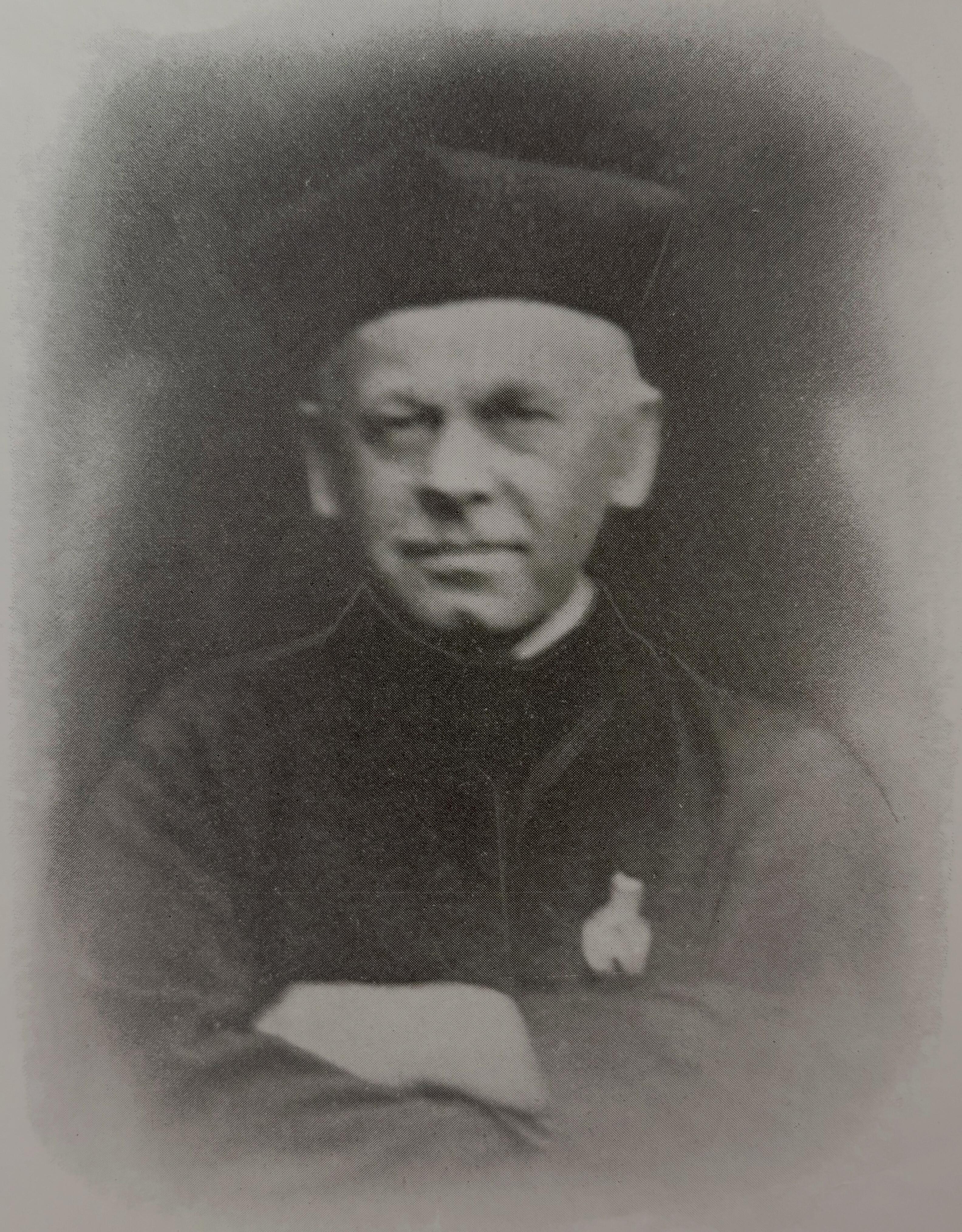
Fr. Bunse, author of the unauthorized account of the Earling exorcisms, pictured in the 1924 Arena (photo courtesy of Canisius High School)
Fr. Riesinger encountered opposition from other members of the clergy who were skeptical that each of the individuals for whom he performed the rite of exorcism was in fact a demoniac. There is no expression of doubt in the present text, which is remarkable given that it was written not by an itinerant devil-wrestling monk but by a staid Jesuit, the author of a textbook who had spent almost his entire career in academia as a professor of Latin.
Born in Elberfeld, Germany, Frederick J. Bunse entered the Novitiate in 1883 in Holland – Chancellor Otto von Bismark had suppressed Jesuit institutions in Germany a decade earlier. After a stint teaching at Canisius College in Buffalo, New York, and further study in Europe Fr. Bunse was ordained in 1897. In 1899 he returned to Buffalo to teach at Canisius High School. In 1924 he was transferred to St. Ann’s Church in Buffalo, where he remained until his death. A candid obituary in a Jesuit publication suggests that he was as rigorous with himself as with his parishioners. Once a heavy smoker, he quit “to mortify himself and because he deemed it more or less opposed to cleanliness.” As an officiant at St. Ann’s, “he sometimes refused Holy Communion to women who appeared at the altar rail with bare arms.” When other priests remonstrated with him for being too strict, he reminded them that the Pope had condemned “immodest dress.” His memorialist notes: “These and similar rigorous views marred his zeal to some extent” (Woodstock, p. 405).
While little other evidence of Fr. Bunse’s demonological interests have thus far come to light, an ode of seven stanzas by his colleague Patrick J. Cormican, S.J. (1858–1945) is telling. The occasion for the poem was the fiftieth anniversary of Fr. Bunse’s entering the Society of Jesus in 1883. It begins:
Just fifty years ago today
A life-long battle began
When a pious youth resolved to fight
The triple foe of God and man.
Since then he has battled valiantly
To do what soldier should or can.
Cormican’s poem suggests that it was not his teaching nor his pastoral duties that most occupied Fr. Bunse, but his spiritual warfare.
The Devil hateth humankind
Because ordained to fill his place;
He prompted Eve to tempt her spouse,
And Adam's sin foredoomed the race.
He still employs his deviltry,
And hides the while his demon face.
Our Jubilarian [Fr. Bunse] has fought
That triple foe for fifty years;
He has fought the battle constantly
Through thick and thin, through smiles and tears.
If God be with us in the fight,
There is no room for human fears.
(Cormican, p. 8)
Fr. Cormican praised Fr. Bunse as a hero while some of their clerical brethren considered him too harsh. The laity had their own opinions. For them, the Jesuit father was clearly on the side of the angels. Fr. Bunse's memorialist notes that at his passing his parishioners marked the presence of the supernatural :
His death occurred during Holy Week, and the funeral was held on Easter Monday. In the meantime, a demented girl who touched the body was miraculously cured. This is known in the parish. (Woodstock, p. 405)
The Earling Exorcism and the Mainstreaming of American Catholicism
All of the principals in the Earling case —the energumen, the exorcists, and the chroniclers — were natives of Germany. Divine messages channeled through Mary were also in German, though interestingly the demons spoke English. According to historian Paula M. Kane, in an odd way the Earling exorcism was a drama not only of Good and Evil but also of assimilation. The failed president campaign of Al Smith on 1928 brought to the fore the hostility many Protestant Americans felt towards Catholics. Anti-Catholicism was one of the central tenets of the Ku Klux Klan when it was reorganized in 1915. For Kane, the nationwide attention to the Earling case heralded a generational shift as American Catholics became increasingly assimilated into the mainstream, not by abandoning their immigrant roots but by disseminating some of the most traditional aspects of the faith.
The Earling exorcism became an event that propelled Catholics from homogeneous time into “messianic time,” transforming the United States into a battleground where cosmic forces are always wrangling … The message to American Catholics was clear: even though Christ’s casting out of devils took place in ancient Palestine, today, in the cornfields of Iowa or on the Hudson Palisades of New York, Lucifer and Antichrist were still lurking to snatch the unwary. … The irruption of evil forces in America propelled those living in ordinary time to a heightened need to derive lessons from reminders such as Earling and Peekskill. For one surgeon from Milwaukee …“No more vivid picture has been presented to us of the losing battle which the great enemy of the human race has been waging against the “camp of Christ.’” … [T]he message of Earling confirmed the singular powers of the ordained ministry to cast out demons. (Kane, p. 262)
The “heightened supernaturalism” that Kane discusses leaked out of once-insular Catholic communities into the mainstream. The Earling exorcism was thus the flip side of Bing Crosby’s affable Father Chuck in Going my Way (1944): crooning “Too-ra-loo, ra-loo-ral” and battling the forces of Hell represented two very different approaches to normalizing a faith that many non-Catholics in America regarded with suspicion.

Emmett J. Culligan fled to the hills after reading this manuscript
Heightened supernaturalism also motivated some American Catholics to take the sort of measures one usually associates with premillennial branches of evangelical Protestantism. In Earling, the spirits speaking through Mary revealed that the mother of the Antichrist was a nun who held intercourse with “the old serpent,” that Jesus would return in twenty years, and that the final battle between the hosts of Heaven and the hosts of Hell would unfold from 1952 to 1955. Entrepreneur Emmett J. Culligan (1893–1970), inventor of a water treatment system marketed nationwide, had recently been knighted by Pope Pius XII into the Order of St. Gregory the Great when he heard the news.
I took my family to the mountains in 1951 following the advice of the Apostle, Matthew, Ch. 24:16, in which he advised at the time of the “abomination of desolation” that we drop everything and head for the hills. I took this advice seriously. I had been reading the manuscript of the Jesuit Father, Reverend F. J. Bunse, S. J., in which he reviewed the exorcisms by Father Theophilus Riesinger O.F.M., Cap., at. Earling is a small town near the community where many of my people and the folks of Mrs. Culligan lived for almost a century. At the time of these exorcisms, the whole countryside was excited with what was taking place in the Earling church and convent of the parish buildings on top of the Earling hill. I believed the prophecies resulting from these exorcisms by Father Theophilus would occur as foretold. As the father of a large family, I considered it my duty to go into hiding in the mountains to prepare for the coming of the Antichrist. (Culligan, p. 197)
That Culligan had access to some version of this present manuscript is very interesting indeed. Fr. Bunse's account focused on those aspects of the exorcism that was not sanctioned by the Church, which forbids interrogating one possessed by the Tempter on future or hidden matters. Fr. Bunse made it clear that the manuscript was intended for private circulation only: “THESE ARE NOT TO BE PUBLISHED THROUGH THE PRESS OR FROM THE PULPIT,” he wrote. Fr. Bunse composed the manuscript after the publication in German of Carl Vogl's account of the exorcism and in February-March 1934 he submitted it for review by Church authorities. He died on 16 April 1935. Three months later, Fr. Kapsner's English translation of Vogl's work was granted the nihil obstat. The timing is intriguing: was the latter rushed into print to preclude the wider dissemination of Fr. Bunse's work?
If so, as Culligan's testimony reveals, these efforts met with incomplete success. Historian Joseph Laycock has traced two samizdat typescripts of Fr. Bunse’s account, one at the University of Scranton, the other at the University of St. Mary of the Lake. These typescripts were prepared posthumously -- each bears notice of Fr. Bunse's death "last year." In contrast, the present corrected typescript appears to be the author's own production. It concludes with a note soliciting comments to be sent to his address at 271 Watson Street, Buffalo.
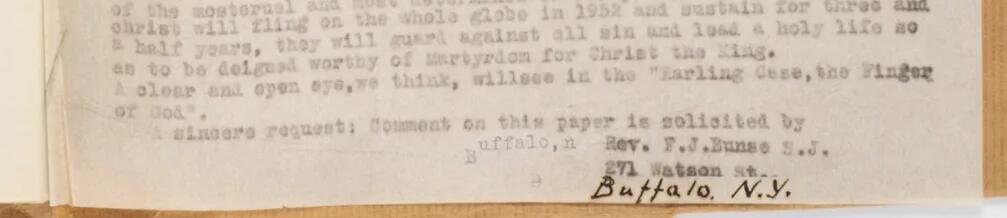
A fascinating and revealing document from a febrile period in American Catholicism.
Selected References
Avella, Stephen M. The Catholic Church in Southwest Iowa: a history of the Diocese of Des Moines. Collegeville, MN: Liturgical Press, 2018
Bandini, Albert R. Angels on horseback: A critical review of the pamphlet ‘Begone Satan! which relates an alleged case of demoniacal possession occurred in Earling, Iowa. 1936; Fresno, Calif.: Academy Press, 1950
Baudelaire, Charles. "Le Joueur généreux," Petits poèmes en prose. 1869
Blatty, William Peter. The exorcist. New York: Harper & Row, 1971
-----. If there were demons, then perhaps there were angels: William Peter Blatty's own story of The Exorcist. New York: Tor, 2015
Bunse, Frederick J. A Latin grammar for schools and colleges. Buffalo, NY: Charles Joseph Weber, 1906
Cormican, Patrick J. "Fifty years in religion: Rev. Frederick J. Bunse, S. J., September 29, 1883-1933," The Echo (Buffalo), 28 September 1933, p. 8
Culligan, Emmett J. The last world war and the end of time. 1950; Rockford, Illinois: Tan Books, 1975
Cuneo, Michael. American exorcism: expelling demons in the land of plenty. New York: Doubleday, 2001
Dousa, Thomas M., ed. "Carl Vogl" in Oliver Leonard Kapsner, O.S.B. Cataloging Bulletin, No. 56. July 2021, pp. 3-4
[Echo] "Father Frederick Bunse to observe golden jubilee," The Echo (Buffalo), 28 September 1933, p. 8
Kane, Paula M. (2015). Sister Thorn and Catholic mysticism in modern America. Chapel Hill: University of North Carolina Press
Laycock, Joseph. "The secret history of the ‘Earling Exorcism,'" in Giuseppe Giordan and Adam Possamai, eds., The social scientific study of exorcism in Christianity. Springer, 2020, pp.17-32
-----, ed. The Penguin book of exorcisms. Penguin Books, 2020
Orsi, Robert A. History and presence. Cambridge: Harvard University Press, 2016
St. Clair, David. The Devil Rocked Her Cradle. New York: Dell, 1987.
[Time]. "Religion: Exorcist & Energumen," Time Magazine, 17 February 1936, p. 21.
Vogl, Carl. Weiche Satan! Eine aufsehenerregende Teufelsaustrieb in Nordamerika. Altötting: Geiselberger, 1931
-----. Begone Satan! A soul stirring account of diabolical possession in Iowa. Translated by Celestine Kapsner. Collegeville, Minn: Rev. Celestine Kapsner, 1935
[Woodstock]. “Obituary: Father Frederick J. Bunse, S.J.” The Woodstock letters, 66/3 (1937) 403-405.
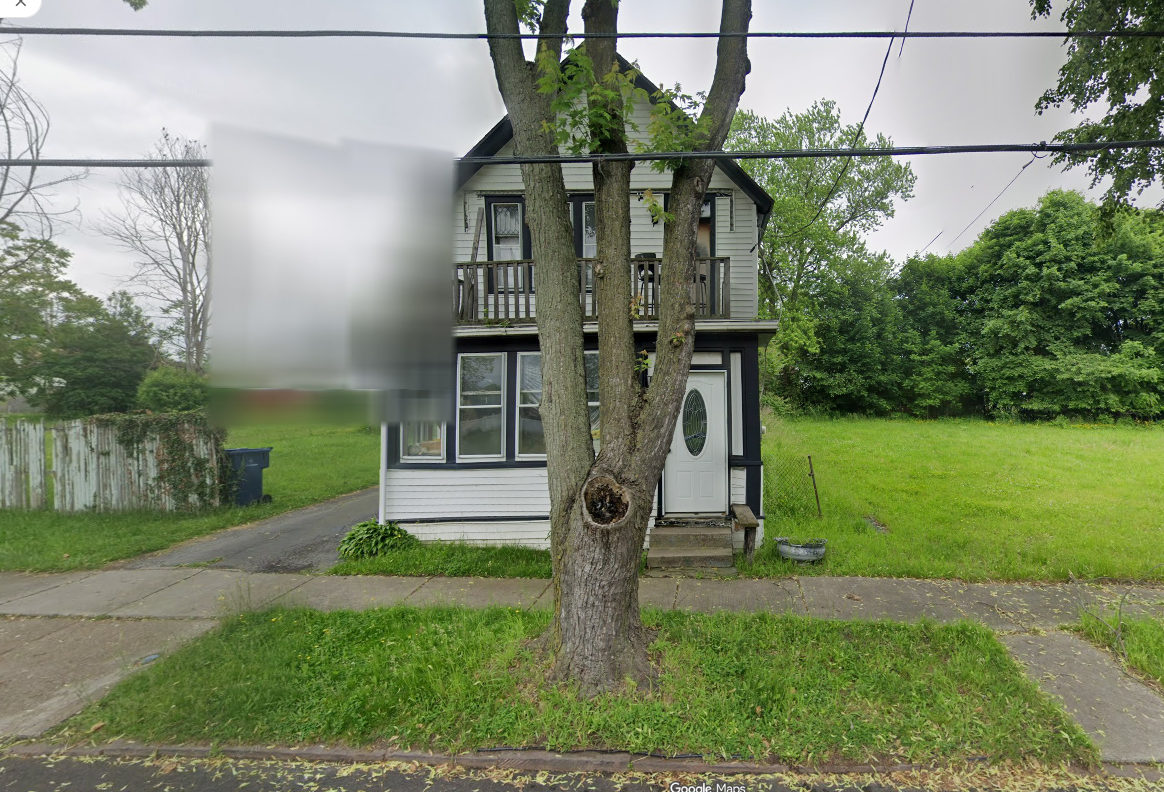
A menacing blur inexplicably appears in the foreground of this Google street view of Fr. Bunse’s house at 271 Watson Street, Buffalo, New York. The house appears to be protected by a triune silver maple
Gratias tibi utrumque, Aleksandra Kinlen et Cristiano Casalini !
Product tabs
SOLD
Recommend this product
A Jesuit Father's unpublished memoir of the Earling exorcism
Related products
Consumer culture, art, and subjectivity in Kazimierzowo, Chicago
Porembski, Olga V. (1924-2011). Rose Rosinski and Bruno Zidek, April 11, 1942. 96 leaves, 11½ x 14 in. (29 x 26 cm.) Homemade scrapbook comprised pri...
view details
$1,250
View details

Original painting of the American bark Fury, with the captain’s ledgers
Wilson, Samuel H. (1836 – 1888). Ledgers of disbursements for the bark Fury and other vessels under his command, 1865 – 1887. 140 numbered pages, cont...
view details
$3,750
View details

Samuel Palmer: The sketchbook of 1865-71
Palmer, Samuel (1805–1881). Pocket notebook, 1865-71. 50 leaves, about 7 x 12 cm. The notebook has been partially paginated in pencil by Palmer: [pp] ...
view details
$37,500
View details

A Calligraphic Manuscript for a Pioneer in Religious Education
[Athearn, Walter S.] To Our Friend Walter S. Athearn, Dean, Boston University School of Religious Education and Social Service, 1918-1928. Four vellu...
view details
$350
View details

Document Signed by Alexander Hamilton as Secretary of the Treasury, 1793
Hamilton, Alexander (1755 – 1804). Signed Treasury Receipt addressed to Samuel Gerry, Collector at Marblehead. Partially printed document dated June 2...
view details
$8,500
View details

A memoir of Siberian prisons by Kropotkin and Andréoli
[Andréoli, Émile (1835–1901) and Pyotr Alexeyevich Kropotkin (1842–1921)]. Siberian Convict Life. Corrected typescript, circa 1886. 99 pp., each page ...
view details
$8,750
View details

Rockabilly notebook of a teenage fan
[Rockabilly] Lyric Notebook. Manuscript, pencil. [ca. 1960] 11 ff. + [5] blanks. 10½ x8 ¼ in. Spiral bound notebook. Soiling and wear; very good condi...
view details
$125
View details

Stan BRAKHAGE. Space as Menace in Canadian Aesthetics (1989), signed typescript.
BRAKHAGE, Stan (1933-2003). Space as Menace in Canadian Aesthetics: Film and Painting. Photocopy of the 25-page manuscript (typewritten, with holograp...
view details
$750
View details

George Bernard Shaw ghostwrites a preface for Lawrence of Arabia
Lawrence, T[homas] E[dward] (1888–1935) and Shaw, George Bernard (1856–1950). Draft foreword to Revolt in the Desert. Holograph manuscript, [Ayot St. ...
view details
$11,000
View details

Manuscript Archive for Atomsk, a Cold War novel by intelligence operative Paul Linebarger
Linebarger, Paul Myron Anthony (1913 - 1966). Atomsk: A Novel of Suspense by "Carmichael Smith." Original manuscript archive for the novel published p...
view details
$25,000
View details

Unpublished memoir of Bell Laboratories in Canada and New Jersey
Ferguson, James G[ordon] (1900 – 1985). Me and My Bell System (As I Remember Us). Mimeographed typescript, ca. 1965. 8½ x 11 in. 61 pp, stapled. Ther...
view details
$125
View details

A slave sale mandated by the Louisiana Supreme Court
Sale of Slave by Suc[cessors] of Woodruff to Dr. James G. Belden, dated 1 April 1858. Holograph manuscript on printed form folded to make 4 pages. A ...
view details
$3,500
View details

A Whittier between the Devil and Lowell factory girls
Whittier, [ _____ ], letter to William West, July 9, 1832. A lengthy, substantial, and amusing letter written on three sides of a single sheet, 39 cm ...
view details
$125
View details
On
hold
hold
The antisocial gospel in Scotland: a virulent handbook for militant sectarians
Coghlan, John (c.1809 – 1885) Handbook for the Study and Discussion of Political Popery. [Edinburgh, circa 1866]. Manuscript draft in the hand of Mans...
view details
$2,750
View details

Pennsylvania, the Promised Land: emigration songs from the earliest years of the Harmony Society in America
Neff, Jacob (1757–1818). Harmony Society hymnal. [Lancaster, Pennsylvania], 1804–06. Manuscript. 88 pp. of German verse with musical annotations. Smal...
view details
$0
View details

Naomi Murdach and the golden age of trans pageantry in San Francisco
Murdach, Naomi [née Clinton E[dward] Tutt] (1932–2019). Photographic archive of gay theatricals and pageants in San Francisco, chiefly 1970–1972. Seve...
view details
$9,500
View details

Manuscript for an unpublished masterwork in American medicinal botany
Havard, Valery (1846–1927). Medical and Economic Botany. Typescript, ca. 1897-98. 1291 numbered leaves on thin laid paper, with holograph emendations ...
view details
$0
View details

Indian Treaty for Catskill Land Purchase, with an Alexander Hamilton Connection
The Catskill Patent. The Indians to Cornelis Van Dyck & Marte Gerretse [Van Bergen]. Dated the 13th June 1684. Copy Deed Translated. A copy in Eng...
view details
$15,000
View details