


The Megillah and the English Civil War: a seventeenth century allegorical needlework
“B.W.”Esther before Ahasuerus. England, circa 1625-1649. 8 ¾ x 13 in (sight), 17 x 21 ¼ in (framed). Embroidered panel in colored silks with Ahasuerus in contemporary dress seated beneath a canopy holding a scepter, Esther kneeling before him. In the background are three vignettes: (right) a courtier reads the annals of the kingdom to a sleepless Ahasuerus, informing him of Mordecai’s heroism; (center) Mordecai, attired as the king, is paraded around the fortress city of Shushan as Haman leads his horse, sounding a trumpet; and (left) Haman hangs on the gallows. Decorative motifs include a lion in the left corner with various birds, insects, and flowers. Initialed “B.W.” at lower left. Framed and glazed. Appears to be in excellent condition, but not examined out of frame.
A lovely example of early British needlework, richly woven with complex layers of meaning. This particular depiction of scenes from the biblical book of Esther is weighted with significance not only for its affirmation of gender ideals but also for its veiled political commentary on the English Civil War. The Jewish queen and her gentile husband King Ahasuerus are here depicted as another interfaith couple, King Charles I and Queen Henrietta Maria.
Esther as Woman Worthy
The image of Esther as a model of female virtue made her an attractive subject for domestic embroidery in the early modern era. She was on the one hand loyal, obedient, and submissive, particularly in the pose chosen for the central image of this work. In the biblical text, Esther is standing when she first receives the touch of the King’s golden scepter – a sign of royal favor signaling that she was allowed to be in his presence even though she had not been summoned. Those who appeared before the king without a summons were to be executed (Esther 4:11, 5:2). The act of standing is significant in the text. Indeed, the refusal of her adoptive father Mordecai to kneel before Haman was what fired the latter’s rage against the Jews in the first place: Mordecai claimed that his religion forbade him from performing an act of veneration before a descendant of Amalek, the sworn enemy of Israel (Esther 3:2-6; cf. Ex 17:14, I Sam 15, etc.). In some other representations of the scene, Esther is standing (see, e.g. Figure 1).
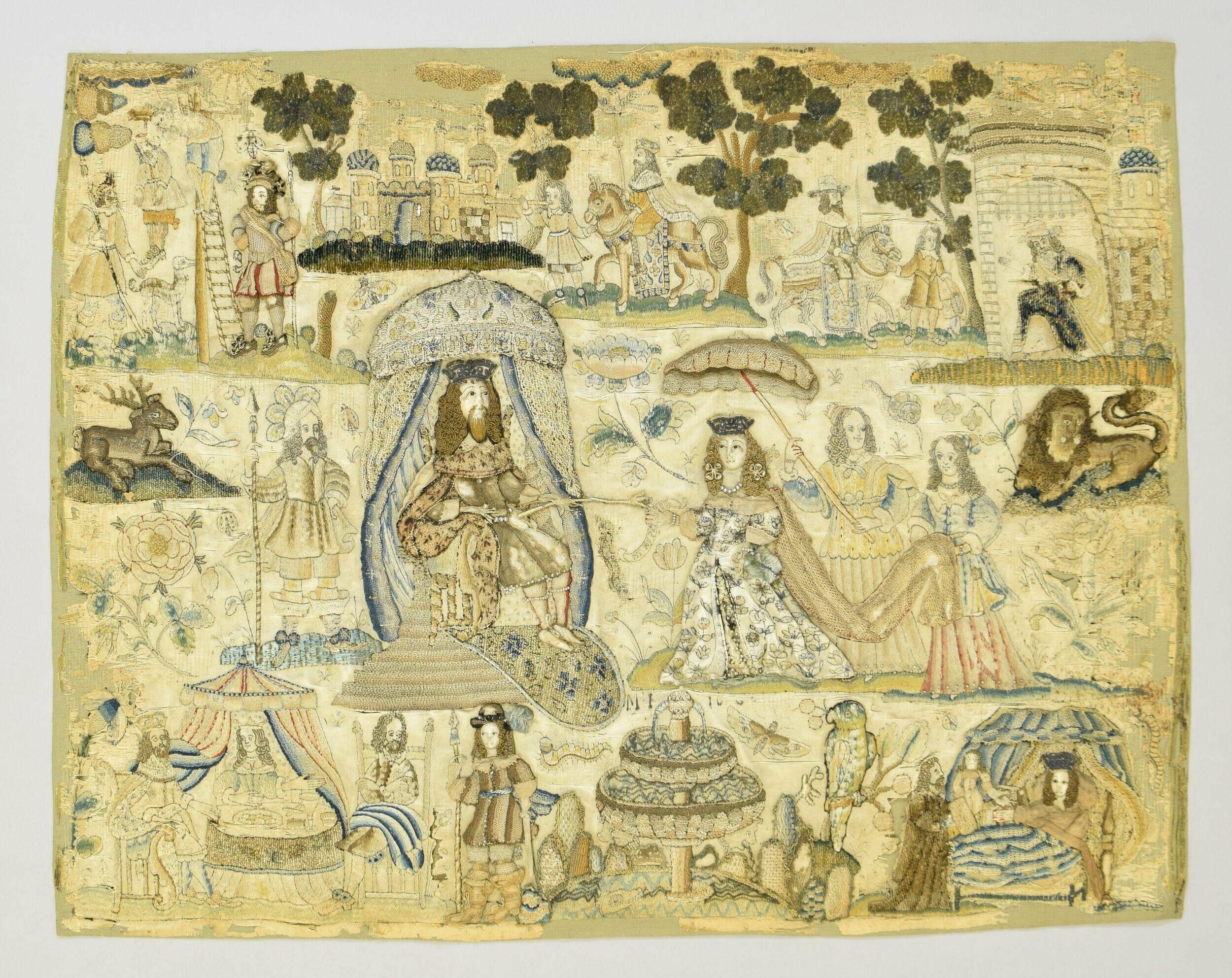
Fig. 1: “M.I.”, Esther and Ahasuerus, 1665. Victoria and Albert Museum
Esther’s submissive attitude here is on the one hand intended as a deliberate affirmation of gender ideals that relegated women to a subservient position. But there is more going on. Once she learns of Haman’s plot to massacre the Jews, she visits the king, “and fell down at his feet,” weeping (Esther 8:3, KJV). It is despair not obeisance that leads her to prostrate herself before the king. This circumstance is clearer in the engraving that historians have identified as one of the reference images for embroideries of Esther, a page from a popular collection of biblical scenes published by Gerard de Jode (figure 2). The present work rejects the abjection of de Jode’s engraving to portray the moment immediately after her expression of grief. “Then the king held out the golden sceptre toward Esther. So Esther arose, and stood before the king” (Esther 8:4, KJV). The image captures this moment of transition as the queen arises and the king grants clemency not to just to her for appearing without leave but, more significantly, to her people.
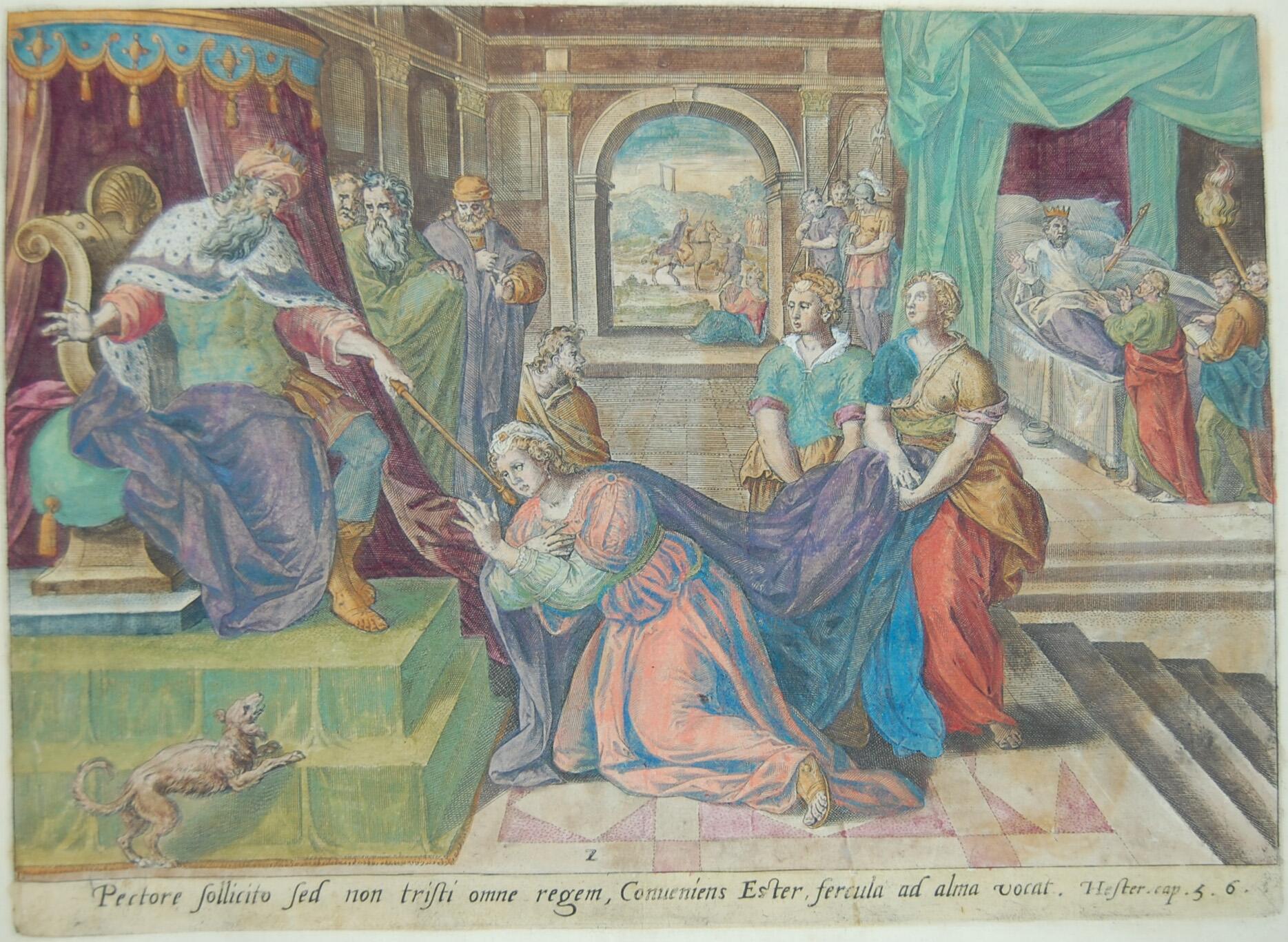
Fig. 2: Jan Collaert (after Jan Snellinck), Esther before Ahasuerus, 1579. Colored engraving from Gerard de Jode, Thesaurus Sacrarum Historiarum veteris testamenti. British Museum
As the central figure of the embroidery, Esther is respectful to her husband but she is hardly docile. She rises from the floor as a “virtuous woman” (Proverbs 31:10, KJV), a figure of courage, intelligence, resourcefulness, and self-sacrifice, who risked her life to guide her husband away from the bad counsel of an evil man (i.e. Haman) and convinced him to rescind a royal edict, leading towards the path of righteousness and justice, and protecting the people who share her faith. In this role, notes Susan Frye, needlework scenes of Esther and Ahasuerus served as a form of engagement with an ongoing debate on women's roles in both the domestic sphere and the political one (Frye, 147-52).
Esther as Henrietta Maria
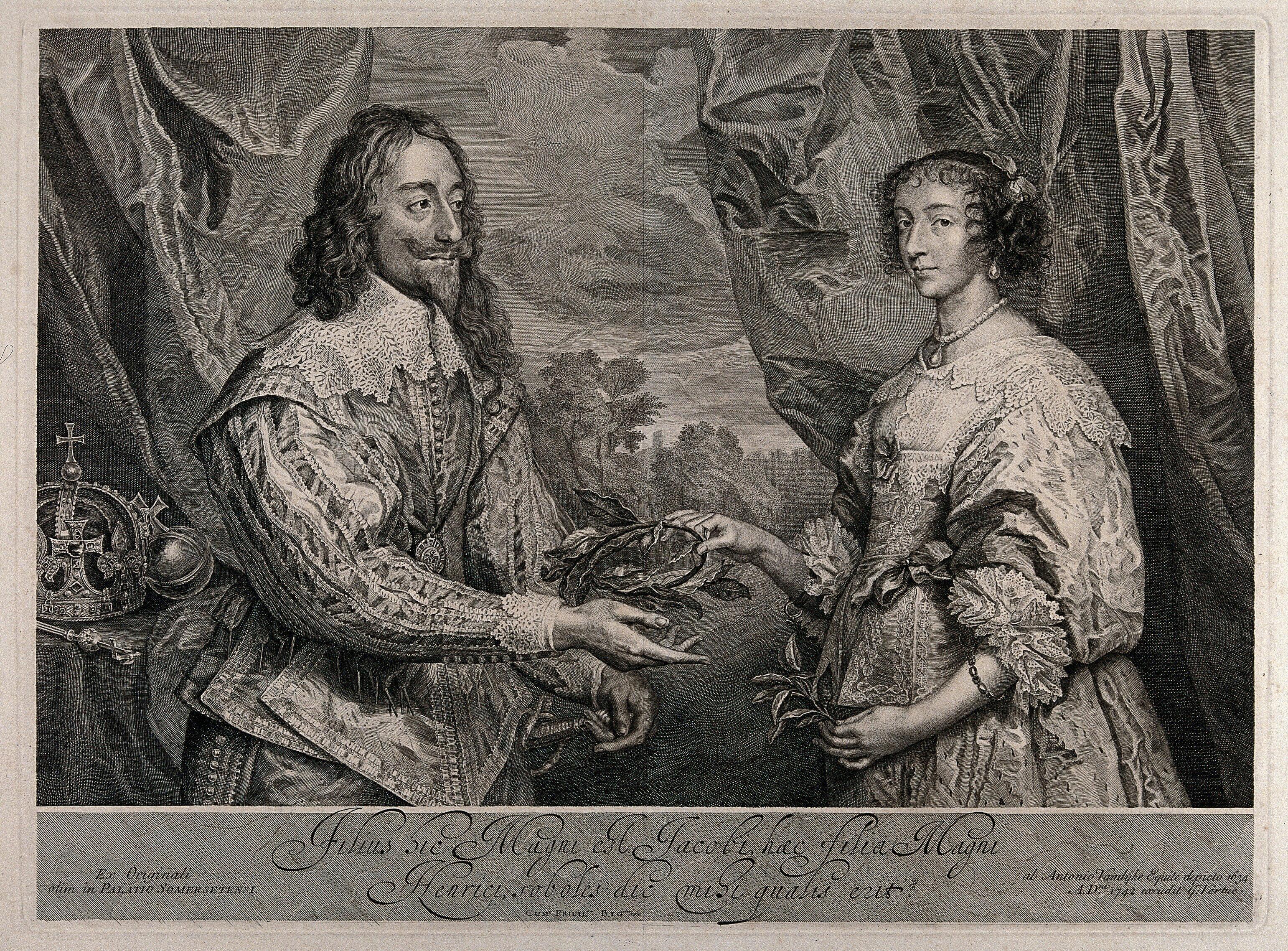
Fig. 3: George Vertue (after Anthony van Dyck), King Charles I and Queen Henrietta Maria with a laurel wreath, ca. 1642. Wellcome Collection
What makes the present embroidery of the story of Esther particularly interesting is that the image serves not only as an emblem of women’s valor but also as a sign of political and religious allegiance during a tumultuous time. The appearances of Ahasuerus and Esther in this panel are modeled on Charles I (1600–1649) and Henrietta Maria (1609–1669). Unlike the figures in later embroidered images of the scene (e.g. Figure 1), the ones in the present work have the distinctive styling of the reigning monarchs –the king’s distinctive goatee and the queen’s short tresses, each wearing the crown of the Stuarts. Images of Charles and Henrietta Maria were widely available both through engraved copies of Anthony van Dyck’s formal portraits of the couple (figure 3), and through coins bearing the king’s portrait (figure 4).
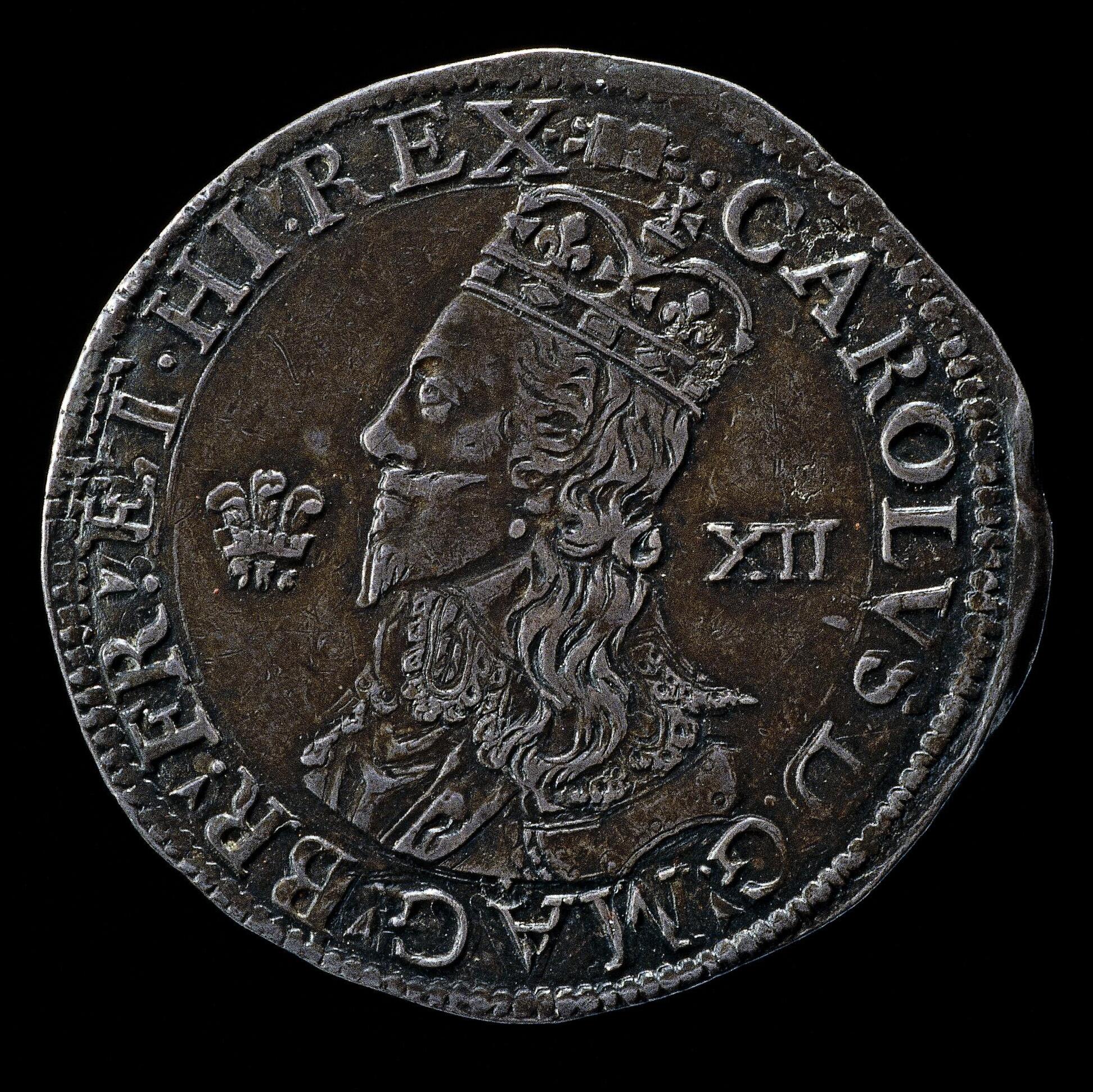
Fig. 4: Silver shilling, 1625-1649, Aberystwyth mint. British Museum
What made Esther and Ahasuerus particularly appropriate as models for Charles I and Henrietta Maria was that both couples represented unions across religious lines. Both the Jewish Esther and the Catholic Henrietta Maria de Medici were members of faith communities that were persecuted in the countries where they lived. In the midst of the conflicts of 17th century England, Henrietta Maria’s religious identity was deeply significant. The interfaith marriage aroused suspicion from both sides. Charles I was roundly criticized for marrying a supposed agent of Rome. And Henrietta Maria had to apply for dispensation from the Pope to marry a Protestant. Upon his approval, both the Pope and other clerics in the Medici circle explicitly advised the young queen to be “an Esther” to British Catholics in a thickening climate of Puritan radicalism (quoted in Geuter, 65). Charles I may have been thinking of these parallels himself when he acquired a painting of Esther and Ahasuerus for his collection (figure 5). As Susan Frye, Ruth Gueter and other scholars have noted, women who were otherwise denied a voice in the public sphere engaged with contemporary events through their domestic arts. Once the Civil War broke out in 1642, this embroidery proclaimed not only Royalist sympathy but perhaps also Catholic identity. The tragedy of course is that whereas the biblical book of Esther has a happy ending, the real life story of Charles and Henrietta Maria did not.
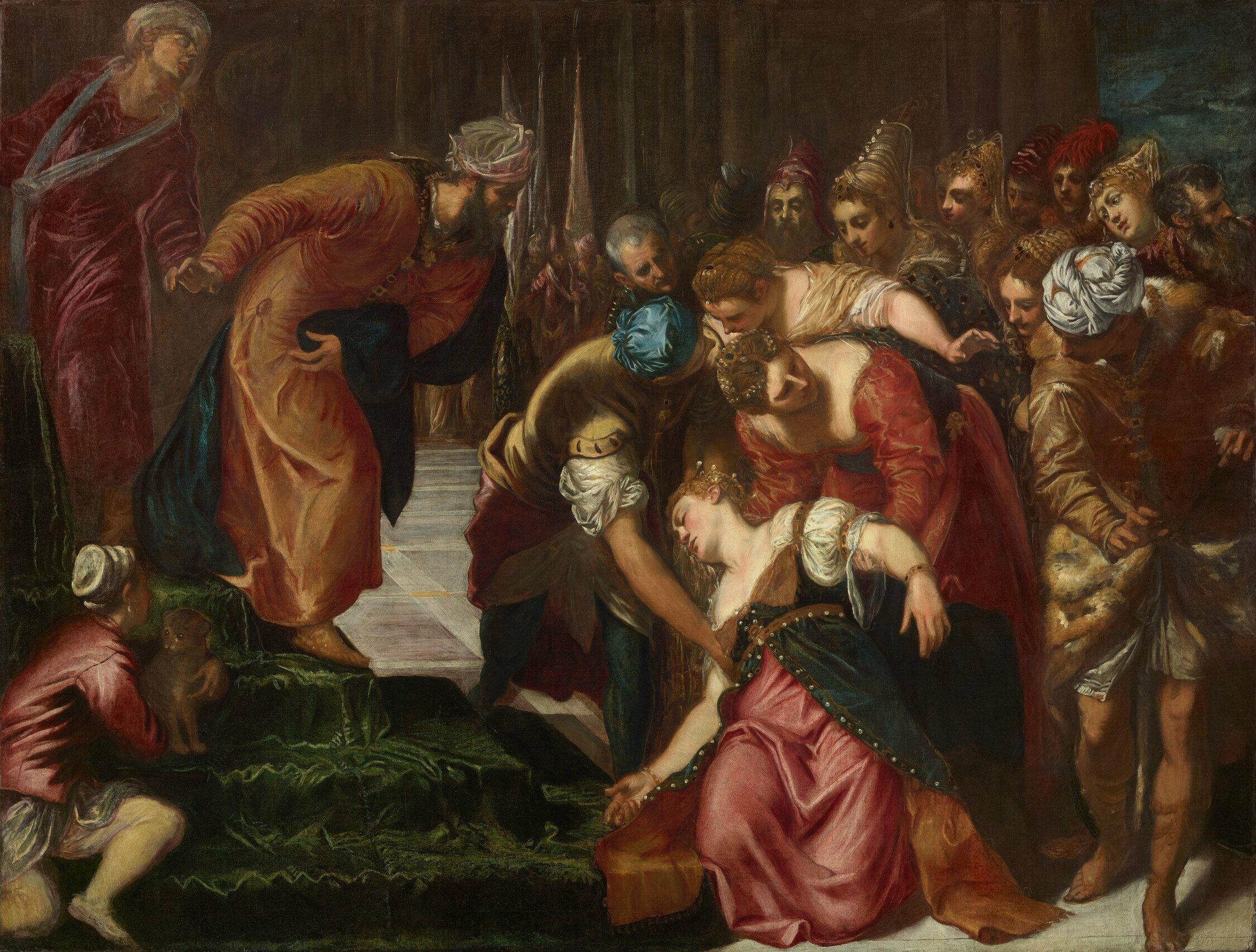
Fig. 5: Jacopo Tintoretto, Esther before Ahasuerus, ca. 1546-47; acquired by Charles I between 1627 and 1639. Royal Collection Trust.
Patterns of Representation

Fig. 6: Many of the key elements are reversed in this needlework of Esther and Ahasuerus, Griffiths collection N54. (DeGregorio and Jussel, p. 123).
While each example of early modern needlework is the unique product of an individual craftswoman, close similarities between surviving embroideries depicting the story of Esther point to the circulation of patterns copied and sold by professional draftsmen. The differences are equally instructive. Some decorative elements – the lion, the fish pond – appear consistently. Others drop in and out. Even the major features can change. The great collector Percival D. Griffiths owned multiple needleworks on the theme of Esther and Ahasuerus (see DeGregorio and Jussel, N41 to N46). One of Griffith's panels (N41) closely parallels the present example though it lacks the vingette of Haman on the gallows. Another (N45) includes Haman but reverses the orientation of the entire scene and omits the scene of Ahasuerus being read the chronicles of the kingdom in his bed. A third (N43) includes both the hanging Haman and the recumbent Ahasuerus and adds another scene of Esther, Haman and the king at a banquet. In both N41 and N43, the resemblance to Charles I is much less pronounced than it is in the present example and in N45. The systematic comparison of other embroideries on the Esther theme might contribute to a richer understanding of the circulation of the industries that supported women’s handcrafts.
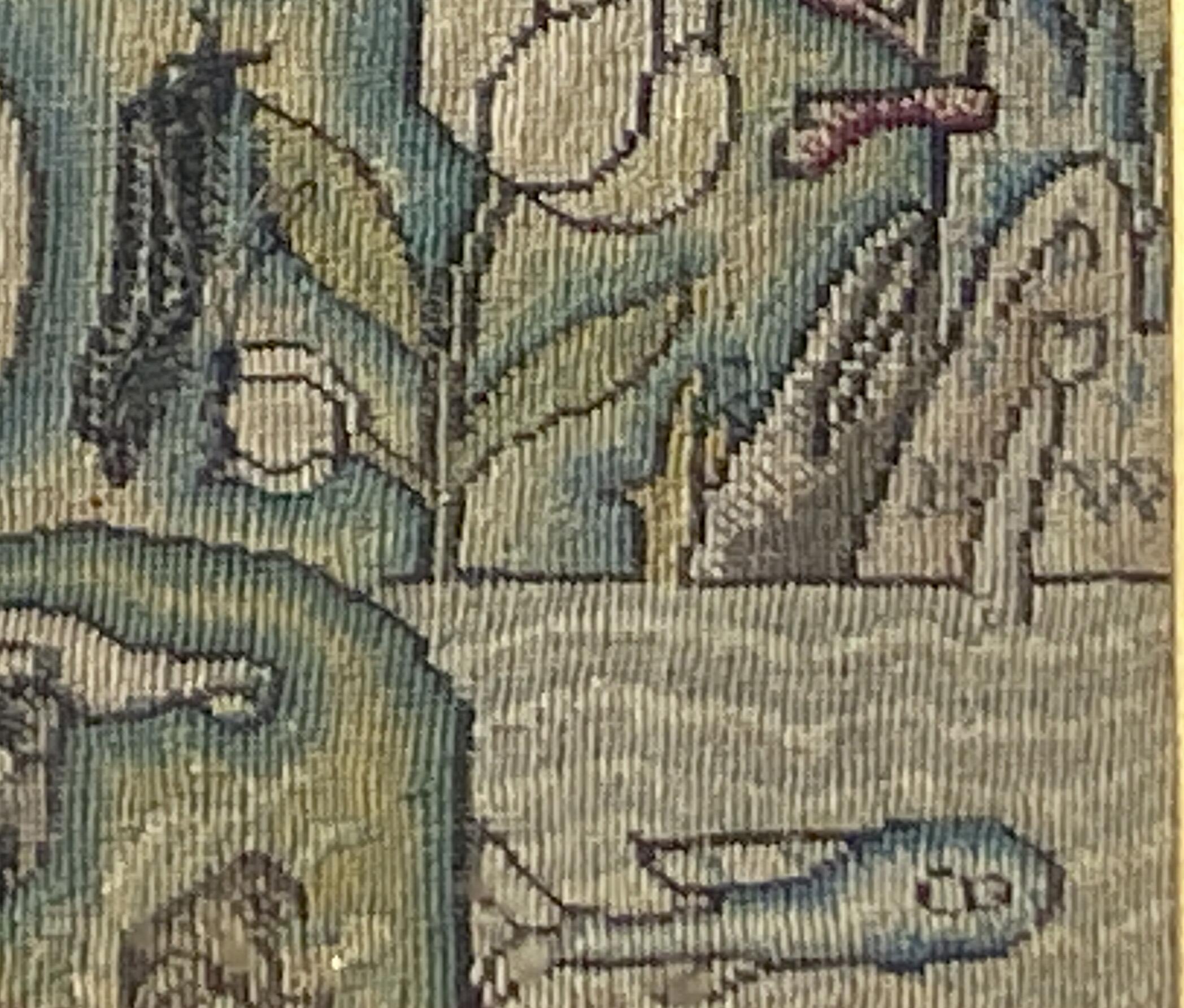
Fig. 7: The artist signs her work.
One of the most intriguing features of the present panel is the fact that the artist added her initials, “B.W.” (figure 7). How are we to read this assertion of the aesthetic self in a medium in which the vast majority of work was produced anonymously? Susan Frye suggests that aristocrats who signed their work with initials and ciphers – including Elizabeth Tudor, Mary Stuart, Bess of Hardwick (Elizabeth Cavendish), and Katherine Parr – engaged in a gendered mode of communication with other women of their class. But even lesser-born women who signed their work did so “to claim their affiliation with the work of their hands and minds.” (Frye, 132). In a world in which wealth was inherited through the male line, women who signed their needlework “sewed themselves into a different memory system, a subculture recorded in physical objects that were nearly always transmitted among women,” according to Ann Rosalind Jones and Peter Stallybrass (p. 156). B.W.’s inclusion of her initials in a work that was as freighted as this representation of Esther and Ahasuerus seems especially meaningful. Was she identifying herself with Esther, or proclaiming her personal loyalty to the doomed King and his Catholic wife? Or was she merely (!) expressing pride in the skill of her craft? Her husband may have held the purse strings and the reins of power, but this panel was an achievement wholly her own. Subtly subversive in its symbolic politics, this needlework offers a rich vector for studying the material culture of early modern England during a tumultuous and dangerous era.
Selected References
Brooks, Mary M., English embroideries of the sixteenth and seventeenth centuriesin the collection of the Ashmolean Museum (London, 2004).
-----. Performing curiosity: re-viewing women’s domestic embroidery in seventeenth-century England, The Seventeenth Century 32, 1, (2017), pp. 1-29.
Cabot, Nancy Graves. Pattern sources of scriptural subjects in Tudor and Stuart embroideries, Bulletin of the Needle and Bobbin Club (1946): 3-57
DeGregorio, William and Christian Jussel. English needlework 1600–1740: the Percival D. Griffiths Collection, volume II. (New Haven: Yale University Press, 2023), cf. cat. no. N45.
de Jode, Gerard. Thesaurus Sacrarum historiarum Veteris et Novi Testamenti (Antwerp: Gerard de Jode, 1585)
Dinan, Susan, Karen Nelson, and Michele Osherow. Crafting habits of resistance, in Merry Wiesner-Hanks, ed., Challenging women's agency and activism in early modernity (Leiden: Amsterdam University Press, 2021)
Frye, Susan, Pens and needles: women’s textualities in early modern England (Philadelphia: University of Pennsylvania Press, 2010).
Geuter, Ruth, Embroidered biblical narratives and their social context, in Andrew Morall and Melinda Watt, eds., English embroideries from the Metropolitan Museum of Art, 1580-1700. ‘Twixt art and nature’ (New York: Bard Graduate Center and Yale University Press, 2009), pp. 57- 77.
Hackenbroch, Yvonne, English and other needlework, tapestries, and textiles in the Irwin Untermyer collection (Cambridge, MA: Harvard University Press for the Metropolitan Museum of Art, 1960)
Jones, Ann Rosalind and Peter Stallybrass. Renaissance clothing and the materials of memory. Cambridge University Press, 2001.
Product tabs
$0
$18,500
Recommend this product
The Megillah and the English Civil War: a seventeenth century allegorical needlework
Related products
Mel Lyman, Boston Avatar: A nearly complete run of underground publications
[Lyman, Mel] Avatar 1, 3-24 (June 9/22, 1967-April 26/May 9, 1968) [with] American Avatar 1-4 (October 1968-Summer 1969; all published) [with] Pluto #...
view details
$2,000
View details

Naomi Murdach and the golden age of trans pageantry in San Francisco
Murdach, Naomi [née Clinton E[dward] Tutt] (1932–2019). Photographic archive of gay theatricals and pageants in San Francisco, chiefly 1970–1972. Seve...
view details
$9,500
View details

Boston broadside blasting beer: an experimental printing in black and gold
Dod, John (ca. 1549-1645). Sermon on Malt. Boston: [Isaac R.] Butts, [ca. 1840]. Broadside, 24 x 19 cm. Printed in gold ink on paper with a glossy bla...
view details
$1,750
View details

Original painting of the American bark Fury, with the captain’s ledgers
Wilson, Samuel H. (1836 – 1888). Ledgers of disbursements for the bark Fury and other vessels under his command, 1865 – 1887. 140 numbered pages, cont...
view details
$3,750
View details

The Eucharist in Stereo
$4,500
The Eucharist in Stereo
Keith, George A., S.J. (1883 – 1960) The Holy Sacrifice of the Mass. Meadville, Pa.: Keystone View Co., [ca. 1930]. 100 sequentially-numbered stereov...
view details
$4,500
View details
Irish Home Rule and the 1910 General Election
Halkett, George Roland (1855–1918). Their Irish Master. Color lithographic poster. [London]: National Union of Conservative and Constitutional Associa...
view details
$3,500
View details

Jazz monologues signed by Civil Rights artist Tracy Sugarman
Sugarman, Tracy (1921 – 2013) and George T. Simon (1912 – 2001), The Feeling of Jazz. New York: Simon & Schuster, 1961. First edition. 4to. Very g...
view details
$95
View details

Robert A. Heinlein’s Cold War manifesto and the origins of Starship Troopers
Heinlein, Robert A. (1907–1988) and Virginia Heinlein (1916–2003). Who are the heirs of Patrick Henry? Stand up and be counted! [Colorado Springs, Col...
view details
$850
View details

Winslow Homer. Hardy Lee, His Yacht (1857). His rare comic album
[HOMER, Winslow] Charles Ellery STEDMAN, Mr. Hardy Lee, his yacht: being XXIV sketches on stone, by Chinks. Boston: A. Williams, 1857. [24] leaves : ...
view details
$5,000
View details

Charles Klauder renovates Dwight Hall
Klauder, Charles Zeller (1872 – 1938). Architectural diagram for renovations of Dwight Hall, dated 28 January 1931. Photostat on heavy stock, 18 x 28 ...
view details
$375
View details

Bartolomeo Pinelli. Roman costumes (1817). The Italian Origins of British Romanticism
Pinelli. Bartolomeo. Roman Costumes: Nuova raccolta di cinquanta costumi pittoreschi incisi all'acquaforte, da Bartolomeo Pinelli. Roma, Giovanni Scud...
view details
$1,950
View details

Photographs from the Evangelical Association, precursor to the United Methodist Church
[Breyfogel, Seneca P. (1823 – 1884)]. Photo album, c. 1860 to 1880. 5 ½ x 7 ¼ inches, decorative calf binding. The album contains 73 images, six of wh...
view details
$1,750
View details
On
hold
hold
The Mexican Inquistion meets the French Enlightenment
Flores, Manuel de (1732 -- ?) and Francisco Javier Mier y Campillo (1748 -- 1818). Nos el Dr. D. Manuel de Flores, Inquisidor Apostólico, contra la h...
view details
$0
View details

Zarafamania!
$65
Zarafamania!
Chalon, Alfred Edward (1780-1860). La Giraffe, dèdiée sans permission à Mademoiselle Chalon 1828. [London: The Graphic, 1889] 8pp., printed on rectos ...
view details
$65
View details

Max ERNST. Sept Microbes (1953). Microscopic Surrealism
Ernst, Max. Sept Microbes: Vus à Travers Un Tempérament. Paris: Les Editions Cercle des Arts, 1953. First edition. One of 1,000 numbered copies. A ...
view details
$500
View details

Scientific racism, human remains, and the guano trade, 1845
Wonderful natural phenomenon. A specimen of a Negro man, preserved by guano, now exhibiting in the Victoria Saloon Rooms. Lowgate, Hull: William Steph...
view details
$8,750
View details

Plate glass negatives from the Cook Studio, Richmond, Virginia
Price on Request
Plate glass negatives from the Cook Studio, Richmond, Virginia
Cook, George Smith (1819–1902), George LaGrange Cook (1849–1919), and Huestis Pratt Cook (1868–1951). Archive of photographic negatives from the Cook ...
view details
Price on Request
View details

Cover design for Blasco Ibanez, Four Horsemen of the Apocalypse
[Blasco Ibáñez, Vicente] Quinn, Paul (1910–1957). The Four Horsemen of the Apocylypse [sic]. Original cover design, circa 1930. Gouache on illustratio...
view details
$1,250
View details

Visionary designs for a Manhattan Project
[VASSILIEVE, Nicholas (1875-1958)] New York City Planning Commission. A Plan for Manhattan Civic Center and related improvements. [New York, 1948]. 29...
view details
$650
View details